

Mobile Auto Repair Advertising: A Local Visibility Checklist
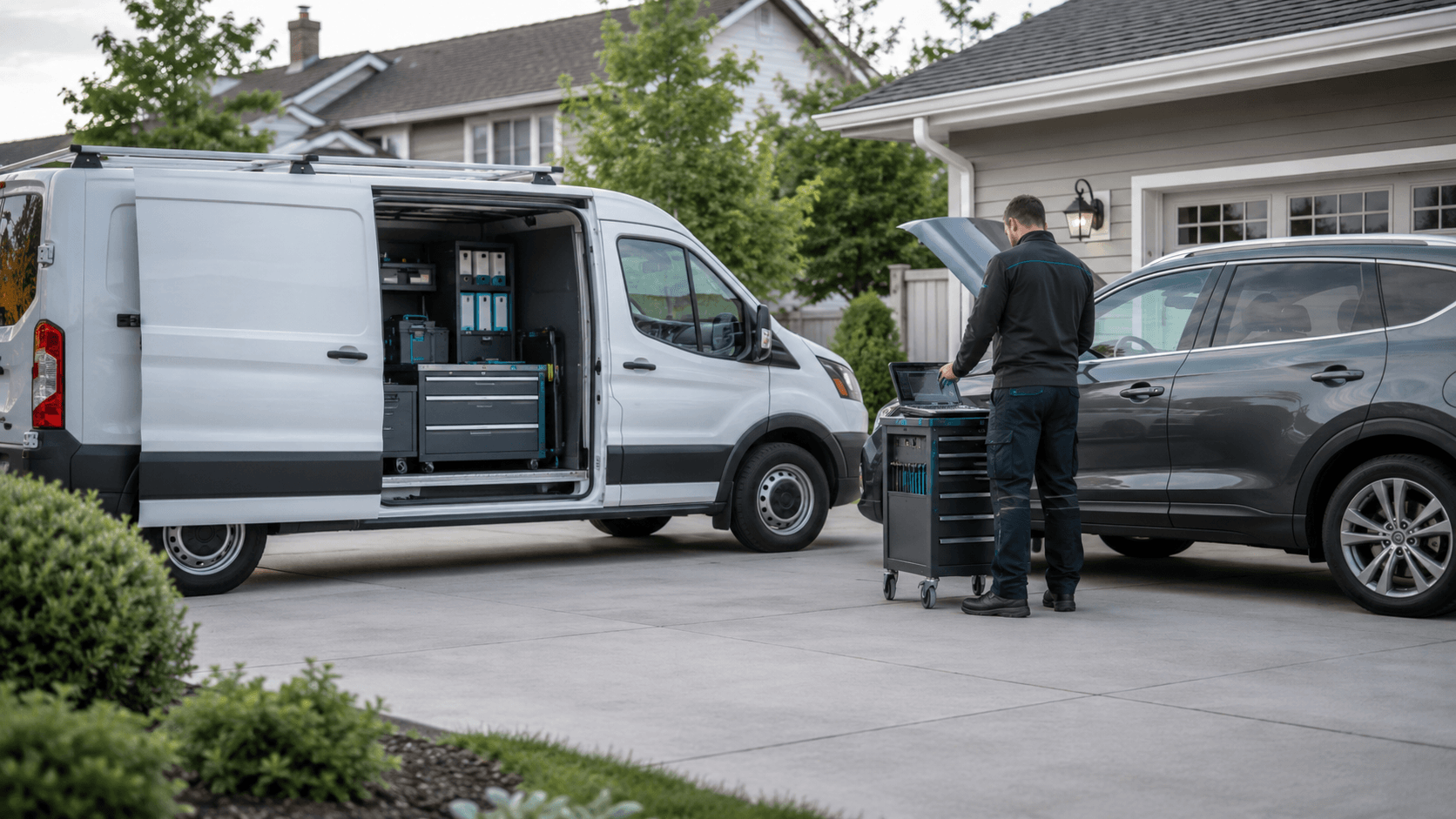
Mobile auto repair advertising has to answer a question that a fixed-location shop can partly answer with a building: can this business come to me, handle my problem, and be trusted at my address? A service van, vehicle wrap, or roadside sign may make a name familiar, but it does not tell a stranded driver whether you cover their area, have an opening, or can perform the repair.
That is why the first advertising decision is not how many channels to buy. It is whether one local customer can find an accurate service promise, verify the business, and reach a person who can qualify the job. The practical task is to produce suitable local inquiries and booked work, not to launch a broad auto repair marketing plan.
Contents:
- Why a Service Van Is Not an Advertising System
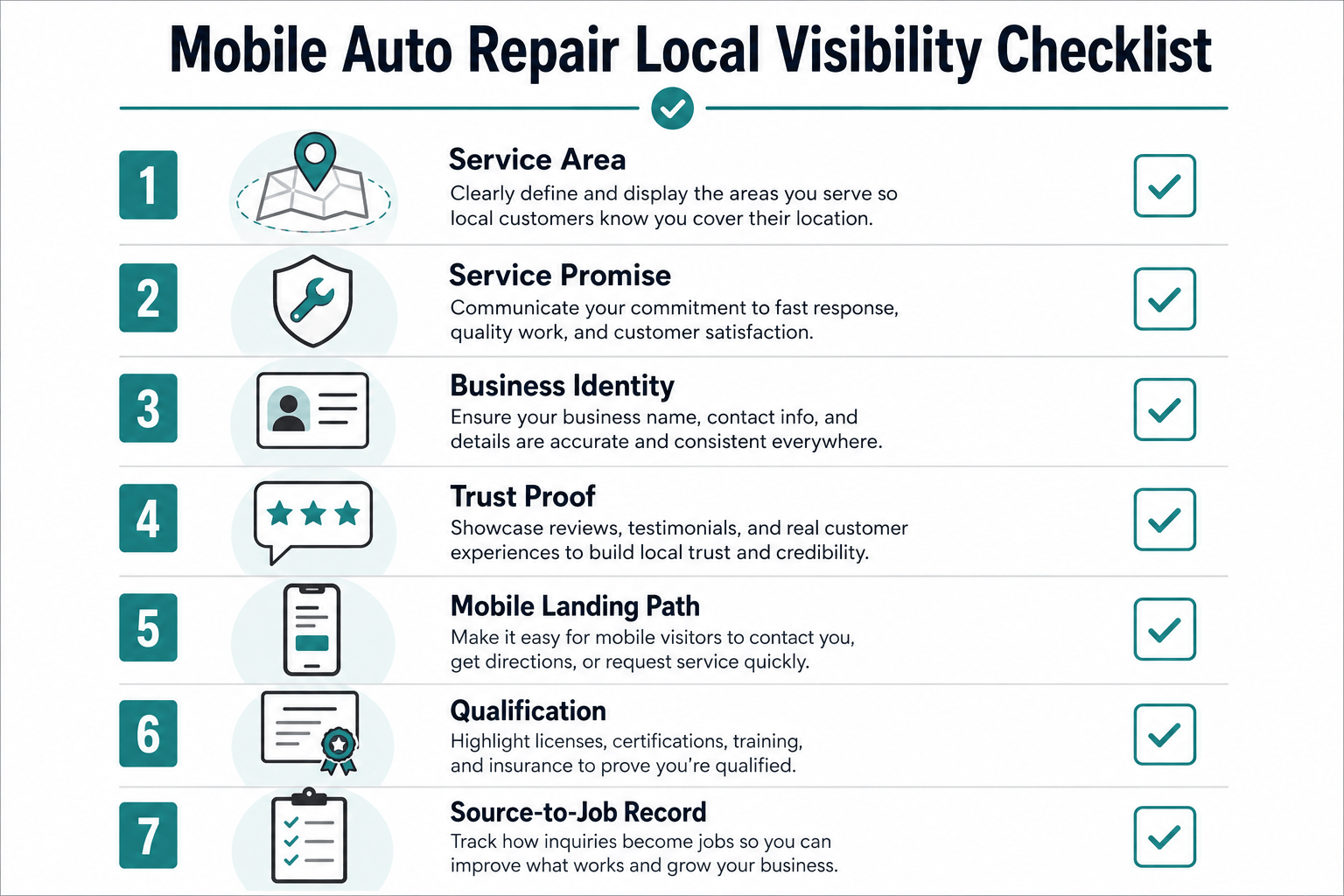
- The 7-Point Local Visibility Checklist
- Choose One Service Promise Before Choosing a Channel
- Advertising for Mobile Auto Repair: Choose the First Channel by the Constraint
- Make Maps, Reviews, and the Booking Path Tell the Same Story
- Measure the Cost of a Booked Job, Not Just the Cost of a Call
- Use Call Data Without Treating Every Call as Success
- A 14-Day Local Advertising Test
- Common Mobile Auto Repair Advertising Mistakes
- FAQ
- Make the Next Local Booking Easier to Trust
Why a Service Van Is Not an Advertising System
The old storefront-sign question still matters, but it changes for a mobile mechanic. A clean, legible van can reinforce recognition after a neighbor sees you working nearby. It cannot carry the full decision path. A customer who searches after a no-start, brake concern, or diagnostic warning needs a matching service, service-area confirmation, current contact details, and proof that the business is real before they place a call.
Treat vehicle visibility as one trust signal, not as the source record. Put a simple, readable business name, phone number, and site address on the vehicle where local rules allow. Then make the same business facts and service scope easy to verify online. When the vehicle prompt, ad message, profile, and landing page describe different services or areas, the customer has to solve the inconsistency instead of booking.
The 7-Point Local Visibility Checklist
Use this checklist before increasing spend. A missing item does not mean the business cannot advertise; it means the first test should be small enough to expose and fix the weak point.
| Check | What the customer needs to see | Evidence before spend grows |
| Service area | The cities, ZIP codes, or areas you can reach without creating an unprofitable drive. | A current list that the dispatcher or owner can use when qualifying a call. |
| Service promise | One advertised repair need that the mobile team can actually schedule. | A technician-approved scope, exclusions, and availability rule. |
| Business identity | The same name, phone, hours, and website wherever the customer checks. | One controlled record of current business facts. |
| Trust proof | Recent work photos, specific reviews, credentials only where true, and clear payment or warranty information. | Proof the team can keep current without inventing claims. |
| Mobile landing path | A page that repeats the service, area, next step, and what details to have ready. | A phone test and form test completed from a real mobile device. |
| Qualification | A fast way to confirm symptom, vehicle, address, timing, and job fit. | A named person and a short intake sequence. |
| Source-to-job record | A business that can distinguish a call from a booked and completed repair. | Source, service, status, attributable cost, and outcome fields. |
For a service-area or hybrid business, use Google’s service-area guidance when deciding whether an address should be shown and how the service area should be represented. Do not list a virtual office or advertise a service radius the team cannot support.
A repair-shop-specific Google Business Profile checklist can help keep those visible business facts accurate.
Choose One Service Promise Before Choosing a Channel
A generic message such as ‘mobile mechanic available’ invites calls that may be outside the team’s skills, route, or schedule. Start with one service promise connected to real availability. The exact service will vary by business; the table is a decision aid, not a list of promises every mobile mechanic should make.
| Service situation | Useful advertising promise | Qualification question |
| No-start or battery concern | Mobile diagnosis or battery-related help in named service areas, only when equipped and available. | What vehicle, location, symptoms, and access conditions are involved? |
| Brake concern | A mobile brake inspection or eligible repair service with accurate scheduling expectations. | Is the work safely serviceable on site and within the current route? |
| Diagnostics | A diagnostic visit for vehicles and faults the technician is prepared to assess. | What warning, drivability issue, make, model, and year are involved? |
| Fleet maintenance | Scheduled onsite maintenance for a defined fleet type or route. | How many units, where are they located, and what downtime window is available? |
This is also where onsite auto repair ads become more disciplined. The ad, profile, and landing page should all describe the same service and area. A campaign that promises immediate roadside work but leads to a page about general shop repair can create expensive calls that nobody can fulfill.
Advertising for Mobile Auto Repair: Choose the First Channel by the Constraint
The right first channel depends on what is missing. Paid demand does not fix an unclear service area; a profile update does not solve missed calls; vehicle branding does not prove that a specific repair is available today. Choose one channel that tests the immediate constraint, then give it a source label and a review date.
| Constraint | First channel or action | Measure after launch |
| Drivers cannot find a credible local answer | Correct the Business Profile and matching service page before adding paid reach. | Relevant local inquiries and service-area fit. |
| A priority service has ready capacity | Run a focused local search or eligible Local Services Ads test with one service promise. | Qualified inquiries, booked jobs, and cost per booked job. |
| Trust is the barrier | Use current work proof, clear business information, and a review process before broad awareness spend. | Whether callers mention proof, reviews, or a specific service page. |
| A local referral source is credible | Test one permitted partner or referral message with the same destination and source code. | Introductions that become suitable bookings, not just mentions. |
| The van creates neighborhood awareness | Use a simple vehicle URL or QR code only when it leads to the matching mobile service page. | Visits or calls that can be separated from other traffic. |
Google says Local Services Ads are available to eligible automotive service businesses, but eligibility and available features depend on the business and market. Check current eligibility before planning around the format. Google also explains that these ads can generate calls, messages, or booking requests, so the receiving process needs to be ready before the campaign is expanded.
Review Google’s Local Services Ads information and confirm the current account and market options instead of assuming an ad type will be available everywhere.
Make Maps, Reviews, and the Booking Path Tell the Same Story
A mobile auto repair advertising business usually earns the call before the technician arrives. The customer should be able to see what is offered, where it is offered, how to make contact, and what information will help the team respond. Keep the information modest and specific. Do not use a review, badge, photo, price, arrival time, or credential that the business cannot verify.
- Keep the service area aligned with actual travel time, staffing, and fuel economics.
- Use current photos of the service vehicle, technician work, and tools only with permission and without customer-identifying details.
- Ask for genuine feedback after completed work; do not reward, script, or selectively solicit reviews in a way that misleads customers.
- Send every ad to a page that repeats the advertised service, names the contact method, and asks only for the details needed to assess job fit.
- Set an after-hours rule so a caller knows whether to leave details, use a form, or contact emergency assistance when the business is closed.
For the separate mobile-screen and click-to-call checks that happen after a customer chooses to contact the business, see mobile auto repair phone call leads.
When the local-search foundation needs work beyond one campaign, SEO for auto repair shops can help connect service pages, local proof, and the paths that turn searches into calls.
Measure the Cost of a Booked Job, Not Just the Cost of a Call
A call can be a wrong-area request, an unsupported repair, a price-only question, or a suitable job. For mobile services, that difference matters because drive time and onsite conditions affect the economics. Track the same stages for each source: inquiry, qualified inquiry, booked visit, completed job, and attributable cost. Then review the service mix alongside the headline number.
| Metric | Calculation | Decision question |
| Cost per qualified inquiry | Attributed advertising cost divided by qualified inquiries. | Are we attracting needs the mobile team can serve? |
| Cost per booked job | Attributed advertising cost divided by booked visits. | Is the promise and response path converting suitable demand? |
| Completion rate | Completed jobs divided by booked visits. | Are scheduled visits becoming viable work? |
| Gross-profit contribution | Attributed completed-job gross profit minus advertising cost. | Should the service, route, or campaign receive another test? |
Fictional 30-Day Example
A fictional mobile mechanic spends $750 on one local battery and no-start campaign. The campaign creates 30 inquiries. Eighteen are within the service area and fit the approved scope; 12 become booked visits and 10 become completed jobs. Cost per qualified inquiry is $41.67 ($750 divided by 18). Cost per booked job is $62.50 ($750 divided by 12). If the completed jobs each contributed a fictional $300 in gross profit, the campaign generated $3,000 in gross profit before advertising cost and $2,250 after that $750 cost.
The example is not a benchmark or a promise. A different route, repair type, labor cost, cancellation rate, or customer response time can change the result. Its purpose is to show why advertising for mobile auto repair should be judged on suitable completed work, not a cheap click or a raw call count.
Use the Ads Revenue Calculator to replace the fictional assumptions with the business’s own cost, booking, and margin inputs.
Use Call Data Without Treating Every Call as Success
Set a meaningful call threshold only after the owner understands what a qualified conversation looks like. Google Ads call conversion tracking can count calls that meet a selected duration, but call length is an indicator, not a completed repair order. The intake record still needs to show service fit, location, booking outcome, and completed work.
Google explains the available call-conversion methods and minimum call-length settings in its phone call conversion tracking documentation. Use that platform data alongside the business’s booking and repair-order record.
For broader help tying paid and organic demand to qualified work, see auto repair lead generation.
A 14-Day Local Advertising Test
- Choose one service promise, one service area, and one capacity limit with the technician or owner who will handle the work.
- Check the Business Profile, landing page, and service-van details against the same name, phone number, and service description.
- Test the phone and form from a mobile device. Confirm the intake person can record source, symptom, vehicle, location, and booking status.
- Launch one small, clearly labeled campaign or referral test. Do not combine several services, areas, and messages in the first measurement window.
- Review qualified inquiries, bookings, completed jobs, route problems, and cost after 7 and 14 days. Improve the weak point before increasing budget or adding a second channel.
For a broader list of tactics after the first local test is working, see auto repair shop marketing ideas.
Common Mobile Auto Repair Advertising Mistakes
- Advertising a larger service area than the technician can profitably reach.
- Using a generic mobile-mechanic message when a specific, available repair service is the better fit.
- Letting the profile, vehicle, ad, and landing page describe different services, hours, or contact details.
- Treating every call, form fill, or QR scan as a qualified lead without checking route and repair fit.
- Scaling a campaign while the team is missing calls, declining too much work, or cannot record outcomes.
- Claiming same-day availability, pricing, credentials, reviews, or guarantees that the business cannot substantiate.
FAQ
What is mobile auto repair advertising?
Mobile auto repair advertising is the local promotion of a mechanic or repair team that travels to the customer. The message should identify a real service, a service area, a trustworthy way to verify the business, and a clear contact path.
What is the best way to advertise a mobile mechanic?
Start with the channel that addresses the current constraint. For many businesses, that means accurate local business information and a focused service page before paid demand. A ready, specific service can then be tested with a small local search or eligible Local Services Ads campaign.
How should advertising for mobile auto repair be measured?
Track the source through qualified inquiry, booked visit, completed job, and attributable cost. Cost per booked job and gross-profit contribution are more useful than raw clicks or calls alone.
Can onsite auto repair ads use a Business Profile?
A mobile repair business may qualify as a service-area or hybrid business when it follows Google’s current representation guidelines. Show or hide the address according to whether customers are actually served there, and keep the listed service area accurate.
Should a mobile mechanic put a QR code on a service van?
A QR code can be useful when it leads to a mobile page that matches the vehicle message and can be measured separately. It should not replace a readable business name and phone number, and it should not send visitors to an unrelated general homepage.
Make the Next Local Booking Easier to Trust
Mobile auto repair advertising becomes more reliable when every message helps a local driver decide whether the service fits, then gives the business a way to learn from the result. Start with an accurate service area, one bookable promise, current proof, and a measured contact path. Add reach only after the team can turn suitable inquiries into completed driveway or fleet work.
For wider positioning choices specific to a traveling repair business, see mobile mechanic marketing mistakes to avoid.
Element DMA helps repair businesses connect local visibility, paid demand, call handling, and booked-job measurement through auto repair lead generation services.

With a background in psychology, Valeriu has worked in sales and marketing for 8+ years, and learned through experience that the best way to do business is to serve clients well, and solve their problems. He has joined Element DMA in September of 2025, attracted by the honest nature of the work and attitude of auto & truck repair shops. In this role, he helps shop owners across the U.S. see the ROI of properly done advertising, and the growth this brings to their shops, regardless of niche or state.