

Auto Repair Customer Communication Workflow for Repair Shops

Auto repair customer communication breaks down when the repair record, the advisor, and the customer are working from different versions of the job. The fix is not a larger library of texts or a new software subscription. It is a defined operating workflow for the moments when a customer needs an answer, a decision, or a new expectation.
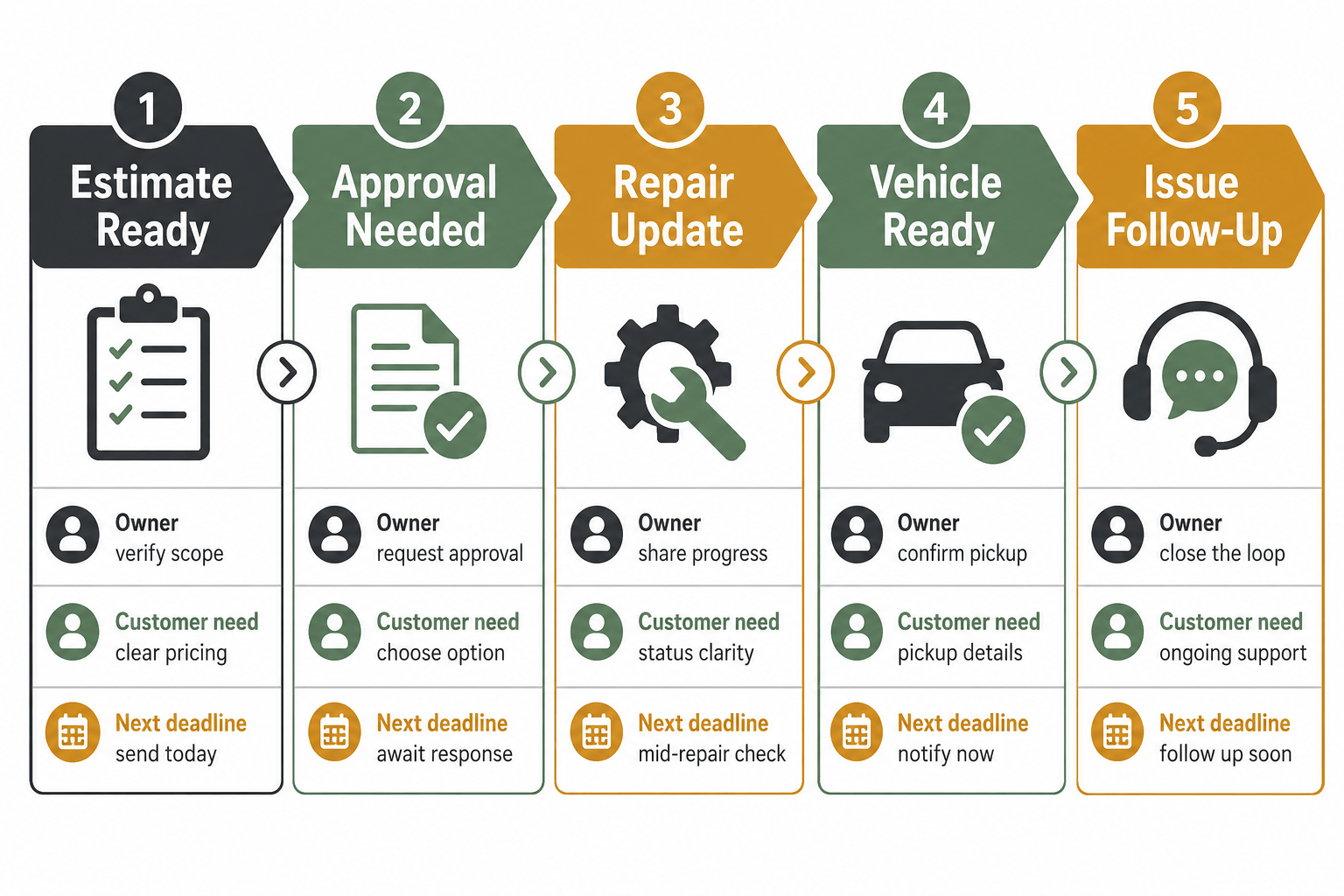
For an independent repair shop, every open repair order needs four visible fields: the next update owner, confirmed information, a customer deadline, and a fallback when that promise changes.
This guide starts after the customer is checked in or the appointment is set. When the first conversation begins on an inbound lead call, use a separate service advisor call workflow to capture the concern and confirm the next step. Once the vehicle is in process, the communication system below takes over.
Contents:
- The Standard: No Open Repair Without a Next Update
- The Five-Moment Customer Communication Matrix
- Build the Record Before the Work Gets Busy
- Explain Estimates So the Decision Is Clear
- Send Status Updates Before Customers Have to Ask
- Copy-and-Customize Message Pack
- Make Technician-to-Advisor Handoffs Part of the Workflow
- One Repair Order, Worked Through
- Review the System Weekly With a Small Scorecard
- Introduce the Workflow in 30 Days
- FAQ
- Make the Next Promise Visible
The Standard: No Open Repair Without a Next Update
A customer does not need a running commentary from the shop. They do need clarity when their approval is required, when the promised completion time is at risk, and when the vehicle is ready. The most useful standard is simple: every open repair has a named next communication event. It can be an estimate, an approval request, a status promise, a pickup notice, or an issue response. It cannot be an unowned mental note.
Set deadlines from the shop’s actual capacity, parts availability, and diagnostic process. A consistently met promise is better than an aggressive target that expires without an update.
The Five-Moment Customer Communication Matrix
Use this matrix as the hero operating tool. Put the five rows into the repair order, CRM, or daily dispatch board. The owner is accountable for the customer-facing update; technicians, parts staff, and managers supply the facts needed to make it accurate.
Build the Record Before the Work Gets Busy
Good auto repair customer service begins with one usable record. The repair order should hold the decisions and promises that affect the customer, rather than leaving them in text threads or memory.
Before diagnosis or repair moves forward, make sure the record contains:
- The concern in the customer’s own words, including when it happens and any drivability or safety context.
- The customer’s preferred contact method and the shop’s documented permission to use it for repair-status communication.
- The current scope: diagnostic work, approved repair, or an estimate waiting for a decision.
- The latest promised update or completion checkpoint, with the name of the person responsible for it.
- Authorizations, declines, deferrals, and questions that still need an answer.
At in-person check-in, the advisor should also confirm:
- What the shop will do first and what the customer should expect before work begins.
- Whether the customer needs a call, text, or email for a decision that cannot wait.
- Any transportation, deadline, fleet authorization, or insurer constraint that changes the repair plan.
For text-based repair updates, collect and maintain contact details and consent rather than assuming a mobile number is permission to message. CCC’s repair-status update guidance illustrates the practical fields a shop should capture. Review applicable privacy, consent, and messaging rules for the locations where the shop operates.
Explain Estimates So the Decision Is Clear
An estimate message should tell the customer that a decision is ready. The explanation should make that decision understandable. The advisor does not need to turn every inspection into a technical lecture; they need to connect the finding, the consequence, the recommended action, and the customer’s choice.
Use a four-part estimate explanation:
- Finding: State what the technician observed in plain language and identify the vehicle area involved.
- Reason: Explain the practical consequence without inventing urgency or certainty the inspection did not establish.
- Scope: Separate the recommended repair, any diagnostic work already performed, and options the shop can support.
- Decision: Confirm the amount or approved range, timing impact, warranty terms the shop actually offers, and the approval requested.
For example: “The front brake pads are worn and the technician measured the rotors below the shop’s approved reuse threshold. We recommend replacing the pads and rotors together so the new pads have a proper surface. The estimate is $[amount] and adds approximately [time] once approved. Would you like us to proceed with that scope?” The wording is direct, but it leaves no uncertainty about the finding, recommendation, price, or decision.
Authorization requirements differ by jurisdiction. The California Bureau of Automotive Repair’s consumer guide to auto repair is a useful example of why written estimates and approval records matter; confirm the rules that apply to the shop’s own state before setting policy.
Send Status Updates Before Customers Have to Ask
The best repair-status update is often triggered by a missed expectation, not by a timer. If a job is moving as promised, the next planned checkpoint may be enough. If a part is delayed, testing reveals a new issue, or the technician needs more time, contact the customer before the promised time passes. Silence after a deadline turns a manageable delay into a trust problem.
Every status update should include three things:
- The current state: completed, awaiting approval, waiting on a part, in testing, or ready for final inspection.
- The reason for a material change, stated briefly and without blame or unnecessary technical detail.
- The next checkpoint: a reliable time for pickup or the next update, even when the final completion time is still uncertain.
Avoid phrases such as “almost done” or “should be ready soon.” A better update names the cause, the effect, and the next checkpoint: “The part has not arrived as scheduled, so we cannot confirm pickup today. We will check delivery status at 10 a.m. tomorrow and update you by 10:30 a.m.”
Copy-and-Customize Message Pack
Use approved shop language for pricing, warranty, and timing. These prompts do not replace the repair record.
| Moment | Customer message |
| Estimate ready | Hi [Name], the inspection on your [vehicle] is complete. Your estimate for [scope] is ready: [link]. The total is [amount/range]. Please review it and let us know whether you approve or have questions. |
| Additional work | Hi [Name], we found [finding] while completing [approved work]. It affects [safety/reliability/repair outcome] because [plain-language reason]. The added scope is [amount] and changes timing by [time]. May we proceed? |
| Delay | Hi [Name], [brief reason] has changed the repair timeline. We cannot confirm [earlier promise]. Our next update will be by [time/date], after we confirm [part/test/approval]. |
| Vehicle ready | Hi [Name], your [vehicle] is ready for pickup. We completed [scope]. Pickup is available [window]. We will review the invoice, warranty information, and any remaining recommendation with you. |
| Issue acknowledgement | Hi [Name], we received your concern about [issue]. [Name/role] is reviewing the repair record and will update you by [time/date]. If the vehicle feels unsafe to drive, please tell us before using it. |
When approval does not arrive, record the estimate as awaiting decision, send one reminder through the customer’s selected channel, and state when the schedule may change. Assign a time-sensitive follow-up to a named person. Never treat silence as approval.
Make Technician-to-Advisor Handoffs Part of the Workflow
Customers notice when an advisor can explain a repair accurately and when they have to repeat the same question to multiple people. That difference is usually created inside the shop. The technician does not need to write customer-facing copy; the advisor does not need to invent technical findings. They need a handoff standard that keeps each person in their role.
Require the technician’s update to answer these operational questions:
- What was found, what testing supports it, and what remains unconfirmed?
- What repair or additional diagnostic step is recommended?
- What parts, labor, timing, or vehicle-access constraints affect the estimate?
- What evidence can be shared with the customer, such as measurements, photos, or a brief inspection note?
- What needs approval before the job can continue?
The advisor then translates that update into the customer’s decision, records the authorization, and returns the outcome to the work order. A clear handoff prevents the common failure where a technician starts waiting for approval while the advisor assumes the job is still progressing.
One Repair Order, Worked Through
At 9:00, the advisor records a brake-noise concern, text preference, and a noon diagnostic promise. At 11:40, the technician posts measurements; the advisor sends the estimate and records approval. A parts delay at 2:00 changes the 4:00 pickup expectation, so the advisor sends a delay message and records a next-day checkpoint. The revised pickup is confirmed only after final checks.
Review the System Weekly With a Small Scorecard
A communication scorecard should show whether the shop kept its commitments, not reward people for sending the most messages. Review a small sample of completed and delayed repair orders every week. Look for broken promises and ambiguous records before looking for individual blame.
| Measure | Simple definition | What a weak result usually means |
| Promised updates on time | Updates sent on or before the recorded checkpoint divided by updates due. | No clear owner, an unrealistic promise, or a dispatch board that does not surface overdue updates. |
| Authorization record complete | Sampled scope changes with a documented customer decision divided by sampled scope changes. | The shop is relying on memory, loose text messages, or verbal handoffs. |
| Late-change notice | Delayed jobs where the customer was informed before the earlier promise expired. | Parts, technician, or advisor exceptions are reaching the customer too late. |
| Repeat status requests | Open-job calls or messages asking for status, tracked as a trend rather than a universal benchmark. | The promised update was missing, vague, or not recorded where the team can see it. |
| Issue acknowledgement | Post-service concerns acknowledged within the shop’s stated business-hours standard. | No named resolver or no escalation path for customer issues. |
Use the scorecard to choose one repair-order defect to fix each week. For example, if late-change notices are weak, trace the last ten delayed jobs: when was the delay known, where was it recorded, who owned the update, and what message was sent? The answer usually exposes a process gap that a generic customer-service reminder would miss.
Introduce the Workflow in 30 Days
- Days 1-5: Pull ten recently completed and ten delayed repair orders. Mark where the customer was waiting for an estimate, an answer, a status update, or a pickup notice.
- Days 6-10: Set the five communication moments, one named owner per moment, and the fields that must be recorded before an update is sent.
- Days 11-20: Pilot the matrix on a limited group of open repairs. Have the manager check every promise before the end of each day.
- Days 21-30: Review the scorecard, simplify messages that advisors avoid using, and correct the handoff point creating the most missed updates.
For truck, fleet, collision, or mobile work, keep the five moments but adapt the fields. A fleet contact may need unit number, downtime, authorization contact, and location; a collision customer may need insurer or supplement status.
FAQ
What should an auto repair shop communicate to customers?
Communicate the repair status when it changes the customer’s decision or expectation: the estimate is ready, authorization is needed, scope or timing has changed, the vehicle is ready, or an issue requires follow-up. The message should identify the current state, any action required, and the next reliable time the customer will hear from the shop.
How often should a repair shop send status updates?
There is no universal frequency that fits every repair. Set an update when the shop makes a promise, and send a new update before that promise expires if the plan changes. Routine messages that add no useful information can be ignored; missed promised updates create unnecessary calls and frustration.
Can a shop use text messages for repair updates?
Text can be useful when the customer has selected it and the shop manages consent, contact details, message records, and applicable legal requirements. Keep a formal record for estimates, approvals, and information that needs to be referenced later. The right channel is the one the customer can use and the shop can document responsibly.
Which customer communication metrics should a service advisor track?
Start with promised updates sent on time, authorization records completed, late-change notices sent before the prior promise expired, repeat status requests, and issue acknowledgement. Use a clean baseline from the shop’s own repair orders before setting improvement targets.
How can service advisor customer service improve without rigid scripts?
Review a small sample of repair orders with the advisor and technician together. Look for one observable failure, such as an unclear estimate handoff or a missing next-update time, then change the workflow and check the next sample. Coaching should protect the required information and customer promise while allowing the advisor to speak naturally.
Make the Next Promise Visible
Start with tomorrow’s open repair orders. For each one, write down the customer’s current expectation, the next communication event, the owner, and the deadline. Any job without all four fields is an avoidable service risk. Once the team can see and keep the next promise, customer communication becomes a repeatable part of repair operations instead of an emergency response to an incoming status call.

With a background in psychology, Valeriu has worked in sales and marketing for 8+ years, and learned through experience that the best way to do business is to serve clients well, and solve their problems. He has joined Element DMA in September of 2025, attracted by the honest nature of the work and attitude of auto & truck repair shops. In this role, he helps shop owners across the U.S. see the ROI of properly done advertising, and the growth this brings to their shops, regardless of niche or state.