

Auto Repair Shop Online Marketing: Online vs. Offline Decision Guide
Auto repair shop online marketing is often the first place a driver looks when a warning light, brake noise, or no-start problem creates urgency. It is not automatically the first investment every shop should make. An inaccurate profile, weak phone response, or unclear service page can waste online demand. A trusted local partner without a defined referral path can waste offline effort just as easily.
The decision is not online versus offline forever. It is which controlled test should come first, given the shop’s capacity, customer path, local relationships, and ability to measure booked work. Digital marketing for auto repair shops covers much more than this decision; this guide stays focused on choosing the first channel to test.
Here you can download the auto repair channel matrix.
Contents:
- Start With the Customer Path, Not the Channel
- Score Your Starting Point in Two Minutes
- Make Google Business Profile Ready Before Search Spend
- When Online Marketing Should Come First
- When Offline Partnerships Should Come First
- The Online vs. Offline Decision Matrix
- Use the Same Measurement Standard for Both
- A Practical 30-Day Sequence
- Common Online and Offline Mistakes
- FAQ
- Choose the Next Test You Can Actually Learn From
Start With the Customer Path, Not the Channel
Before choosing reach, confirm that a driver can understand the service, contact the shop, receive a response, and be recorded through appointment and completed work. The same foundation supports search, local partnerships, community events, and permitted print materials. Without it, comparing channel results is guesswork.
| Foundation | Question to answer | Ready evidence |
| Service capacity | Which services, vehicle types, and scheduling limits can the shop support now? | A technician-approved service inventory and adviser script. |
| Response path | Who answers, returns missed calls, and qualifies the inquiry? | A named owner and a recorded missed-call standard. |
| Local facts | Can a driver verify the shop’s name, hours, contact details, and location? | Consistent business information across controlled properties. |
| Measurement | Can the shop connect a source to a qualified inquiry, booking, and completed job? | A source field and a weekly review owner. |
Build the phone-to-booked-job record before choosing reach. Automotive call tracking explains how to avoid counting every call as a qualified opportunity.
Score Your Starting Point in Two Minutes
Give each line 0, 1, or 2 points. The goal is not a perfect score; it is to avoid adding reach before the shop can use it.
| Input | 0 points | 1 point | 2 points |
| Search demand | No priority service or local query is defined. | One service appears to have demand, but the page is weak. | A priority service and matching local search path are ready. |
| Partner fit | No relevant partner or permission. | A possible partner exists, but the handoff is vague. | A named partner, clear service fit, and referral path are agreed. |
| Response readiness | Missed calls or ownership are unknown. | A person responds, but the result is not recorded. | Response owner, callback standard, and source field are active. |
| Capacity | The shop cannot identify suitable open work. | Some availability exists, but service limits are unclear. | The team knows which jobs and booking windows it can support. |
| Score pattern | First move |
| Search 5-8; response and capacity each at least 1 | Run an online-first service or profile test. |
| Partner 5-8; response and capacity each at least 1 | Run one local-partnership test. |
| Both paths score 5-8 | Run a small hybrid test with separate source IDs. |
| Response or capacity scores 0 | Fix readiness before buying reach or asking for referrals. |
Make Google Business Profile Ready Before Search Spend
Online marketing should not begin with a broad campaign if the local proof is incomplete. Before paying for clicks or increasing visibility, confirm the primary category, relevant service categories, current hours, address, phone number, service details, recent shop photos, review-response process, and mobile call path. Google Business Profile guidelines are the baseline for accurate business identity, location, services, and representation. Do not publish a service or availability statement that the shop cannot schedule.
Use Google’s Business Profile guidelines when checking the business facts before a search-led test.
For a repair-shop-specific implementation checklist, see Google Business Profile optimization for auto repair shops.
When the profile, service pages, and local search path need deeper work, review SEO for auto repair shops.
When Online Marketing Should Come First
Choose an online-first test when drivers are already likely to search for work the shop can provide and the shop can give them an accurate local answer. The objective is not to be everywhere online. It is to make one priority service, contact path, and set of business facts findable and trustworthy for a local searcher.
| Situation | Online-first action | What to measure |
| A driver searches for the service when the need occurs | Complete the Business Profile details and matching service page before adding paid reach. | Relevant calls, direction requests, service-fit inquiries, and booked appointments. |
| The shop has a verified specialty or clear urgent-service scope | Build a focused service page and controlled search test after tracking is ready. | Qualified call quality and completed work by service type. |
| Business facts are inconsistent or hard to verify | Correct name, address, phone, hours, categories, photos, and contact path. | Fewer customer-confusion calls and accurate local interactions. |
| A new service needs a small demand test | Use one search or local-profile message that points to the exact service page. | Booked work relative to attributed cost and capacity. |
When Offline Partnerships Should Come First
Choose an offline-first test when a nearby organization already has relevant local trust and the partnership can create a clear, permitted referral path. This does not mean skipping the website or Business Profile. The referred driver still needs a service page, address, phone number, and response process. Offline comes first only when the relationship is more actionable than an unprepared online campaign.
| Situation | Offline-first action | Control to add |
| A relevant non-competing partner serves the same local drivers | Create one referral path with a service-specific message and written permission. | Partner ID, referral source field, and a shared review date. |
| The shop has a fleet, employer, or property-manager fit | Offer an operational conversation about actual service scope, scheduling, and contact process. | Dedicated contact path and capacity qualification. |
| A community event matches a real seasonal service | Attend or support one permitted event with an accurate service invitation. | Event ID, staff intake script, and a mobile service page. |
| Local awareness is low but nearby businesses know the owner | Test introductions and approved collateral before a larger campaign. | Placement permission and a way to separate referral work from walk-ins. |
- Use one named contact on each side and define how referrals are handed off.
- Give the partner only approved service, availability, and offer information.
- Send each referral to the same accurate service page or phone path used by other customers.
- Agree on a review date and stop the test when service fit or capacity is poor.
When a partnership test needs a consistent local message beyond the referral itself, use these local brand-building ideas for auto repair shops without turning the partnership into a generic awareness campaign.
Claims, testimonials, offers, and referral materials should be truthful and supportable. Use the FTC’s advertising and marketing guidance as a practical claim-review baseline.
The Online vs. Offline Decision Matrix
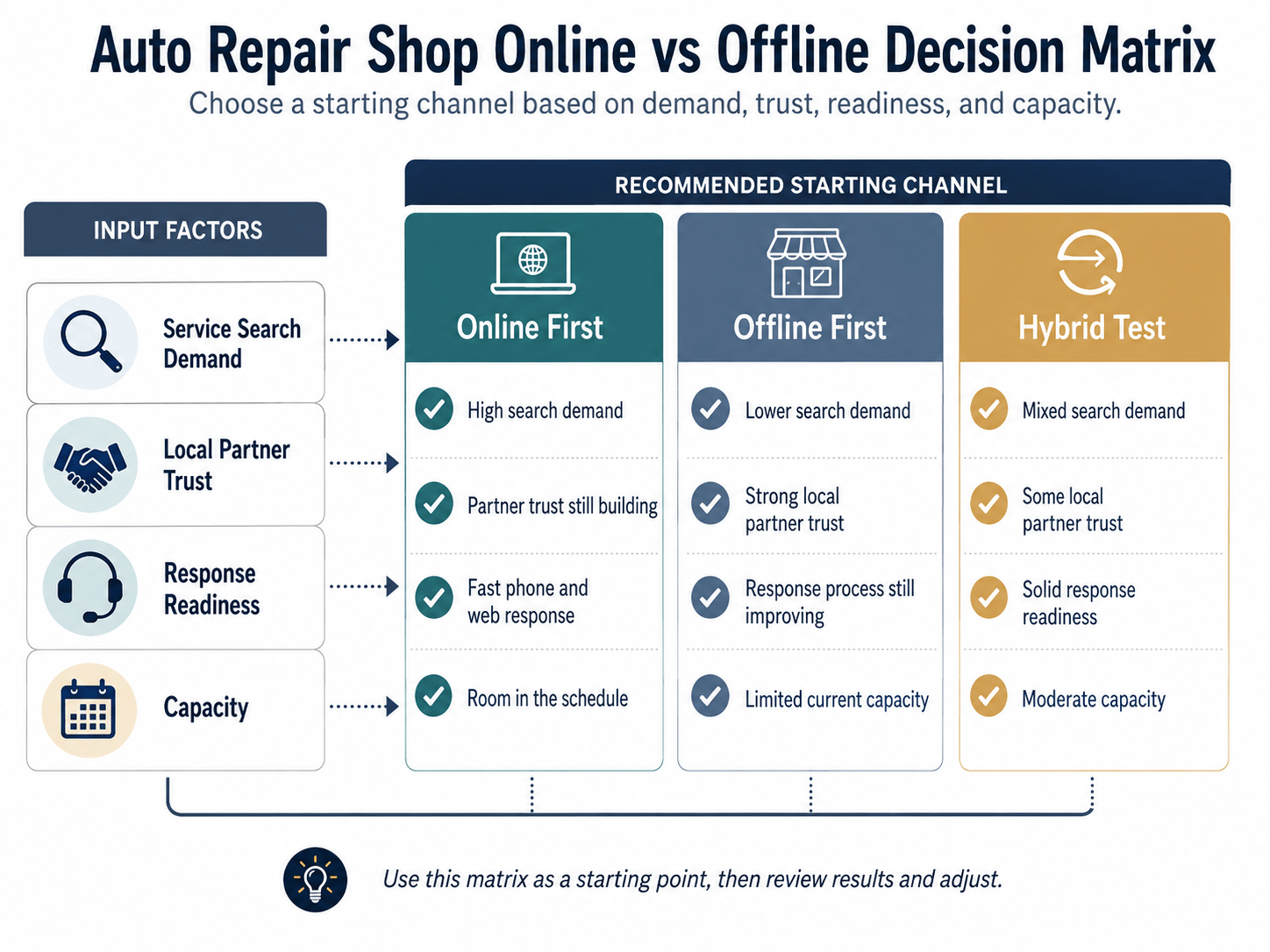
| If this is true | Start here | Do not scale until |
| The priority service has active local search intent and the service page is ready | Google Business Profile and a focused online test. | The team records service fit, bookings, and completed work. |
| The shop has a named local partner with a relevant audience and permission | A single offline referral or partner test. | The partner path, landing page, phone response, and attribution are tested. |
| Neither the customer path nor service scope is ready | Fix response, facts, and priority service information first. | A customer can take one accurate next step without staff improvisation. |
| Both channels are ready but capacity is limited | Choose the channel most likely to create suitable work in the next available slots. | The first test has a source ID and a review date. |
| Both channels are producing tracked, suitable work | Run a small hybrid test where both messages point to the same service path. | The shop can compare completed work and cost without double counting. |
Use the Same Measurement Standard for Both
Do not compare a Google click with a partner introduction, or a flyer scan with a completed repair order. Give every source the same downstream record: source, service requested, service fit, qualified inquiry, booked appointment, completed job, gross profit, and attributable cost. This makes online and offline decisions comparable without inventing a universal cost-per-lead benchmark.
| Metric | Calculation | Decision |
| Cost per qualified inquiry | Attributed source cost divided by qualified inquiries. | Is the channel producing needs the shop can serve? |
| Cost per booked job | Attributed source cost divided by booked appointments. | Is the response and service path turning demand into scheduled work? |
| Completion rate | Completed jobs divided by booked appointments. | Are appointments becoming suitable work or exposing a capacity problem? |
| Gross-profit contribution | Attributed completed-job gross profit minus attributable source cost. | Continue, improve, or stop the controlled test. |
Fictional Example: Compare the Same 30-Day Window
A fictional four-bay shop has room for 12 suitable jobs in the next month. It spends $600 on a focused search test and records 15 inquiries, 9 service-fit inquiries, 6 bookings, and 5 completed jobs. Its cost per qualified inquiry is $66.67 and cost per booked job is $100. A local-partner test costs $150 in approved materials and staff time, produces 8 introductions, 6 service-fit inquiries, 5 bookings, and 4 completed jobs. Its cost per qualified inquiry is $25 and cost per booked job is $30.
If each completed job produced a fictional $450 in gross profit, the online test contributes $1,650 after its attributed cost and the partner test also contributes $1,650. The online test creates one more completed job; the partnership uses less cash. The owner should compare service mix, staff load, repeat potential, and whether either source can grow without lowering job quality before selecting the next test.
Model the cost and capacity assumptions with the Ads Revenue Calculator, then replace the example assumptions with actual recorded outcomes.
A Practical 30-Day Sequence
- List the services the shop can schedule now, the local customer types that fit them, and the capacity limits that should stay out of promotion.
- Set the phone, missed-call, booking, and source-recording process; test it with a real call and appointment request.
- Make Business Profile facts and one priority service page accurate, complete, and easy to contact from mobile.
- Identify one relevant partner or one search-led service test. Write the message, proof, boundary, destination, and source ID before launch.
- Run the smallest useful test, monitor staff capacity, and record qualified inquiries, booked appointments, completed jobs, and gross-profit contribution.
- Review the evidence after the agreed period. Improve the response path, service message, partner fit, or campaign scope before adding the second channel.
For the separate planning and execution of a physical mail campaign, see auto repair direct mail marketing. This guide does not prescribe a mail cadence or turn partnerships into a direct-mail guide.
Common Online and Offline Mistakes
- Starting paid search before the phone owner, service page, and source tracking are ready.
- Treating a filled-in Business Profile as proof the shop is visible, trusted, or prepared for every service inquiry.
- Asking a partner to send anyone and everyone rather than defining a relevant service and referral path.
- Using unapproved offers, reviews, prices, qualifications, or turnaround promises in either channel.
- Counting clicks, impressions, flyer scans, or introductions as success without reviewing booked and completed work.
- Adding every channel at once, then being unable to separate what created suitable customer demand.
FAQ
Should an auto repair shop start with online or offline marketing?
Start with the channel that has a real customer path and the clearest ability to create suitable work. Online is often first for actively searched services; offline can be first when a relevant local partner has permission and a trackable referral path. Both require accurate service information and response ownership.
What is online marketing for an auto repair shop?
It includes the controlled online paths a local driver uses to find, verify, understand, and contact the shop, such as Business Profile, service pages, local search, and paid search tests. It should not be treated as a substitute for phone handling or service capacity.
Does auto repair digital marketing have to start with Google Ads?
No. Auto repair digital marketing can begin with accurate Business Profile details, service pages, review handling, and call ownership. Use Google Ads only when the service path, response process, capacity, and source tracking are ready.
Can local partnerships work for auto repair shops?
They can be useful when a non-competing organization serves relevant local drivers and both sides can define the service scope, permission, referral path, and measurement. Do not count a partnership as successful until it produces suitable booked and completed work.
How should a shop compare online and offline marketing?
Use the same source record for both: qualified inquiry, booked appointment, completed job, gross profit, and attributable cost. Do not compare a click or scan directly with a repair order.
Choose the Next Test You Can Actually Learn From
Auto repair shop online marketing works best when it starts with a channel the shop can support, track, and review through real work. Establish the same service and response foundation for every channel, start with the most credible local path, and scale only after the record shows suitable bookings and completed jobs.
For a broad catalog of tactics after this decision is made, see auto repair shop marketing ideas. Shops that need help connecting local discovery, paid demand, calls, and booked work can review auto repair lead generation.

With a background in psychology, Valeriu has worked in sales and marketing for 8+ years, and learned through experience that the best way to do business is to serve clients well, and solve their problems. He has joined Element DMA in September of 2025, attracted by the honest nature of the work and attitude of auto & truck repair shops. In this role, he helps shop owners across the U.S. see the ROI of properly done advertising, and the growth this brings to their shops, regardless of niche or state.