

Auto Repair Shop Marketing Ideas That Increase Car Count

Auto repair shop marketing ideas are only useful when they lead to the right outcome: more qualified calls, more booked jobs, better repeat visits, stronger reviews, or higher-value repair orders. A long list of tactics can look impressive, but a shop with limited time needs priorities.
The mistake is treating every idea as equal. A Facebook post, a Google Business Profile update, a brake repair landing page, a declined-work follow-up, and a referral offer do not solve the same problem. One builds trust, one captures urgent demand, one recovers work already diagnosed, and one helps the shop stay visible between visits.
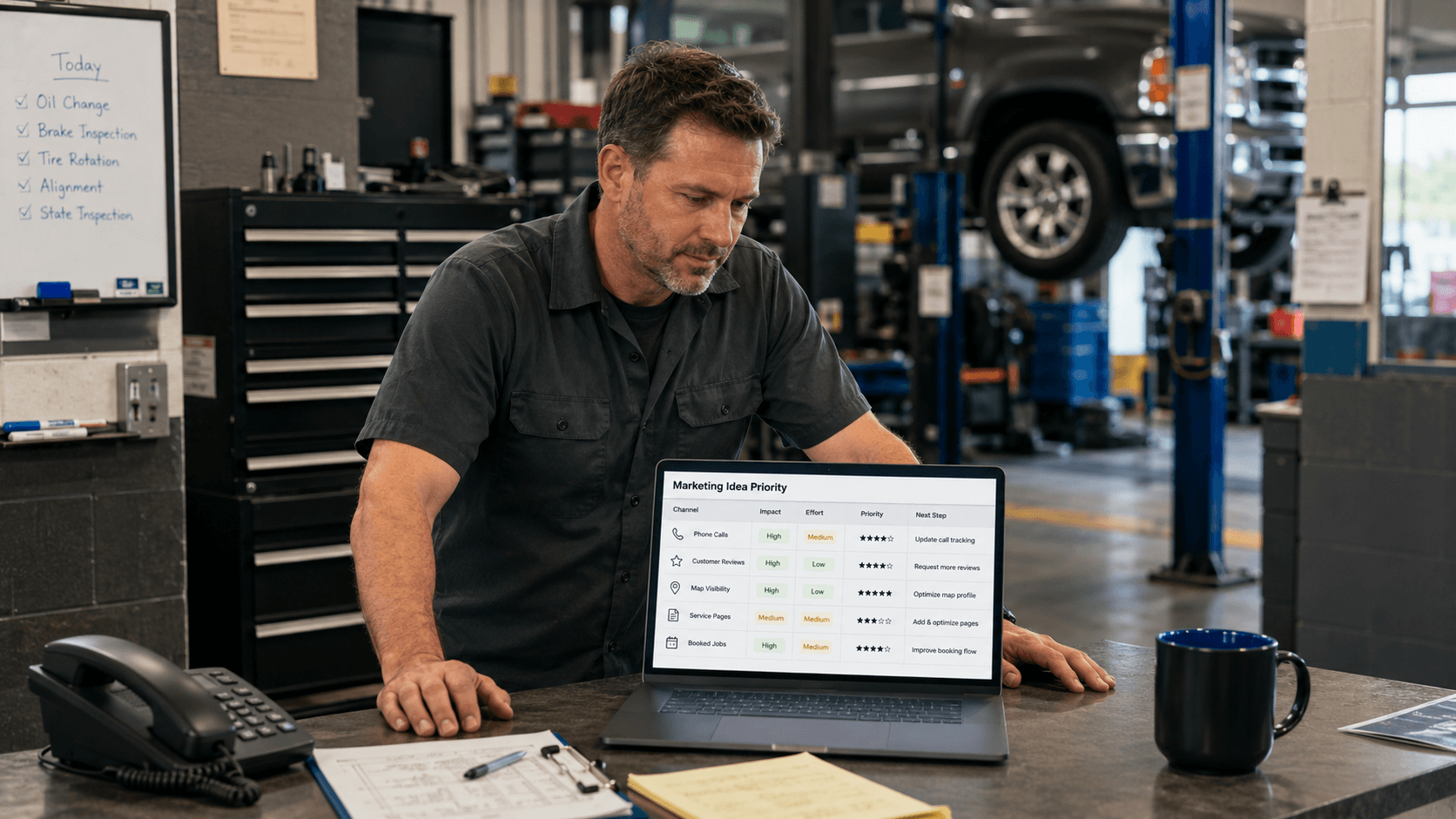
Use this guide as a practical filter. Start with the priority matrix below, choose the ideas that match the shop’s current bottleneck, and measure them by booked jobs instead of list size. Empty bays, missed calls, weak local visibility, poor reviews, low repeat visits, and unclear ROI each need a different first move.
Contents:
- Start With the Shop Bottleneck, Not a Random List
- 1. Make Google Business Profile Useful Enough to Generate Calls
- 2. Turn Reviews and Photos Into Local Proof
- 3. Build Service Pages Around Work the Shop Wants More Of
- 4. Use Search Ads for High-Intent Repair Demand
- 5. Recover Work the Shop Already Earned
- 6. Use Local Retention and Referral Ideas Carefully
- 7. Track Ideas by Booked Jobs, Not Activity
- A 30-Day Implementation Sprint
- FAQ
- Choose Fewer Ideas and Execute Them Better
Start With the Shop Bottleneck, Not a Random List
Before choosing channels, name the constraint. A five-bay shop with open capacity needs a different first move than a busy shop with missed calls, weak review velocity, or too many low-margin oil changes.
| Goal | Best first ideas | Measure | Common mistake |
|---|---|---|---|
| More calls now | Google Business Profile cleanup, Search Ads, service-specific landing pages, missed-call callbacks | Qualified calls and booked jobs | Judging success by clicks or views only |
| More booked jobs | Phone scripts, call tracking, estimate follow-up, appointment reminders | Call-to-booked-job rate | Buying more leads before fixing the phone process |
| Better local trust | Review requests, review replies, shop photos, technician photos, service proof | Review growth, map calls, conversion rate | Asking for reviews only when business slows down |
| Repeat visits | Declined-work follow-up, maintenance reminders, seasonal checks, email/text campaigns | Repeat repair orders and retained customers | Sending generic promotions to every customer |
| Higher-value work | Diagnostic pages, brake/AC/transmission campaigns, fleet outreach, service advisor follow-up | Average repair order and gross-profit quality | Promoting only cheap entry offers |
Shop size changes the order. A two-bay shop should usually protect phone answer rate, reviews, maintenance reminders, and a few profitable service pages before expanding into several paid channels. A larger shop with unused bays can test more acquisition ideas because it has the capacity to absorb new appointments. A specialty shop should lead with the services that make it different, such as hybrid diagnostics, diesel repair, European vehicles, fleet work, or transmission service. The best idea is the one that matches capacity, margin, and customer intent at the same time.
1. Make Google Business Profile Useful Enough to Generate Calls
Google Business Profile is often the fastest free surface to improve because it sits close to Maps, reviews, hours, photos, directions, and calls. Google’s Business Profile performance reporting can show actions such as calls and other customer interactions, but the shop still needs call notes or call tracking to know whether those actions became booked work.
- Use the most accurate primary category for the shop.
- Add specific services such as brake repair, diagnostics, AC repair, oil changes, suspension, transmission, and fleet maintenance only when the shop performs them.
- Keep hours, holiday hours, phone number, appointment path, and service area accurate.
- Upload current photos of the exterior, entrance, service counter, bays, team, equipment, and completed work where appropriate.
- Answer common questions about appointments, estimates, waiting area, after-hours drop-off, fleet work, and vehicle types.
If the shop needs Maps and organic visibility rebuilt around services, start with SEO for auto repair shops before adding more disconnected campaigns.
2. Turn Reviews and Photos Into Local Proof
Reviews are not just reputation decoration. They help a nervous driver decide whether to call, and they give local searchers proof that the shop is active. Keep the process ethical: the FTC’s guidance on reviews and endorsements is a good reminder that fake or misleading review activity creates trust and compliance risk.
A repair shop should ask satisfied customers at the right moment: after a clean pickup, a solved diagnostic problem, a fast turnaround, or a helpful service advisor interaction. The request should be simple, honest, and never conditional on a discount for a positive rating.
- Ask for service-specific reviews after successful repairs.
- Reply to reviews with useful, non-private details.
- Photograph real trust signals: bays, tools, signage, waiting area, staff, certifications, and vehicle-safe before/after examples.
- Use review themes to improve service pages and advisor scripts.
3. Build Service Pages Around Work the Shop Wants More Of
Generic website pages rarely convert urgent repair searches well. Google’s SEO starter guide emphasizes making page information useful for searchers. For a repair shop, that means a brake page should explain brake symptoms, inspection flow, appointment options, location, trust proof, and a clear phone path.
| Service page | Marketing idea | Proof to add | Conversion path |
|---|---|---|---|
| Brake repair | Seasonal brake safety campaign | Brake reviews, inspection process, photos of bay/equipment | Call or book inspection |
| Check engine light | Diagnostic confidence campaign | Scan/diagnostic process, common causes, advisor explanation | Book diagnostic appointment |
| AC repair | Pre-summer comfort campaign | Leak test/recharge distinction, AC reviews, seasonal urgency | Schedule AC inspection |
| Fleet maintenance | Local business outreach | Vehicle types, scheduling process, downtime language | Request fleet consultation |
| Oil change / maintenance | Retention and reminder campaign | Maintenance intervals, inspection add-ons, convenience | Book routine service |
4. Use Search Ads for High-Intent Repair Demand
Search Ads are useful when the shop needs demand now and can answer the phone. Google describes Search campaigns as a way to reach people searching for products or services. For repair shops, the strongest campaigns usually match services and geography: brake repair near me, check engine light diagnostic, AC repair, transmission repair, oil change, fleet maintenance, and truck repair where relevant.
The cleanup matters as much as the launch. Use the search terms report to see the actual queries that triggered ads, then add negative keywords for jobs, training, DIY, parts-only searches, unavailable services, and towns outside the service area.
If the shop’s immediate problem is campaign setup, landing pages, and paid-search reporting, review auto repair PPC advertising before building a broader acquisition plan.
For shops that need calls tied to tracking and follow-up, auto repair lead generation should connect paid search, landing pages, call handling, and reporting instead of treating ads as a standalone tactic.
5. Recover Work the Shop Already Earned
Some of the best marketing ideas do not require finding a brand-new customer. The shop may already have open opportunity in declined work, missed calls, unscheduled estimates, old diagnostic notes, and customers who are overdue for routine service.
- Call customers with declined safety-related work before the expected due date.
- Send maintenance reminders based on mileage, time, and service history.
- Create a same-day callback rule for every missed call during business hours.
- Review unbooked estimates weekly and assign one person to follow up.
- Use advisor notes to personalize the reason for the follow-up instead of sending generic discounts.
This is often where smaller shops can move fastest. The customer already knows the business, the vehicle history is known, and the next action can be specific.
6. Use Local Retention and Referral Ideas Carefully
Email, text, direct mail, referral cards, partnerships, sponsorships, and local events can all work when they have a specific job. They get weak when they become a pile of generic promotions.
| Idea | Best fit | Repair-shop example | Guardrail |
|---|---|---|---|
| Email or text reminders | Repeat visits | Oil change, tire rotation, AC check, winter inspection | Segment by vehicle and service history |
| Direct mail | Local awareness | New mover offer or seasonal maintenance postcard | Use call tracking or unique offer codes |
| Referral program | Trust-based acquisition | Credit for referrer and first-time customer | Protect margin with minimum-ticket rules |
| Partnerships | Commercial or local proof | Fleet managers, used-car dealers, towing companies | Track referred jobs separately |
| Community events | Brand trust | Car-care clinic, teen driver safety night, local sports sponsorship | Do not judge by likes alone |
7. Track Ideas by Booked Jobs, Not Activity
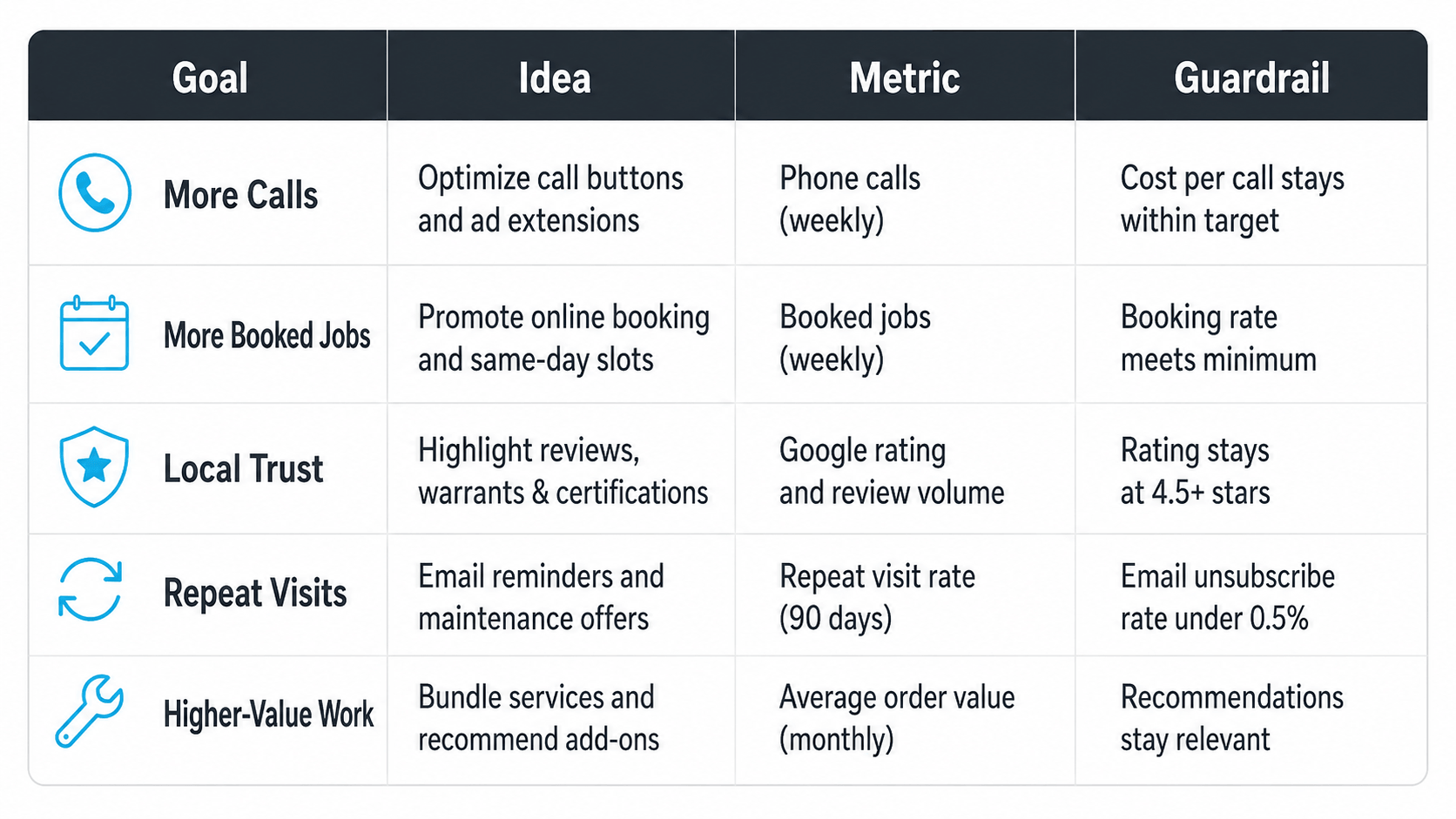
Every idea needs a simple measurement rule. If the shop cannot tell whether an idea produced a qualified call, booked job, repeat visit, or repair order, it is easy to keep spending because the activity feels productive.
Booked-Job Scorecard Template
Use one scorecard for every test so the owner can compare channels fairly. The first question is not whether the idea created attention; it is whether the idea created work the shop could actually perform at a healthy margin.
| Scorecard field | Example | Decision rule |
|---|---|---|
| Idea tested | Brake Search Ads, review request text, declined-work callbacks | Test one idea at a time when possible |
| Qualified calls | $900 spend / 18 qualified calls = $50 each | Remove spam, wrong-service, and out-of-area calls |
| Booked jobs | $900 spend / 10 booked jobs = $90 each | Scale only when the phone process can handle the volume |
| Completed revenue | 10 jobs x $425 ARO = $4,250 | Compare against capacity, margin, and technician availability |
| Next action | Scale, revise, pause, or move to retention | Do not keep a campaign alive because clicks look good |
A simple weekly formula keeps the conversation honest: spend divided by booked jobs, then booked jobs multiplied by average repair order. If the shop tracks gross profit, add that field before scaling the idea.
Use the Ads Revenue Calculator to test spend, calls, close rate, average repair order, and revenue before scaling an idea.
Published Element DMA work supports this measurement-first approach. In the Fair Cars USA case study, a $1,000 budget produced 61 calls from Google Ads, 17 calls from Google Business Profile, 78 total calls, and a $19.04 cost per call. The strategy included a new website, 12 service pages, focused Search Ads, and Google Business Profile optimization.
A 30-Day Implementation Sprint
Do not launch every idea at once. Pick a short sprint that fixes the highest-friction part of the customer path, then decide whether the next month should focus on acquisition, conversion, or retention.
- Week 1: clean up Google Business Profile, services, hours, photos, phone number, review replies, and the appointment path.
- Week 2: choose three priority services and improve their pages, calls to action, proof, and tracking numbers.
- Week 3: set up missed-call review, declined-work follow-up, service reminder rules, and one advisor script for callback quality.
- Week 4: test one acquisition channel, such as Search Ads, direct mail, or referral outreach, and fill in the booked-job scorecard every Friday.
At the end of the sprint, keep ideas that created qualified conversations and booked work. Pause ideas that only produced impressions, likes, or unqualified calls. If the best result came from existing customers, make the next sprint about retention before buying more new traffic.
FAQ
What are the best auto repair shop marketing ideas?
The best ideas are usually Google Business Profile optimization, service-specific SEO pages, Search Ads for urgent services, review generation, missed-call follow-up, declined-work follow-up, referral programs, and retention reminders. The right order depends on the shop’s bottleneck.
What is the fastest way to increase car count?
Start with missed calls, declined work, Google Business Profile accuracy, review requests, and Search Ads for high-intent services. These ideas are closer to booked jobs than broad brand campaigns.
Should an auto repair shop use social media?
Yes, but social media should mostly build trust and retention. Post real shop photos, short repair explanations, team content, customer education, and local updates. Do not expect social posts to replace high-intent search traffic.
How much should a repair shop spend on marketing ideas?
Set spend by capacity and expected booked jobs, not by a generic percentage. A shop with open bays can test more acquisition spend. A shop with missed calls should fix call handling before increasing budget.
Which marketing ideas should a small shop avoid first?
Avoid broad campaigns with no tracking, large discount offers that hurt margin, generic social posting, thin city pages, and any channel that cannot be connected to calls, appointments, or repeat repair orders.
Choose Fewer Ideas and Execute Them Better
A repair shop does not need 60 disconnected tactics. It needs a short list of ideas that match its capacity, service mix, phone process, and customer base. Start with the ideas closest to revenue, measure them by booked jobs, and expand only after the shop can prove what is working.
Need a team to implement these ideas across search, paid media, local visibility, tracking, and customer acquisition? Explore Element DMA’s auto repair digital marketing services.

With a background in psychology, Valeriu has worked in sales and marketing for 8+ years, and learned through experience that the best way to do business is to serve clients well, and solve their problems. He has joined Element DMA in September of 2025, attracted by the honest nature of the work and attitude of auto & truck repair shops. In this role, he helps shop owners across the U.S. see the ROI of properly done advertising, and the growth this brings to their shops, regardless of niche or state.