

Auto Repair Marketing Ultimate Guide for New Shops: First 30 Booked Jobs
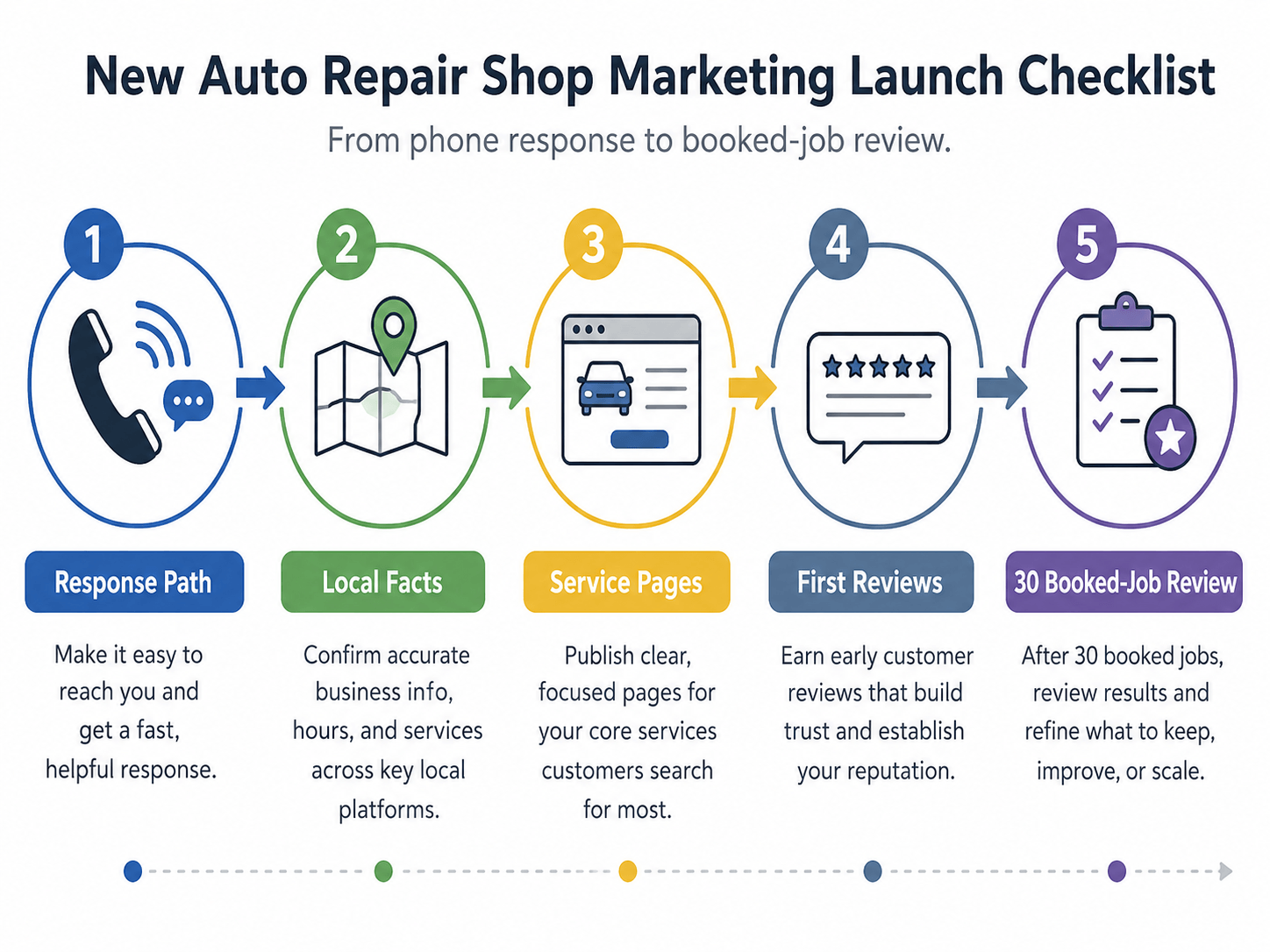
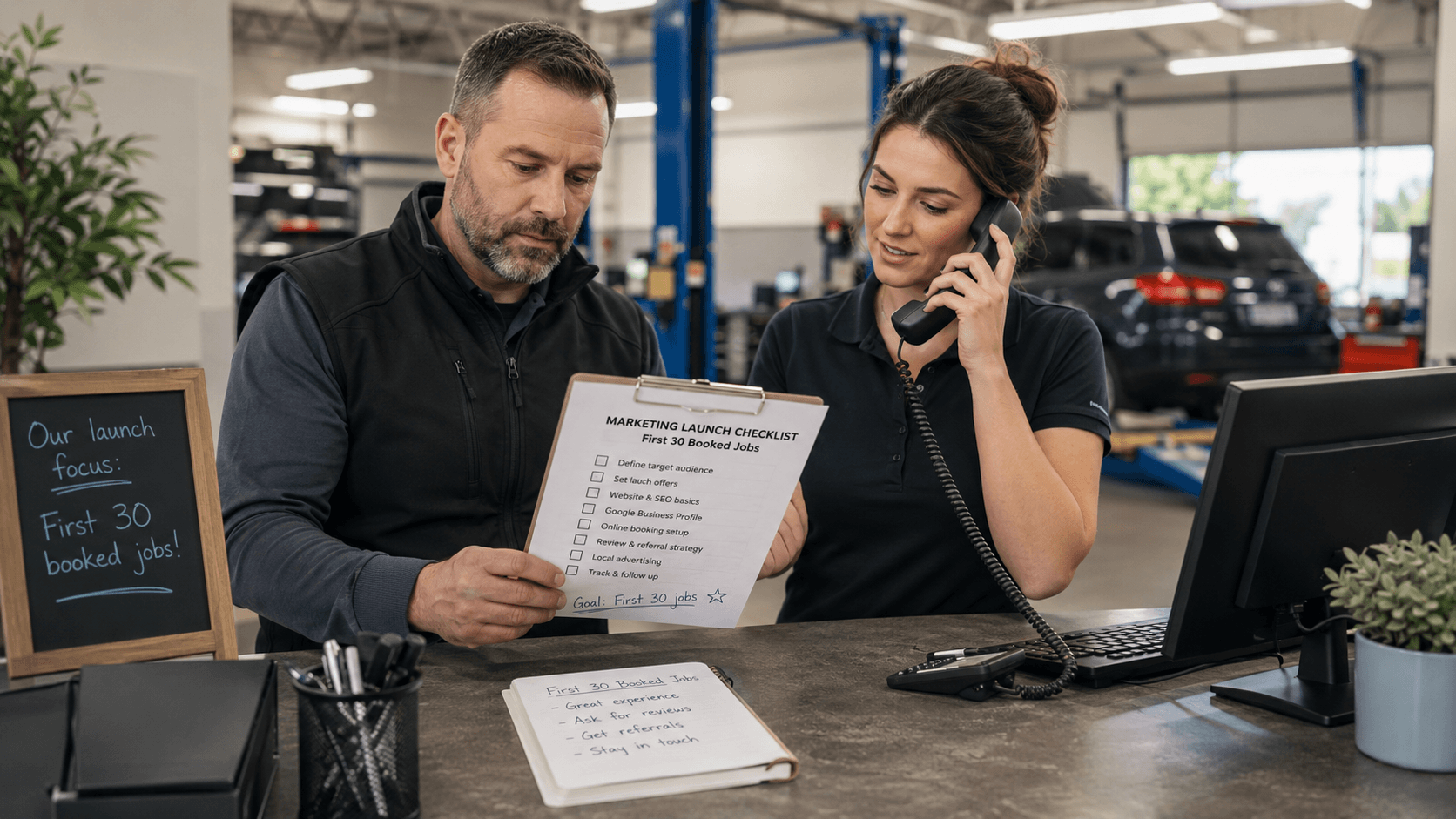
A new shop does not need to launch every marketing channel at once. It needs a reliable path from a local driver’s question to a suitable booked appointment. This auto repair marketing ultimate guide is a launch checklist for that first system: answer the phone, make the shop easy to verify locally, explain the services it can perform, request reviews properly, and learn from the first 30 booked jobs.
That is different from a broad marketing plan or a list of promotion ideas. New owners should not spend the first month publishing everywhere, buying software, or testing paid campaigns before their business details, service scope, call handling, and appointment records work together. Build the foundation first, then add channels based on evidence.
Contents:
- The Launch Order: Fix the Customer Path Before Adding Reach
- Set Up Phone and Appointment Tracking First
- Make Google Business Profile Ready for a First Customer
- Build Service Pages Before a Broad Marketing Campaign
- Earn the First Reviews Without Incentives or Scripts
- Choose One Launch Channel With a Priority Matrix
- Measure the First 30 Booked Jobs
- A Documented Start-From-Zero Example
- Examples by Service Type
- A 30-Day New Auto Repair Shop Marketing Checklist
- Mistakes That Slow a New Shop Launch
- FAQ
- Launch a System You Can Improve
The Launch Order: Fix the Customer Path Before Adding Reach
| Priority | What must work | Why it comes first | Evidence to keep |
|---|---|---|---|
| 1. Response | A customer can call, get an answer or callback, and request the right service. | Visibility creates waste when the phone path is unclear or unowned. | Call owner, response standard, missed-call review. |
| 2. Local facts | Name, address, phone, hours, service area, and categories are accurate everywhere the shop controls. | Drivers need to verify that the shop is real, open, and nearby. | Current business record and change owner. |
| 3. Service explanation | Priority services have clear pages with scope, process, limits, and an appointment path. | A visitor should not have to guess whether the shop can help. | Technician-approved service inventory. |
| 4. Trust capture | The team asks eligible customers for honest reviews after completed work. | A new shop needs real, policy-compliant evidence over time. | Request workflow and response owner. |
| 5. Growth test | One local channel is measured through booked and completed work. | The owner can improve a controlled test instead of guessing across channels. | Campaign ID and 30-job scorecard. |
Set Up Phone and Appointment Tracking First
A call is not automatically a lead, and a lead is not automatically the right work. Before asking Google, a referral partner, or a flyer to create demand, decide who answers, how a missed call is returned, what the adviser records, and how an inquiry becomes an appointment. The record can be simple: source, service requested, vehicle or concern, appointment outcome, completed work, and a short note on why the inquiry did or did not fit.
| Call-stage field | Minimum record | Why it matters |
|---|---|---|
| Source | Google Business Profile, service page, referral, campaign, or unknown. | Shows which launch activity created the inquiry. |
| Service fit | Requested service and whether the shop currently offers it. | Prevents unsuitable calls from being counted as marketing success. |
| Appointment | Booked, not booked, cancelled, or no-show. | Separates conversation volume from actual capacity. |
| Completed work | Closed repair order and gross profit when available. | Lets the owner judge the quality of the first demand. |
Use the practical workflow in automotive call tracking to define the handoff from ringing phone to completed work. The launch checklist should improve the shop’s own records, not rely on a vendor’s lead count.
Make Google Business Profile Ready for a First Customer
A new Google Business Profile should be accurate before it is promotional. Verify the real business identity, use the true address or service-area setup, set current hours and phone details, choose categories that match the offered services, and add photos that show the actual facility, team, and work environment. Do not add services, locations, hours, or attributes that the shop cannot support operationally.
Review Google’s Business Profile guidelines before setup and keep a single owner responsible for changes. The profile should match the website and phone script, including how the shop describes its priority services.
| Profile element | Launch check | Do not do this |
|---|---|---|
| Business identity | Use the real shop name, location, and contact information. | Add keyword stuffing or a non-existent location. |
| Hours and access | Confirm current hours, holiday handling, and the call path for after-hours messages. | Leave outdated hours after the launch period. |
| Services | List services the shop can schedule and explain priority work on matching website pages. | Publish a long menu of future capabilities. |
| Photos | Use current exterior, interior, team, and work-area photos with appropriate permission. | Use stock imagery as proof of the actual shop. |
Build Service Pages Before a Broad Marketing Campaign
A new shop’s website does not need dozens of thin pages. It needs a small set of useful commercial pages for the services the shop is ready to provide. Start with the work that fits capacity, can be explained clearly, and has a real appointment path. Each page should cover what the shop evaluates or performs, who the service is for, limits that matter, local contact details, and what happens at the first visit.
| New-shop situation | First page to improve | Supporting content later |
|---|---|---|
| General repair shop with limited launch capacity | One core service page for the service most central to the shop’s current work. | A technician-reviewed FAQ that answers the common hesitation before booking. |
| Specialty import, diesel, or fleet focus | A scope page naming verified vehicle or service boundaries. | A capability explainer after the team approves the details. |
| Seasonal launch window | A page for the actual inspection or maintenance service being promoted. | A local seasonal guide only when it matches capacity and conditions. |
For the technical and local-search work behind these pages, see SEO for auto repair shops. This guide keeps the focus on launch order; the service page remains the place for commercial service intent.
Earn the First Reviews Without Incentives or Scripts
A review process should start after a real service experience, not before the shop has earned customer trust. Ask every eligible customer consistently, provide a direct review path, and give the customer room to write in their own words. Do not condition discounts, gifts, or better service on a positive review. Record who owns review responses and have that person address feedback professionally.
Google’s user-contributed content policy is the baseline for review requests and content. A new shop should treat the first reviews as operating feedback as well as local trust evidence.
- Choose the moment: after completed work and a clear customer handoff.
- Use one honest request script that asks for feedback, not a five-star rating.
- Give the adviser a direct link or QR path that is tested and current.
- Record review requests separately from review outcomes; never fabricate missing feedback.
- Respond to relevant reviews with accurate, privacy-aware language and an escalation path for disputes.
Choose One Launch Channel With a Priority Matrix
The next channel should match the shop’s launch constraint. A shop with no local profile needs accurate discovery before paid traffic. A shop receiving calls but missing appointments needs intake repair before another campaign. A shop with a clear service page and response process can test one local source. Do not treat this matrix as a universal ranking of channels.
| Current constraint | First test | Success measure | Pause when |
|---|---|---|---|
| Drivers cannot find or verify the shop | Complete business information and priority service pages. | Relevant calls or directions requests with correct business details. | Facts, service scope, and contact path are still inconsistent. |
| Calls arrive but do not become appointments | Call review and adviser follow-up workflow. | Qualified inquiries that become scheduled visits. | The team cannot respond within its own standard. |
| One service needs a controlled demand test | A small local campaign or permitted partner referral tied to one service page. | Booked appointments and completed jobs by source. | The landing page, offer terms, or capacity are unclear. |
| Customers leave without future contact permission | A compliant process for service reminders or review requests. | Consented contacts and completed customer actions. | Consent, ownership, or message relevance is uncertain. |
Measure the First 30 Booked Jobs
Thirty booked jobs are not a universal benchmark or a promise of pace. They are a manageable first sample for a new owner to review. Track the same fields for every booked job, then look for a repeatable pattern: which source creates suitable work, which service pages create clear questions, where calls are missed, and which requests the shop should stop promoting.
| Metric | Calculation | Decision question |
|---|---|---|
| Booking rate | Booked appointments divided by tracked qualified inquiries. | Is the call path and service explanation helping the right people book? |
| Cost per booked job | Attributed launch cost divided by booked jobs from that test. | Is the channel affordable before the owner increases spend? |
| Completion rate | Completed jobs divided by booked appointments. | Are appointments becoming suitable work or exposing an operational issue? |
| Gross-profit contribution | Gross profit from attributed completed jobs minus attributable campaign cost. | Should the test continue, change, or stop? |
Model the inputs before committing budget with the Ads Revenue Calculator. Replace assumptions with the shop’s own call, appointment, and completed-work data after the test begins.
A Documented Start-From-Zero Example
Element DMA’s published A&V Auto Repair case describes a shop that began with no website or online presence. The implementation included a new website with 25 pages, Google Business Profile setup, service-based campaign structure, and phone scripts. That is relevant as a documented example of building the launch components together. It is not proof that every new shop will receive the same call cost, call volume, rankings, or booking results; the launch checklist should still be judged by each shop’s own first-30-job record.
Read the A&V Auto Repair case study for the documented implementation and case-specific results.
Examples by Service Type
| Service type | Launch message | Page and measurement boundary |
|---|---|---|
| Brake or inspection work | Start with an approved inspection process, not a diagnosis or universal price. | Send to the matching service page; record inspection requests, booked appointments, and completed work. |
| Maintenance | Describe the maintenance service and vehicle-specific limits accurately. | Do not imply a single interval fits every vehicle; measure service-fit calls. |
| Verified specialty | Name the makes, categories, or procedures the team can support today. | Do not turn training plans into active services; review suitable inquiries by source. |
| Fleet or commercial work | State the actual scheduling, vehicle, and service scope the shop can handle. | Use a dedicated contact path and qualify capacity before treating interest as a lead. |
A 30-Day New Auto Repair Shop Marketing Checklist
| Week | Priority actions | Deliverable |
|---|---|---|
| Week 1 | Set call ownership, missed-call follow-up, source fields, service inventory, and business facts. | A response and local-facts checklist with one accountable owner. |
| Week 2 | Complete the Business Profile, add current photos, and publish or improve priority service pages. | A consistent local discovery and service-information path. |
| Week 3 | Start policy-compliant review requests after completed work; test one approved local source or partner path. | A review workflow and one trackable launch test. |
| Week 4 | Review inquiries, booked jobs, completed work, response issues, and service-fit notes. | A documented decision to improve, continue, or stop the test. |
Mistakes That Slow a New Shop Launch
- Buying traffic before the phone, booking, and follow-up process has an owner.
- Creating thin pages for every service, location, or vehicle type before the shop can explain the work accurately.
- Counting calls, clicks, or review requests as success without recording booked and completed work.
- Offering a broad promotion without terms, service limits, capacity checks, or a matching landing page.
- Asking only selected happy customers for reviews, offering incentives for sentiment, or using scripted review copy.
- Treating a new-shop launch checklist as a permanent marketing plan instead of a foundation for measured tests.
FAQ
What marketing should a new auto repair shop do first?
Start with call handling, accurate business facts, a verified Google Business Profile, and clear service pages for work the shop can perform. Add one measurable channel only after those foundations work.
How should a new repair shop get its first reviews?
Ask eligible customers for honest feedback after completed work, provide a direct review path, and follow platform policies. Do not reward positive sentiment or use fabricated review content.
Should a new auto repair shop run ads immediately?
Only after the phone response, service page, capacity, terms, and source tracking are ready. Begin with one controlled test and judge it by booked and completed work, not impressions alone.
How do I measure auto repair marketing at launch?
Record source, service fit, qualified inquiry, booked appointment, completed job, gross profit, and campaign cost. Review the first 30 booked jobs for patterns instead of assuming every lead has equal value.
Is this a full auto repair marketing plan?
No. It is a new-shop launch checklist. Broader channel selection, positioning, retention, and long-term budgeting should be developed after the initial customer path and measurement records are reliable.
Launch a System You Can Improve
The first marketing advantage for a new repair shop is not a larger list of tactics. It is a clear, trustworthy customer path that the owner can observe. Make the shop easy to reach and verify, explain only services it can support, request honest feedback, test one source at a time, and use booked and completed work to decide what earns the next investment.
For broader tactical discovery after the launch path is reliable, see auto repair shop marketing ideas. Shops that need a connected acquisition system can review auto repair lead generation.