

Auto Repair Shop Work Order Marketing: Turn Completed Repairs Into Return Visits

Auto repair shop work order marketing begins after a customer says yes to a repair. The work order is not only an internal billing document. It can become the record that helps an advisor explain what was completed, what was declined, what to monitor next, and when a returning customer has a reason to call again.
That does not require a large automation program or a sequence of generic messages. It requires a consistent handoff: accurate work-order notes, an understandable customer explanation, a clear next service trigger, and a way to measure whether the customer returns. The goal is a better service experience and more suitable repeat work, not a broad marketing campaign.
Contents:
- The Retention Problem Is Often Hidden Inside the Work Order
- The Work Order Retention Snapshot
- Make Each Work-Order Field Usable at the Next Conversation
- Start With the Customer’s Reason for Saying Yes or No
- Make Deferred Work Easy to Revisit Without Chasing the Customer
- Use a Decision Map for Declined Work
- Use Review Requests as a Service Closeout, Not a Retention Shortcut
- Measure Return Visits by Work-Order Cohort
- Give Advisors a Handoff They Can Repeat
- Where Local Visibility Still Supports Retention
- Common Work-Order Retention Mistakes
- FAQ
- Let the Completed Repair Create a Clear Next Decision
A shop can see car count and total sales while missing the reason a first-time customer never returns. A closed repair order may show the completed job but not whether the customer received a clear explanation, understood any deferred recommendation, knew the next maintenance interval, or had an easy way to book the next visit. That gap is where retention becomes guesswork.
A useful work-order record links the repair to the customer decision. It should be specific enough for the next advisor to understand the vehicle history, but simple enough that the customer can leave with an accurate summary. This is not a request to put promotional language into a technical document. It is an operating habit that creates a better next conversation.
The Work Order Retention Snapshot
Before closing a customer-pay repair order, review these six fields. The snapshot is the article’s practical asset: it gives the service advisor a short completion check without turning the process into a CRM or email workflow.
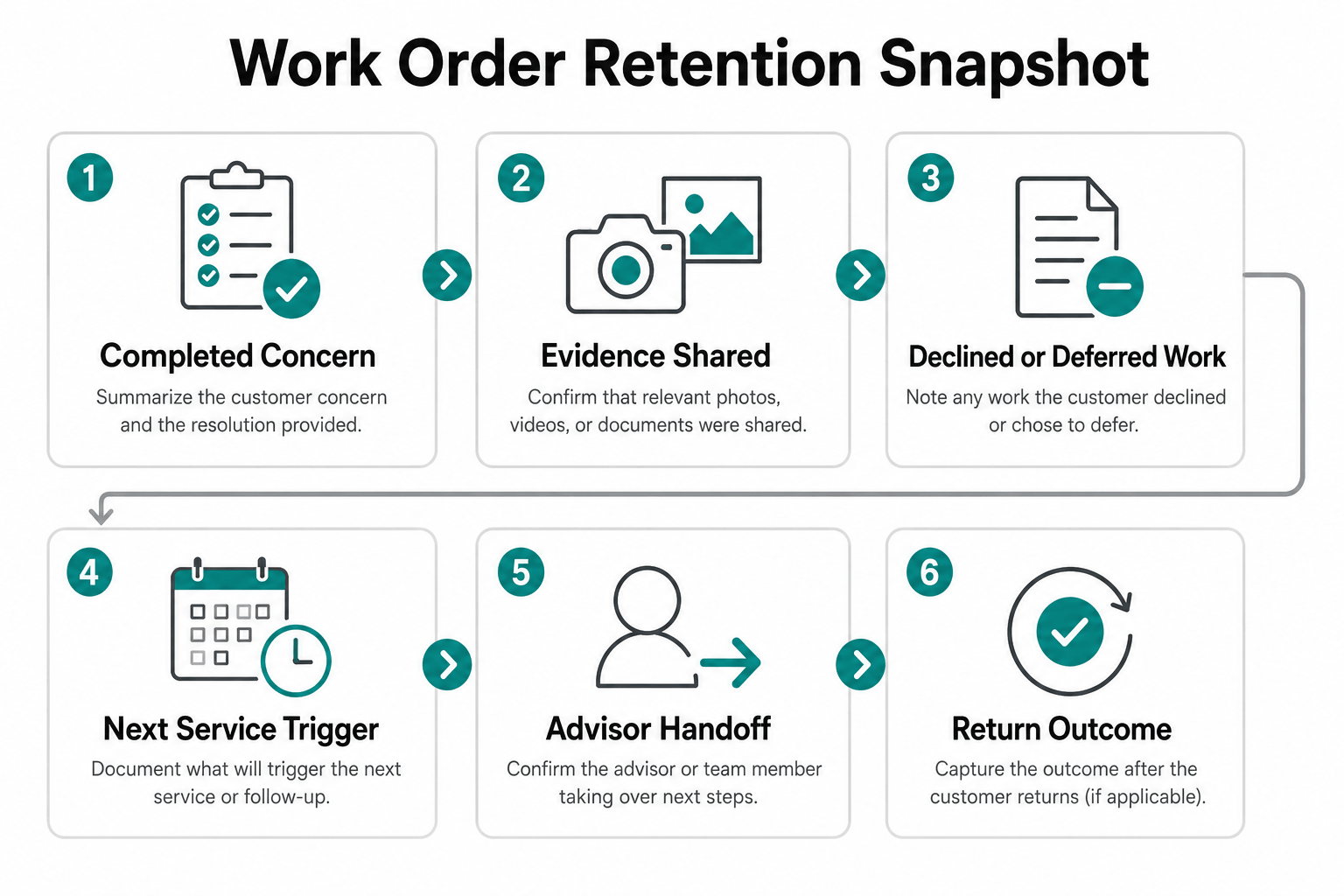
Digital inspections with photos, structured repair priorities, and written approvals can help reduce confusion when they accurately reflect the work. The record should show only what the technician found and what the customer actually reviewed or approved.
Make Each Work-Order Field Usable at the Next Conversation
A retention note has value only when the next advisor can use it without reconstructing the visit. Pair the technical record with a customer-ready explanation, a return trigger, and one measurable outcome. Adapt the examples with technician approval.
| Work-order field | Customer-ready explanation | Next trigger and KPI |
| Diagnostic finding | State the confirmed finding, completed repair, and any unresolved symptom in plain language. | Return if the symptom continues or at the technician-approved inspection point. KPI: suitable second visit. |
| Brake recommendation | Separate completed work from a measured or observed deferred item and its priority. | Return when the approved condition or interval is reached. KPI: documented deferred-work booking. |
| Routine maintenance | Confirm service completed and the vehicle-specific interval used by the shop. | Return by date, mileage, or condition. KPI: maintenance cohort return rate. |
| A/C or seasonal concern | Explain the completed test or repair and the condition that would warrant another check. | Return when the condition reappears or before a relevant seasonal need. KPI: repeat visit without a duplicate complaint. |
Start With the Customer’s Reason for Saying Yes or No
A work order should not treat every declined recommendation as the same problem. Record only the facts the customer shares, the technician-approved priority, and the next reasonable decision point. Do not guess at motives or pressure the customer to accept work.
Make Deferred Work Easy to Revisit Without Chasing the Customer
Deferred work is not automatically lost work. It is a customer decision that needs a clear record. The retention value comes from making the next conversation specific: what was observed, why it matters, what condition changes the urgency, and how the customer can book when ready. A vague note such as ‘recommended brakes’ does not give an advisor or customer much to work with.
- Use the technician’s actual finding and approved priority language, not a generic sales label.
- Record whether the customer asked for an estimate, needed a later date, or declined because the job was not currently affordable.
- Keep the next step proportionate to the urgency. A maintenance item and a safety concern should not use the same follow-up expectation.
- At the next interaction, begin with the customer’s prior decision and new vehicle condition rather than repeating a scripted pitch.
This approach deliberately stops short of building email, SMS, or automation sequences. Those workflows have their own operational and consent requirements. The work-order process should first make any later communication accurate and useful.
Use a Decision Map for Declined Work
A declined-work follow-up should preserve the customer’s informed decision. Review the technician-approved priority, the facts the customer shared, and the condition that would make another visit appropriate.
| If the deferred item is… | Record and explain | Do not do |
| Safety or immediate concern | Use the technician-approved finding, urgency, and safe next step. Record what the customer decided. | Invent a deadline, guarantee an outcome, or make a non-technical claim. |
| Monitorable condition | Name the observed condition and what change should prompt a return visit. | Treat it as emergency work or repeat a generic sales message. |
| Budget-limited but suitable work | Keep the estimate, scope, and customer timing request accurate. | Assume the customer refused permanently or alter the work-order reason. |
| Needs a second opinion or more diagnosis | Record the unresolved question and the next diagnostic or inspection option. | Mark the recommendation as completed or count it as retained revenue. |
For example, a weak note says ‘recommended brakes.’ A useful note identifies the observed item, what was discussed, the approved priority, whether the customer asked to revisit it later, and the condition that should prompt another inspection. The second note helps the advisor continue an informed conversation without pretending that the customer accepted the work.
Use Review Requests as a Service Closeout, Not a Retention Shortcut
A genuine review request can help a shop understand the customer experience and give future drivers useful proof. It cannot repair a poor handoff or replace a clear repair summary. Ask every eligible completed customer for honest feedback using the same process, and do not request a particular rating, script the content, or offer an incentive for a review.
Google’s Maps policy requires reviews to reflect genuine, unbiased experiences and prohibits incentivized or selectively solicited reviews. Review the Google review-content policy before assigning a review-request process.
The FTC’s guidance on soliciting online reviews also cautions businesses not to seek reviews only from customers expected to leave positive feedback.
For a customer-facing use of genuine feedback after the work-order process is sound, see how auto repair reviews can increase conversions.
The review signal belongs beside, not inside, the work-order record: note that the request was made if the business tracks it, but never mark a customer as satisfied simply because they left a review. A return visit, a resolved concern, and a five-star rating are different outcomes.
Measure Return Visits by Work-Order Cohort
Do not use a single all-customer return rate if it mixes customers whose expected return windows are completely different. A brake repair, diagnostic visit, and oil service may each have a different reason and timing for a return. Start with one cohort: for example, first-time customer-pay repair orders closed in a defined month. Then ask how many returned for suitable work within a period the shop defines and applies consistently.
| Metric | Simple calculation | Use it to decide |
| Second-visit rate | Customers in the defined cohort who complete another suitable visit divided by customers in that cohort. | Whether the first work-order handoff is creating a return path. |
| Deferred-work booking rate | Customers with a documented deferred item who later book that item divided by customers with that item. | Whether the explanation and timing were useful. |
| Advisor continuity rate | Return visits where the prior history is visible and used divided by sampled return visits. | Whether the record supports a consistent experience. |
| Gross-profit contribution | Gross profit from attributed return work minus the cost of the measured retention action. | Whether the effort is worth continuing or changing. |
Fictional Cohort Example
A fictional three-bay shop closes 80 first-time customer-pay repair orders in April. It uses the retention snapshot at checkout and reviews the cohort after six months. Twenty-four customers complete a suitable second visit. The second-visit rate is 30 percent (24 divided by 80). Twelve customers had a documented deferred item; four later book that work. If gross profit from the 24 return visits is a fictional $7,200 and the documented follow-through costs $480 in staff time and materials, the measured gross-profit contribution is $6,720 before other overhead.
The numbers are not a benchmark. The point is to use the shop’s own cohort definition, repair-order data, labor mix, and costs. A shop should not count a phone call, an open estimate, or a review as a completed retained visit.
Use the formula retained gross profit = completed second visits x gross profit per return visit – retention-action cost. Substitute the shop’s own labor mix, parts margin, advisor time, and cohort window.
Use the Ads Revenue Calculator to model the gross-profit and cost assumptions before treating a retention action as financially successful.
Give Advisors a Handoff They Can Repeat
The best retention process is small enough to survive a busy day. The advisor does not need to deliver a presentation at every checkout. They need a repeatable closeout: explain completed work, confirm any deferred item, name the next relevant trigger, make the booking path clear, and record the facts. That sequence is more useful than a generic loyalty offer because it is tied to the vehicle and decision in front of the customer.
- Before repair: capture the customer’s stated concern and any relevant decision constraints.
- During approval: use the technician’s documented findings and approved priority language.
- At pickup: explain completed work and any deferred item in plain language; confirm the next service trigger.
- At closeout: make the rebooking path clear and ask for honest feedback through the shop’s approved process.
- At review: compare one work-order cohort’s second visits, deferred-work bookings, and gross-profit contribution with the prior period.
When a shop needs help connecting local discovery, lead quality, calls, and completed repair work, auto repair lead generation provides the broader service context.
For the related intake and advisor skills before a repair order is opened, see how to turn a first caller into a loyal customer.
Where Local Visibility Still Supports Retention
Returning customers still check a shop’s hours, phone number, reviews, and service information when a new concern appears. Accurate local business information supports the retention process because a customer can verify the same business they trusted before. It does not replace the work-order handoff, and it should not be used to turn this retention guide into a local SEO checklist.
When a return visit depends on a clear available slot, the workflow in booking specific auto repair appointment times can help make that next commitment easier.
For the separate work of making service pages and local proof easier for drivers to find, review SEO for auto repair shops.
Common Work-Order Retention Mistakes
- Recording a generic recommendation instead of the actual technician finding and priority.
- Using a deferred-work note as permission to repeatedly pressure a customer.
- Treating an estimate, call, or review as proof of a completed return visit.
- Mixing unlike repair types in one retention cohort and drawing conclusions from the average.
- Promising an interval, price, or future availability that the shop cannot support.
- Offering incentives or selecting only likely-positive customers for public reviews.
FAQ
What is auto repair shop work order marketing?
It is the practice of using accurate repair-order information to improve the next customer decision: explain completed work, record deferred work, identify a relevant return trigger, and measure whether suitable return visits occur.
Should a work order include deferred repairs?
It should document approved technician findings and the customer’s actual decision when that information is needed for future service. The note should be specific, factual, and proportionate to the repair priority.
How can a shop measure retention from repair orders?
Choose a defined cohort of completed repair orders, then measure how many customers return for suitable work during a consistent window. Keep calls, reviews, estimates, and completed visits as separate stages.
How should a shop follow up on declined work?
Start from the documented technician finding and the customer’s stated decision. Explain the relevant condition or approved timing for another inspection, then give the customer a clear booking path. Do not use a generic pressure message or treat the deferred item as completed revenue.
Do review requests improve auto repair retention?
They can support trust and feedback when every eligible customer is invited to leave an honest review. They are not a substitute for clear repair communication, and the request must follow platform rules.
Does this require email or SMS automation?
No. The essential process is accurate work-order information and an advisor handoff. A shop can later evaluate communication tools separately, but they should not be used to send generic or unsupported reminders.
Let the Completed Repair Create a Clear Next Decision
Auto repair shop work order marketing is effective when the record makes the next conversation easier, not louder. Document the repair accurately, preserve the customer’s deferred decision, give a relevant return trigger, and review actual return visits by cohort. That gives the shop a retention process it can improve without pretending every customer needs the same follow-up.
For a broader catalog of marketing tactics after the customer path is working, see auto repair shop marketing ideas.

With a background in psychology, Valeriu has worked in sales and marketing for 8+ years, and learned through experience that the best way to do business is to serve clients well, and solve their problems. He has joined Element DMA in September of 2025, attracted by the honest nature of the work and attitude of auto & truck repair shops. In this role, he helps shop owners across the U.S. see the ROI of properly done advertising, and the growth this brings to their shops, regardless of niche or state.