

On-Site Auto Repair Advertising: Readiness Checklist Before You Increase Spend
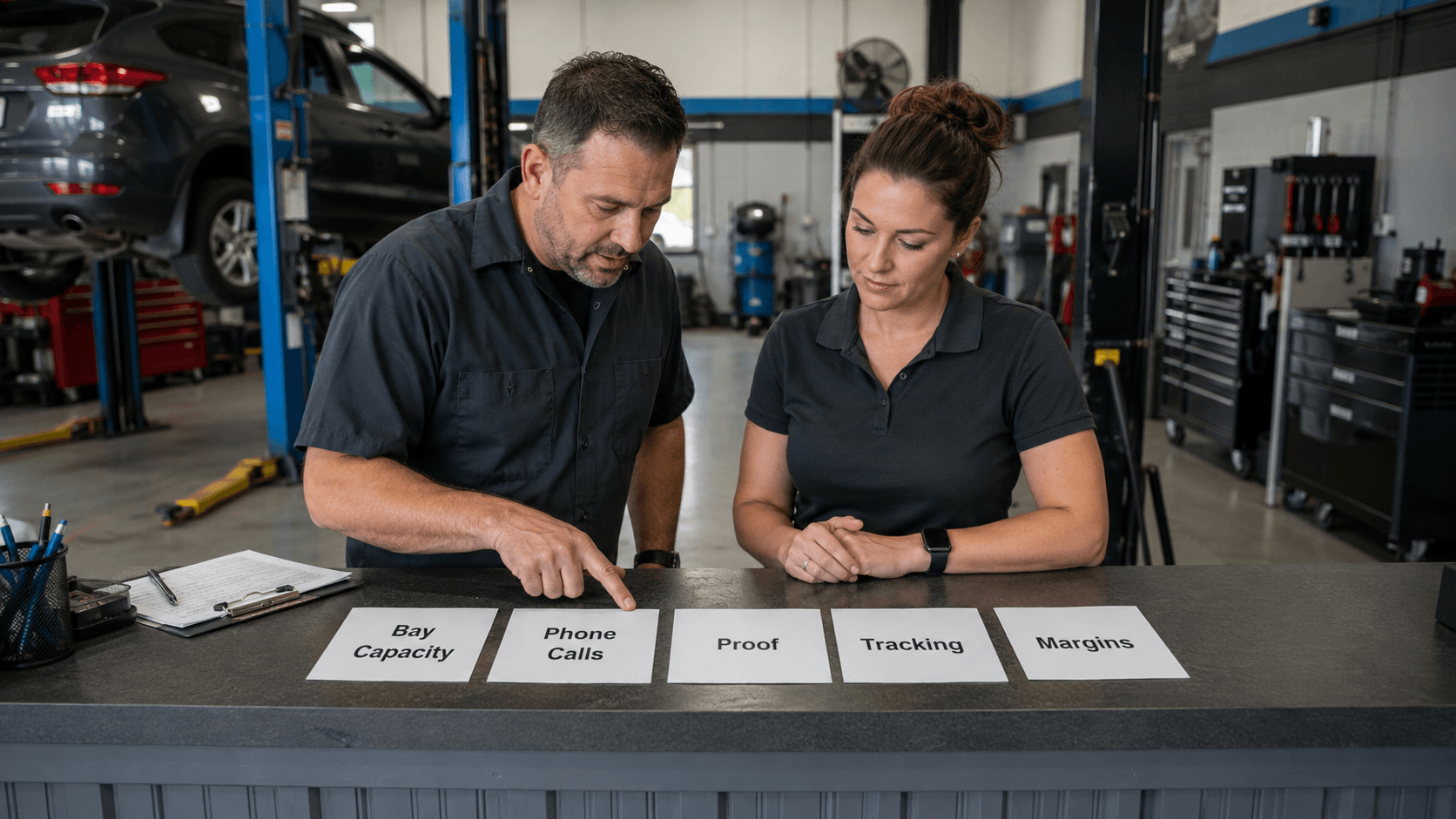
In this guide, on-site auto repair advertising means the readiness work inside the repair shop before more promotion goes live. It is not a guide to mobile mechanic services. Before putting more budget behind Google Ads, local promotions, direct mail, or another campaign, the owner needs to know whether the team can answer the calls, schedule the work, make a credible promise, and see what happened after the customer contacted the business. More leads do not fix a missed-call problem, a weak service page, or a bay schedule that is already full.
The question is not whether advertising can generate attention. It is whether the shop is ready to turn additional attention into the kind of booked repair work it wants. A diagnostic specialist with open capacity may be ready to promote diagnostics. A general repair shop with strong call volume but poor appointment conversion may need to fix intake before increasing spend. A full shop may need to protect the schedule instead of creating more urgent demand.
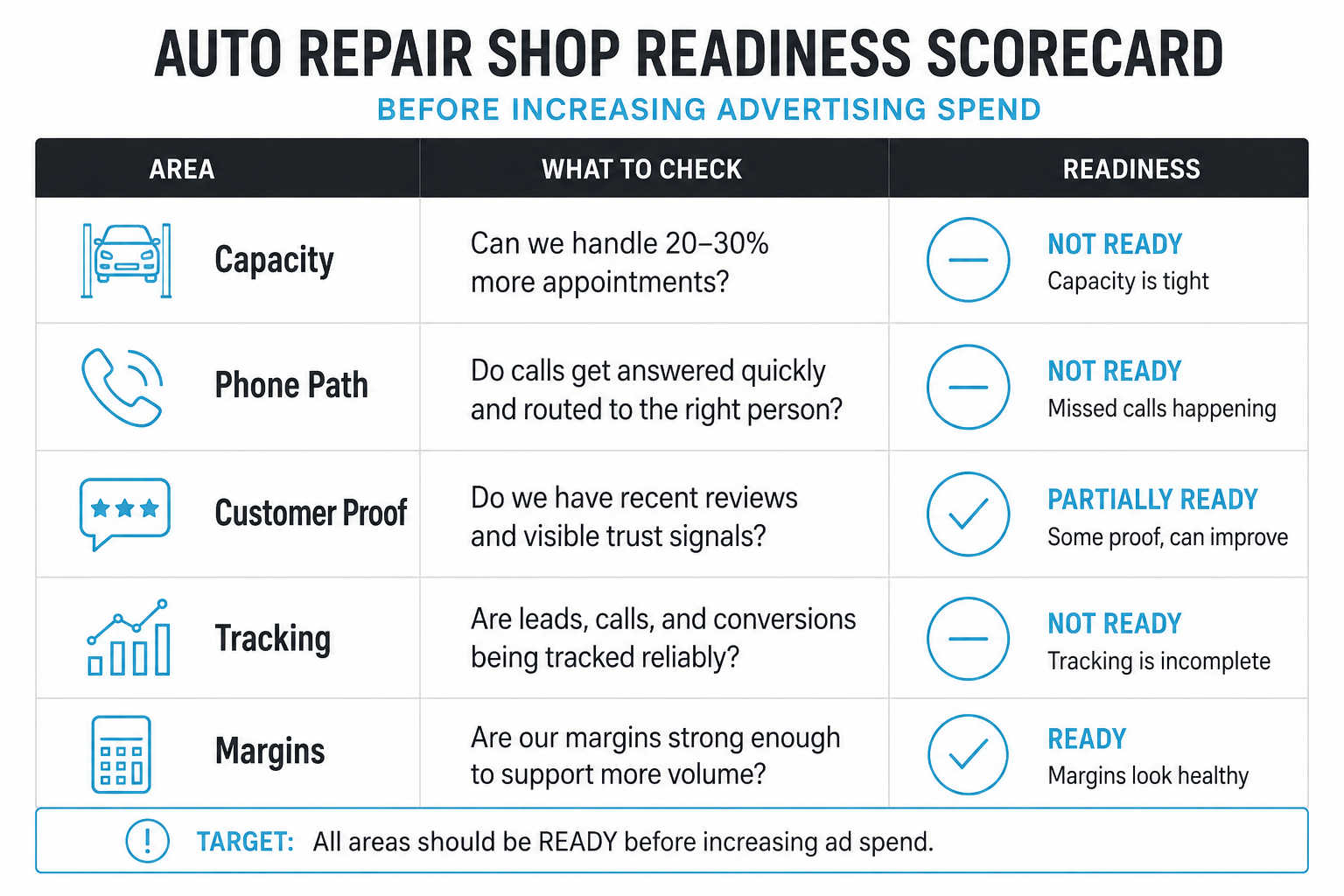
Use this readiness checklist before raising a campaign budget or launching a new advertising idea. It focuses on capacity, phones, reviews, tracking, margins, and the customer path from first search to completed job.
Contents:
- The Advertising Readiness Test
- 1. Start With Bay Capacity, Not an Advertising Budget
- 2. Check the Phone Path Before Paying for More Calls
- 3. Make Sure the Customer Can Verify the Promise
- 4. Track From Advertisement to Completed Job
- 5. Check Whether the Service Can Carry the Cost
- Choose the Right Advertising Test for the Constraint
- A 14-Day Readiness Sprint
- Common Signs the Shop Should Pause Advertising Growth
- FAQ
- Spend More Only When the Shop Is Ready
The Advertising Readiness Test
Score each area honestly. A shop does not need a perfect score to advertise, but a weak area should set the size and type of the next test.
| Readiness area | Ready signal | Fix before increasing spend |
|---|---|---|
| Bay capacity | The shop can name the services and appointment slots it can take this month. | Promoting a service with no near-term capacity or no clear scheduling path. |
| Phone and booking | Calls are answered or returned promptly, and outcomes are recorded. | Buying more calls while missed calls and unbooked inquiries are invisible. |
| Proof | The profile, service pages, reviews, and advisor language support the offer. | Using a promise the customer cannot verify or the team cannot deliver. |
| Tracking | The shop can connect source, qualified inquiry, booked job, and completed work. | Scaling based only on clicks, leads, or a general sense that business is busier. |
| Margins | The target service has enough gross profit to support the expected cost of acquisition. | Attracting low-margin work just because it generates volume. |
1. Start With Bay Capacity, Not an Advertising Budget
Advertising should promote work the shop can serve well now. Start by separating the work that creates open capacity from the work that creates a bottleneck. A shop with unused diagnostic time may need problem-based demand. A shop with a strong maintenance base may need carefully timed reminders. A shop that is already booked two weeks out should not run an urgent same-day message simply because the offer sounds attractive.
| Shop condition | Advertising fit | Do not promote yet |
|---|---|---|
| Open diagnostic capacity | Clear diagnostic message with an appointment path and realistic turnaround expectation. | A blanket discount that attracts unrelated price-only calls. |
| Open routine-maintenance slots | Relevant maintenance or seasonal check offer with an easy schedule option. | Complex repair work if the team cannot quote or schedule it promptly. |
| High demand but poor schedule control | Pause expansion and improve booking rules, callback process, and service triage. | More urgent ads that create another layer of missed or delayed calls. |
| Specialty capability | A focused message for the vehicle type or repair the team genuinely handles. | Broad claims that make every caller assume the shop handles every repair. |
2. Check the Phone Path Before Paying for More Calls
The first on-site advertising issue is often not the ad. It is what happens after the phone rings. A customer who cannot reach a person, get a callback, understand the next step, or find a suitable appointment is unlikely to wait for a better campaign. Review a sample of recent calls with the service advisor or manager before increasing spend.
- Can the team distinguish a qualified repair inquiry from a parts request, job inquiry, or out-of-area call?
- Does the advisor explain the next step for a diagnostic, estimate, routine service, or specialty inquiry consistently?
- Is there an owner for missed-call follow-up, and is the outcome recorded?
- Can the shop identify recurring objections such as timing, price expectations, service limits, or transportation?
For a source-by-source review of phone results, see automotive call tracking.
3. Make Sure the Customer Can Verify the Promise
A driver may see an ad, then look at the business profile, website, reviews, hours, and photos before contacting the shop. The information should answer the same basic questions: does the shop handle this repair, what does the first step look like, and why should the customer trust the call or booking request?
Keep the Business Profile accurate under Google’s Business Profile guidelines. Check services, hours, location details, photos, and contact information after changing a campaign or offer.
Reviews and photos work best as evidence of a real process, not decoration. If the campaign promotes clear diagnostic explanations, the service page, customer feedback, and phone team should be able to support that message. Claims about prices, speed, guarantees, or outcomes must be truthful and supportable under the FTC’s advertising guidance.
For the operational checklist behind local proof, use this Google Business Profile guide for auto repair shops.
4. Track From Advertisement to Completed Job
A lead is not the same as a booked job, and a booked job is not the same as completed work. Before increasing spend, decide how the shop will follow one customer path through the process. The goal is not a complicated dashboard. It is a repeatable record that helps the owner see whether the channel is creating the right work.
Set up Google Ads conversion measurement for relevant lead actions, then reconcile those actions with the shop’s booking and completed-work records.
| Stage | What to record | Question to answer |
|---|---|---|
| Source | Campaign, profile, direct mail code, referral, or other identifiable source. | Where did the inquiry start? |
| Qualified inquiry | Service requested, location fit, vehicle or repair need, and whether the shop can help. | Was this the kind of demand the campaign was meant to create? |
| Booked job | Appointment date, service expectation, and any requirement before arrival. | Did the phone path turn the inquiry into scheduled work? |
| Completed work | Completed service, gross profit, and whether the work fit capacity. | Was the campaign worth repeating or expanding? |
5. Check Whether the Service Can Carry the Cost
An increase in advertising spend needs a financial threshold. Use the margin for the service you are promoting, not a generic average repair order. The numbers below are only a worked example, not a benchmark for another shop.
| Input | Example | Decision use |
|---|---|---|
| Test cost | $1,800 | Include media, creative, tracking, and landing-page costs. |
| Gross profit per completed job | $225 | Use the repair type the campaign is intended to produce. |
| Break-even completed jobs | 8 jobs ($1,800 / $225) | Sets the minimum completed-work threshold. |
| Qualified-call to booked-job rate | 50% | Shows whether the message, intake, or offer needs revision. |
| Available capacity | 10 additional jobs | Prevents the campaign from creating work the shop cannot schedule. |
Use the Ads Revenue Calculator to model the shop’s own service mix, margin, and capacity before increasing a campaign budget.
Choose the Right Advertising Test for the Constraint
Once the readiness checks are in place, choose one test that fits the actual constraint. The point is to learn from a controlled change, not to launch every available channel at once.
| Constraint | Small advertising test | Success measure |
|---|---|---|
| Open bays for a defined service | Service-specific search message and matching landing path. | Qualified calls and completed jobs for that service. |
| Weak local trust | Accurate local profile, real proof, and a focused first-visit message. | Fewer basic objections and more suitable booking requests. |
| Underused past-customer base | Relevant maintenance, declined-work, or reactivation message. | Repeat appointments and completed work from the selected segment. |
| Specialty service with limited awareness | Narrow local message that explains capability and service limits. | Inquiries that fit the specialty and the shop’s service area. |
A 14-Day Readiness Sprint
- Choose one service or customer problem that matches current capacity.
- Review a sample of related calls and document the booking, missed-call, and objection patterns.
- Check the profile, landing path, reviews, hours, and advisor language against the proposed promise.
- Set the source, booked-job, completed-job, gross-profit, and capacity measures before launch.
- Run one focused test for 14 days, then review the same measures with the team before spending more.
Once the readiness checks are complete and the shop needs hands-on campaign management, review auto repair PPC advertising.
Common Signs the Shop Should Pause Advertising Growth
- The team cannot explain which services have open capacity or which work should be promoted.
- Missed calls, callbacks, and appointment outcomes are not assigned to anyone.
- The advertisement makes claims that the profile, service page, reviews, or advisor cannot support.
- Campaign performance is judged only by clicks, leads, or an increase in incoming calls.
- The target service has thin margin or creates a scheduling bottleneck that the shop has not planned for.
- Several channels are launched at once, leaving no clear way to identify the source of a result or problem.
FAQ
What is on-site auto repair advertising?
In this guide, on-site auto repair advertising means the shop-readiness work that has to happen before increasing promotion: capacity, phone handling, local proof, tracking, margins, and the booking process. Advertising works better when the customer path inside the shop is ready for the demand it creates.
When should an auto repair shop increase advertising spend?
Increase spend after the shop can identify available capacity, handle and record relevant inquiries, support the campaign promise with accurate proof, and measure qualified calls through completed work. Start with a controlled test before making a larger budget change.
How can a repair shop tell if advertising calls are valuable?
Record the source, requested service, qualification, appointment outcome, completed work, gross profit, and recurring objections. A valuable call fits the service mix and can become work the shop can deliver profitably.
Should a shop advertise when its bays are already full?
Usually the immediate priority is schedule control, service triage, and protecting the customer experience. Advertising may still be appropriate for a future booking window, a specific underused service, or retention work, but it should not create urgent demand the team cannot handle.
What should be fixed before running more auto repair advertising ideas?
Check capacity, call handling, proof, service-page clarity, review process, source tracking, and the margin of the work being promoted. Fix the weakest part of the customer path before adding another channel or offer.
Spend More Only When the Shop Is Ready
The right time to increase on-site auto repair advertising is when the shop can turn more attention into suitable booked work without creating new operational problems. Start with the capacity and phone path, make the promise verifiable, measure completed work, and then expand the channel that earns the next dollar.
For a broader set of marketing ideas once the readiness checks are complete, see auto repair shop marketing ideas.
Shops that need help connecting demand channels, customer paths, and call measurement can review auto repair lead generation.
When the readiness review reveals weak local visibility or service-page coverage, explore SEO for auto repair shops.