

12 Mechanic Shop Organization Ideas Customers Notice

Mechanic shop organization ideas are usually framed as storage advice: buy cabinets, label bins, and put sockets in order. Those steps help, but they miss the larger system. A customer sees the parking lot, entrance, counter, waiting area, and visible bay before they understand the quality of the repair. A technician experiences the same system through staging, parts flow, tools, chemicals, waste, and job status.
The best organization plan improves both sides. It reduces avoidable motion and confusion while creating visible proof that the shop is controlled, professional, and ready for the next vehicle. Use the same walkthrough as an auto shop safety and customer-trust audit.
Contents:
- Audit the Customer Path Before Buying Storage
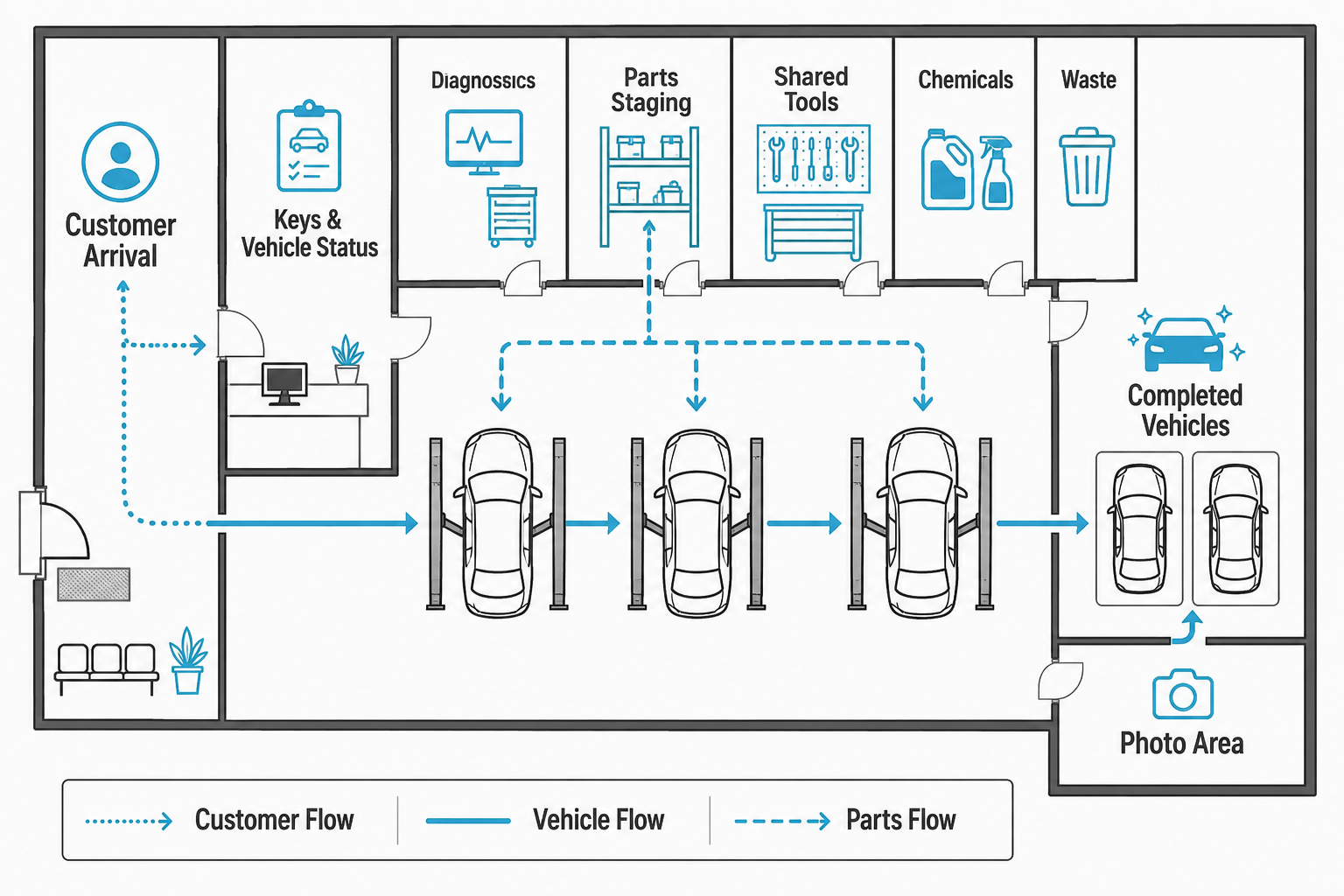
- Build the Shop Around Clear Zones
- Choose Layout Priorities by Shop Size
- Twelve Auto Shop Organization Ideas Worth Implementing
- Connect Physical Order to Digital Proof
- Run This Weekly Mechanic Shop Organization Audit
- A 30-Day Organization Reset
- Case Study Lesson: More Leads Expose Operational Disorder
- Frequently Asked Questions
- Make Control Visible
Audit the Customer Path Before Buying Storage
Walk the property as if you have never visited. Start from the road and move through arrival, check-in, waiting, vehicle handoff, payment, and exit.
Record anything that creates uncertainty:
- customers do not know where to park;
- the office door is difficult to identify;
- keys, estimates, and completed paperwork share one pile;
- old parts or disabled vehicles dominate the first view;
- the waiting area contains internal notices customers should not see;
- the service advisor has to leave the counter to find job status;
- the pickup route crosses an active work zone.
These are not only appearance problems. They create questions, interruptions, and inconsistent service. Fixing the path often costs less than installing new cabinetry.
Build the Shop Around Clear Zones
A useful zone has a defined purpose, an owner, and a reset rule. Start with tape and temporary signs before committing to permanent fixtures.
| Zone | Purpose | Reset rule |
| Arrival | Direct customers and vehicles to the right place | Clear signs and open marked spaces before opening |
| Check-in | Capture keys, concern, authorization, and contact preference | No unassigned keys or loose paperwork overnight |
| Vehicle staging | Separate waiting, in-process, blocked, and complete vehicles | Status must match the management system |
| Active bay | Hold only what the current job needs | Remove parts, tools, and waste after each job |
| Parts staging | Keep ordered, received, return, and core items distinct | Every item has an RO or supplier reference |
| Shared tools | Make location and availability obvious | Missing items are visible at close |
| Chemicals and waste | Control access, labels, and disposal flow | Inspect on a defined schedule |
| Customer proof | Keep one clean area ready for photos and handoff | Five-minute reset after use |
If a small shop cannot dedicate a room to each function, use shelves, floor markings, carts, and named locations. The objective is not more square footage. It is fewer ambiguous surfaces.
These mechanic shop organization ideas should be tested in a temporary layout first. A one-week trial will reveal whether a zone reduces travel and confusion or merely moves the same problem to a different wall. Most auto shop storage ideas fail when the shelf is chosen before the workflow. Practical mechanic shop storage ideas start with the item, point of use, access rule, and reset owner.
Choose Layout Priorities by Shop Size
The same zoning principles apply at different scales, but the first constraint changes with the facility.
| Shop type | First layout priority | Control to add first |
| Two-bay shop | Prevent tools, parts, and customer items from sharing one surface | Mobile job cart plus one labeled parts-staging shelf |
| Four- to six-bay shop | Separate vehicle states and reduce cross-bay travel | Marked staging rows, shared-tool home, and bay-level cart standard |
| Truck or fleet shop | Control larger vehicles, outside staging, and urgent arrivals | Traffic route, dispatch status, parts holding, and visible pickup zone |
| Mobile mechanic | Keep the vehicle safe, complete, and reset between jobs | Locked modules, job kits, spill response, and end-of-job inventory |
Twelve Auto Shop Organization Ideas Worth Implementing
1. Give every key a status
Use a secure key board or controlled drawer with clear stages: arrived, assigned, waiting for approval, ready for pickup, and completed. Do not rely on memory or a handwritten note attached to a key ring.
2. Separate parts by decision state
New parts for installation, removed parts for customer review, warranty returns, cores, and vendor returns should never share one undefined pile. Use labels that include the repair order, vehicle, date, and next action.
3. Put shared tools where the work occurs
Map the jobs that require each shared tool. Store it near the point of use without blocking safe movement. A visible outline or labeled location makes absence obvious and shortens end-of-day checks.
4. Create a red-tag holding area
When an item has no clear purpose, tag it with the date and owner instead of moving it from one shelf to another. Review the holding area weekly. Repair, relocate, sell, recycle, or dispose of each item according to shop policy and applicable rules.
5. Use one mobile cart standard
Define what belongs on a general job cart and how it is reset. Technicians can add specialty tools for a job, but the baseline arrangement should be consistent. This reduces the time spent rebuilding a workstation for routine work.
6. Establish clean and dirty sides
Keep customer-contact items, laptops, inspection devices, seat covers, and paperwork away from oily parts and waste. The distinction matters for efficiency and for the condition in which vehicles and documents are returned.
7. Make spills a workflow, not a surprise
Place appropriate spill materials where a release is likely, define who responds, and make replenishment part of the closing check. Safety decisions must reflect the products and hazards actually present in the shop.
8. Label secondary containers correctly
Do not replace required hazard information with a homemade shorthand that only one employee understands. OSHA’s Hazard Communication Standard addresses workplace labels, safety data sheets, and employee training for hazardous chemicals. Review federal, state-plan, fire-code, environmental, and local requirements that apply to the facility.
9. Protect walking and exit routes
Hoses, cords, tires, boxes, and removed components should not migrate into passageways. OSHA’s general walking-working surface requirements call for clean and orderly work areas, regular inspection, and correction or guarding of hazards. Treat organization as part of the safety system, not an after-hours cosmetic task.
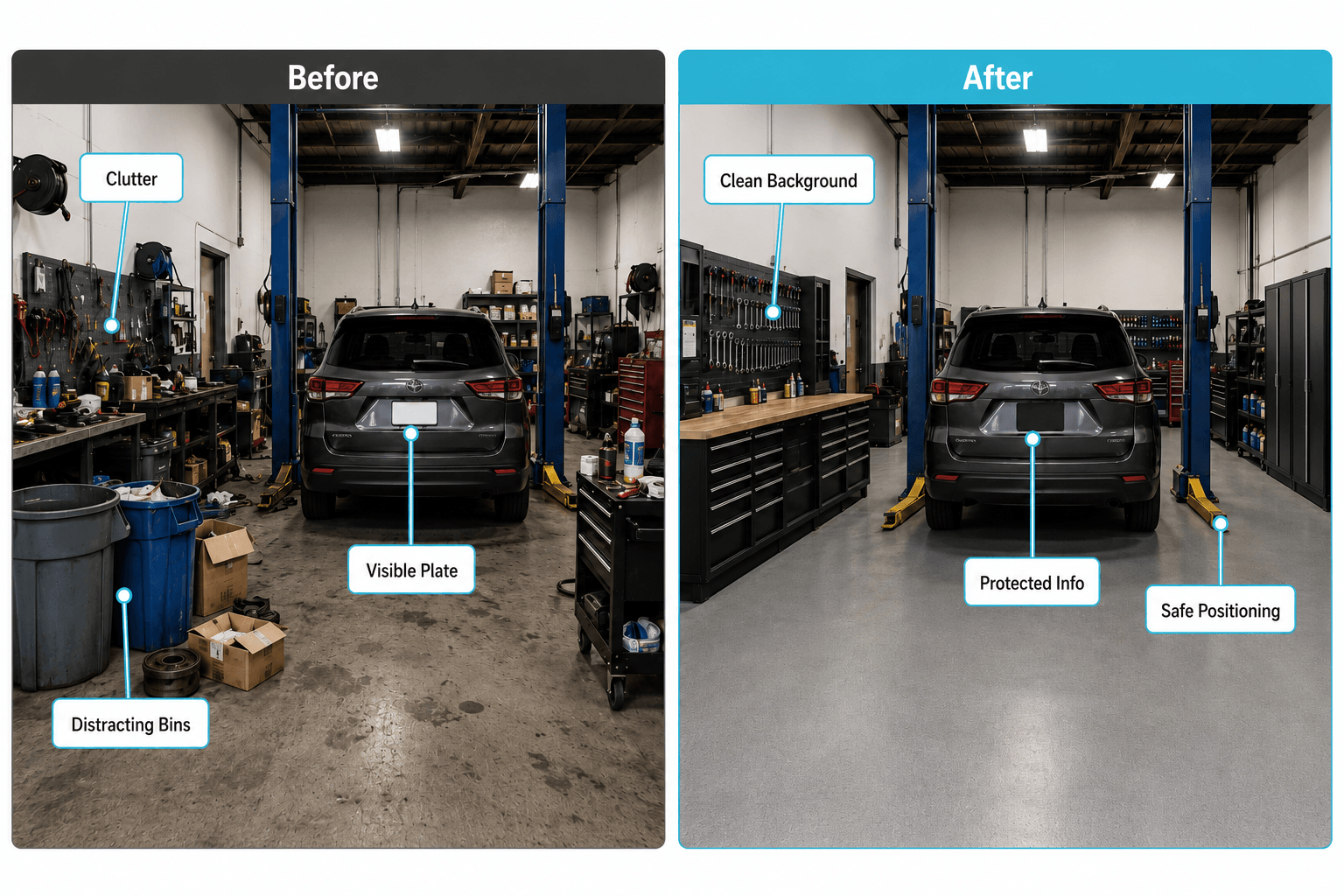
10. Create a five-minute photo area
Select one wall, bay angle, or exterior position where technicians can capture inspections, completed work, team images, and customer-approved delivery photos. Keep distracting bins, personal information, license plates, and unsafe activity out of frame.
That small standard improves the original photo library used on the website, Google Business Profile, estimates, and social content. It also gives the team a clear definition of “photo ready.”
11. Simplify the front counter
The customer-facing counter should support check-in and payment, not become storage for vendor catalogs, food, old promotions, and internal paperwork. Keep current authorization information and customer materials accessible, then move everything else to a named location.
12. End each day with a visible reset
Assign a short checklist by zone. The closing employee should be able to confirm that keys are controlled, vehicles have statuses, parts are identified, tools are returned, waste is handled, passages are open, and the first customer can be received without a morning cleanup.
Connect Physical Order to Digital Proof
Consistent signs, uniforms, estimates, and digital profiles also depend on a usable car repair shop logo system. When customer complaints reveal confusion or a failed handoff, use the negative review response examples to respond publicly while the operational cause is corrected.
Customers cannot evaluate diagnostic reasoning from a parking lot. They use visible signals: a clear entrance, consistent uniforms, organized check-in, clean photos, current reviews, and a website that explains the process.
Do not stage a misleading image of a spotless empty bay while the actual customer path remains confusing. Instead, document real improvements:
- photograph labeled staging and clean work areas;
- show the service advisor and technician handoff;
- explain how keys and approvals are controlled;
- publish team and equipment photos with customer information removed;
- keep business name, colors, signs, and uniforms consistent;
- connect proof to the relevant service page, not a generic gallery.
Element DMA’s auto shop website design work treats real shop proof as part of conversion. The website should show what the customer will actually experience.
Run This Weekly Mechanic Shop Organization Audit
Score each item 0 for failed, 1 for inconsistent, or 2 for controlled.
| Check | What good looks like | Score |
| Parking and entrance | First-time visitor knows where to go | 0-2 |
| Counter | Check-in surface is clear and current | 0-2 |
| Keys | Every key has an owner and status | 0-2 |
| Vehicles | Waiting, blocked, active, and complete are distinct | 0-2 |
| Parts | Every staged item has identification and next action | 0-2 |
| Shared tools | Home location is obvious | 0-2 |
| Passages | Walking and exit paths are clear | 0-2 |
| Chemicals | Labels, access, SDSs, and storage follow the shop program | 0-2 |
| Photo area | One location is ready for safe customer-facing content | 0-2 |
| Closing reset | Assigned owner completes the checklist | 0-2 |
Track the total weekly. A falling score should trigger a process review, not a one-time cleaning sprint.
A 30-Day Organization Reset
Days 1-3: observe
Photograph current conditions for internal use. Record where employees search, walk back, wait, interrupt, or create temporary piles. Ask each role to name the three most common organization failures.
Days 4-7: define zones
Map the customer path, vehicle states, parts flow, shared tools, chemicals, waste, and photo area. Assign one owner to each zone. Use temporary labels and floor markings.
Week 2: remove ambiguity
Create locations for unassigned keys, blocked jobs, parts returns, cores, removed parts, and red-tagged items. Standardize the front counter and one job cart before expanding to the whole shop.
Week 3: standardize
Write short reset rules with photos of the expected condition. Confirm that safety, environmental, and fire-code requirements are handled by qualified people rather than improvised from a general article.
Week 4: sustain and publish proof
Run the scorecard, correct repeated failures, and capture accurate customer-facing photos. Update the website and profiles only after the physical standard is real.
Case Study Lesson: More Leads Expose Operational Disorder
The Truck Pit Stop case study reports call growth from 53 in January to 303 in August, along with an operational bottleneck: unanswered calls. That case is about digital lead generation, not tool storage. It demonstrates a larger point about organization: growth magnifies weak handoffs.
A shop can have labeled drawers and still lose customers if incoming calls, keys, estimates, approvals, or completed jobs have no clear owner. Physical organization and information flow should be reviewed together.
Frequently Asked Questions
What should I organize first in a mechanic shop?
Start with safety-critical areas and the customer path, then control keys, vehicle status, parts staging, shared tools, chemicals, and waste. The most useful mechanic shop organization ideas define the workflow before the shop buys storage.
How do I keep technicians from abandoning a new system?
Design it with the people doing the work, reduce travel and searching, make the expected condition visible, and keep reset tasks short. A system that adds steps without removing friction will not last.
Are shadow boards useful in an auto repair shop?
They are useful for shared tools when quick visual control matters. They are less useful when they force technicians to walk away from the point of use or when the tool set changes constantly.
Can shop organization improve customer reviews?
It can improve the experience customers describe: easier arrival, cleaner handoff, clearer communication, and more confidence. Do not ask for reviews that mention conditions customers did not actually observe. A structured reputation management program should follow real service improvements.
How often should the shop be audited?
Use a short closing reset daily and a scored walkthrough weekly. Review the layout again when staffing, services, equipment, or vehicle volume changes.
Make Control Visible
Useful mechanic shop organization ideas create a place, owner, and reset rule for every important stage. The result should be safer movement, faster handoffs, cleaner customer-facing proof, and less dependence on one employee’s memory.
Once the physical experience is accurate and repeatable, Element DMA can help translate that proof into a stronger website, reputation system, and brand presentation. Marketing works better when it documents a controlled shop instead of trying to disguise an uncontrolled one.