

Auto Repair Shop Email Marketing: 12 Campaigns Beyond Coupons
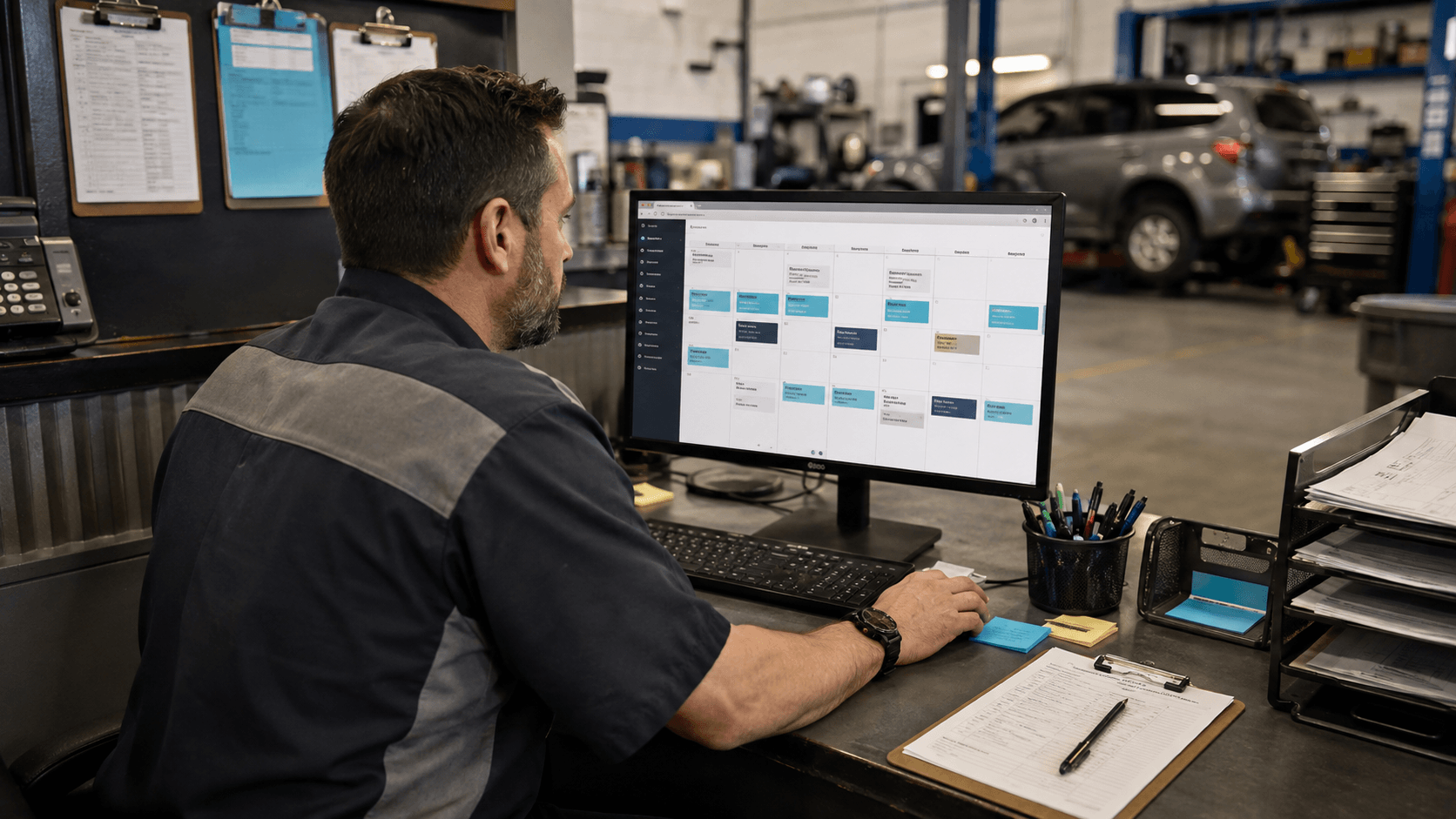
Auto repair shop email marketing should not be a monthly coupon sent to every address in the database. A useful program connects a customer, a vehicle, a service event, and a reasonable next step. The message may remind someone about declined work, prepare a first-time customer for a visit, explain seasonal risk, or reactivate a relationship that has gone quiet.
This article focuses on campaign strategy and messaging. It complements automation, but it does not repeat the question of which workflow triggers to build. The goal here is to decide what to send, to whom, and how to measure whether the email produced booked and completed work.
For trigger logic, data handoffs, and automation guardrails, use the companion guide to marketing automation for auto shops.
Contents:
- Prepare the Minimum Useful Data
- Twelve Campaigns Beyond Coupons
- Use These 12 Subject Lines as Starting Points
- Complete This Campaign Brief Before Sending
- Campaign 1: Welcome Without Selling Again
- Campaign 2: Follow Up on Declined Work With Context
- Campaign 3: Reactivate Without Assuming the Vehicle
- Build Segments Around Decisions, Not Demographics
- Use Offers Without Training Customers to Wait
- Set a 90-Day Campaign Rhythm
- Measure Completed Revenue, Not Open Rate Alone
- Keep the Program Legal and Deliverable
- Case Study Lesson: Email Cannot Fix an Unowned Lead
- Frequently Asked Questions
- Build Campaigns Around the Next Useful Decision
Prepare the Minimum Useful Data
Do not wait for a perfect database. Start by identifying records that are safe and useful enough to segment.
| Field | Why it matters | Common cleanup issue |
| Customer name | Supports a normal greeting | All-caps names or household duplicates |
| Email address | Provides the delivery destination | Typos, shared addresses, old records |
| Vehicle | Makes the message relevant | Missing year, make, model, or duplicate vehicle |
| Last visit | Separates active from lapsed customers | Visits stored under another household member |
| Completed services | Prevents irrelevant promotion | Generic labor descriptions |
| Declined work | Supports specific follow-up | No reason, urgency, or estimate date |
| Preferred shop/location | Prevents routing confusion | Multi-location records merged together |
| Marketing status | Respects opt-outs and list rules | Transactional and promotional consent mixed |
Suppress hard bounces, unsubscribed contacts, obvious duplicates, employee tests, and records that cannot be connected to the correct customer. Never buy a generic email list and treat it like a customer database.
Twelve Campaigns Beyond Coupons
The following campaign matrix gives each email one job.
A practical auto repair shop email marketing calendar should use only the campaigns supported by clean data and available shop capacity. Twelve options are provided so the owner can choose, not so every customer receives twelve messages.
| Campaign | Audience and timing | Message angle | Primary action |
| New-customer welcome | After first completed visit | What to expect, how records are kept, how to reach the shop | Save contact details |
| Post-visit care | 1-3 days after service | Service-specific care and what changes should prompt a call | Ask a question |
| Declined-work follow-up | Based on recorded recommendation | Restate the item, reason, estimate context, and next step | Review or schedule |
| Estimate check-in | After an unapproved estimate | Offer clarification without pressure | Reply or call |
| Seasonal readiness | Before local weather changes | Vehicle-specific risk and limited checklist | Book inspection/service |
| Mileage or time reminder | Near a documented interval | Explain why the service is due for this vehicle | Choose an appointment |
| Lapsed-customer reactivation | No visit for a defined period | Make returning easy and verify current vehicle | Update and book |
| New service announcement | Relevant customers only | Explain who the service is for and what problem it solves | View service details |
| Parts or equipment update | Owners of affected vehicle types | Explain new capability without hype | Ask about fit |
| Educational diagnostic email | Segment with a symptom or vehicle pattern | Explain warning signs and decision thresholds | Request diagnosis |
| Loyalty milestone | After a real visit or spend milestone | Recognize the relationship and explain the benefit | Use earned benefit |
| Community or shop update | Customers in the relevant area | Useful schedule, event, staffing, or location information | Confirm details |
These are campaign concepts, not permission to email everyone. The audience definition is as important as the copy.
Use These 12 Subject Lines as Starting Points
Personalize the vehicle and service details, then test clarity before cleverness. A subject line should describe the message rather than manufacture urgency.
| Campaign | Subject line |
| New-customer welcome | Your service records at [Shop Name] |
| Post-visit care | A quick follow-up on your [Vehicle] |
| Declined work | Your [Vehicle] recommendation from [Date] |
| Estimate check-in | Questions about your [Service] estimate? |
| Seasonal readiness | Is your [Vehicle] ready for [Season]? |
| Mileage or time reminder | Your next service step for [Vehicle] |
| Reactivation | Is [Vehicle] still in your driveway? |
| New service | We now service [Vehicle/Service Type] |
| Capability update | A new option for [Service] at [Shop Name] |
| Diagnostic education | What [Warning Sign] can mean for your vehicle |
| Loyalty milestone | You reached a service milestone with us |
| Shop update | An important update from [Shop Name] |
Complete This Campaign Brief Before Sending
| Field | Decision to document |
| Audience | Exact customer and vehicle segment |
| Trigger | Visit, date, mileage, recommendation, or inactivity rule |
| Message | One useful reason for contacting the customer |
| Offer | None, earned benefit, bundle, or transparent limited offer |
| CTA | Reply, call, review estimate, or request appointment |
| Attribution | Link, reply tag, booking source, offer code, and matchback window |
| Owner | Person responsible for replies, booking, and reporting |
Campaign 1: Welcome Without Selling Again
A customer who just completed a repair does not need an immediate discount. The first email should reduce future friction.
Subject: Your records at [Shop Name]
Hi [First Name],
Thank you for trusting us with your [Year Make Model]. We have saved the service history from your visit on [Date]. If a question comes up about the work, reply to this email or call [Number].
We will use the vehicle information on file to make future reminders more relevant. You can request an appointment at [Booking Link] and update your communication preferences at any time.
[Advisor Name]
This message makes the relationship easier without inventing urgency.
Campaign 2: Follow Up on Declined Work With Context
Generic wording such as “Your car needs service” sounds automated and may create distrust. Use the recommendation recorded at the shop.
Subject: A follow-up on your [Vehicle] recommendation
Hi [First Name],
During your [Date] visit, we recommended [Service/Repair] because [brief factual reason from inspection]. You chose not to complete it at that visit, so we wanted to make sure you still have the estimate and know how to reach us with questions.
The original estimate was [Amount or “attached”]. Conditions can change, so we may need to recheck the vehicle before confirming current pricing or urgency.
[Review Estimate] [Request Appointment]
Do not turn a technician note into a frightening claim. If a condition may be safety-critical, follow the shop’s documented communication and escalation process rather than relying on a promotional email.
Campaign 3: Reactivate Without Assuming the Vehicle
Lapsed records are often stale. The customer may have moved, sold the vehicle, or started servicing another car.
Subject: Is [Vehicle] still in your driveway?
Hi [First Name],
It has been a while since we last saw your [Year Make Model]. If you still own it, reply with the current mileage and we can help identify what may be due based on the history we have.
If the vehicle has changed, update your record here so future messages stay relevant. If you no longer want repair reminders, you can unsubscribe below.
This message invites a low-friction response instead of using a broad discount to buy attention.
Build Segments Around Decisions, Not Demographics
Age and ZIP code may help in some contexts, but repair decisions are usually better informed by vehicle and service history. Start with segments such as:
- first visit completed in the past 30 days;
- open declined work by service category and date;
- no completed visit in 9-15 months;
- owners of vehicles affected by a seasonal service need;
- customers with a specific service completed previously;
- households with more than one vehicle;
- customers who engaged but did not request an appointment;
- customers who booked, completed, canceled, or did not show.
Keep high-risk assumptions out of the copy. A record showing an older vehicle does not prove a component is failing. A past brake recommendation does not prove the current condition. Use customer data to improve relevance, then leave diagnosis to inspection.
Use Offers Without Training Customers to Wait
An offer should change a decision that benefits both customer and shop. It should not become the only reason the list pays attention.
Useful offer structures include:
- an earned loyalty benefit after a defined milestone;
- a bundled seasonal service with clear inclusions;
- a limited new-customer follow-up tied to a first visit;
- a slow-capacity offer limited to services the shop wants to perform;
- a diagnostic or inspection offer with transparent terms.
Avoid permanent percentage discounts, vague “free” claims, and offers that fill bays with low-margin work while higher-value jobs wait. Confirm availability, exclusions, expiration, and whether the front counter can apply the offer consistently.
Set a 90-Day Campaign Rhythm
The exact calendar should follow local climate, shop capacity, and customer data. This sample avoids sending a promotion every week.
| Week | Campaign | Segment | Decision metric |
| 1 | New-customer welcome | Recent first visits | Replies and booking-page visits |
| 2 | Declined-work follow-up | Recent recommendations | Approved and completed ROs |
| 4 | Educational diagnostic email | Relevant vehicle/service segment | Diagnostic appointments |
| 6 | Seasonal readiness | Eligible active customers | Booked seasonal work |
| 8 | Lapsed-customer reactivation | 9-15 month inactive | Returning completed ROs |
| 10 | Service-specific education | Prior related service | Qualified requests |
| 12 | Shop update or loyalty milestone | Relevant active customers | Responses and redemptions |
Continue transactional appointment, estimate, invoice, and pickup messages according to the shop workflow. Promotional campaigns should not obscure service communication.
Measure Completed Revenue, Not Open Rate Alone
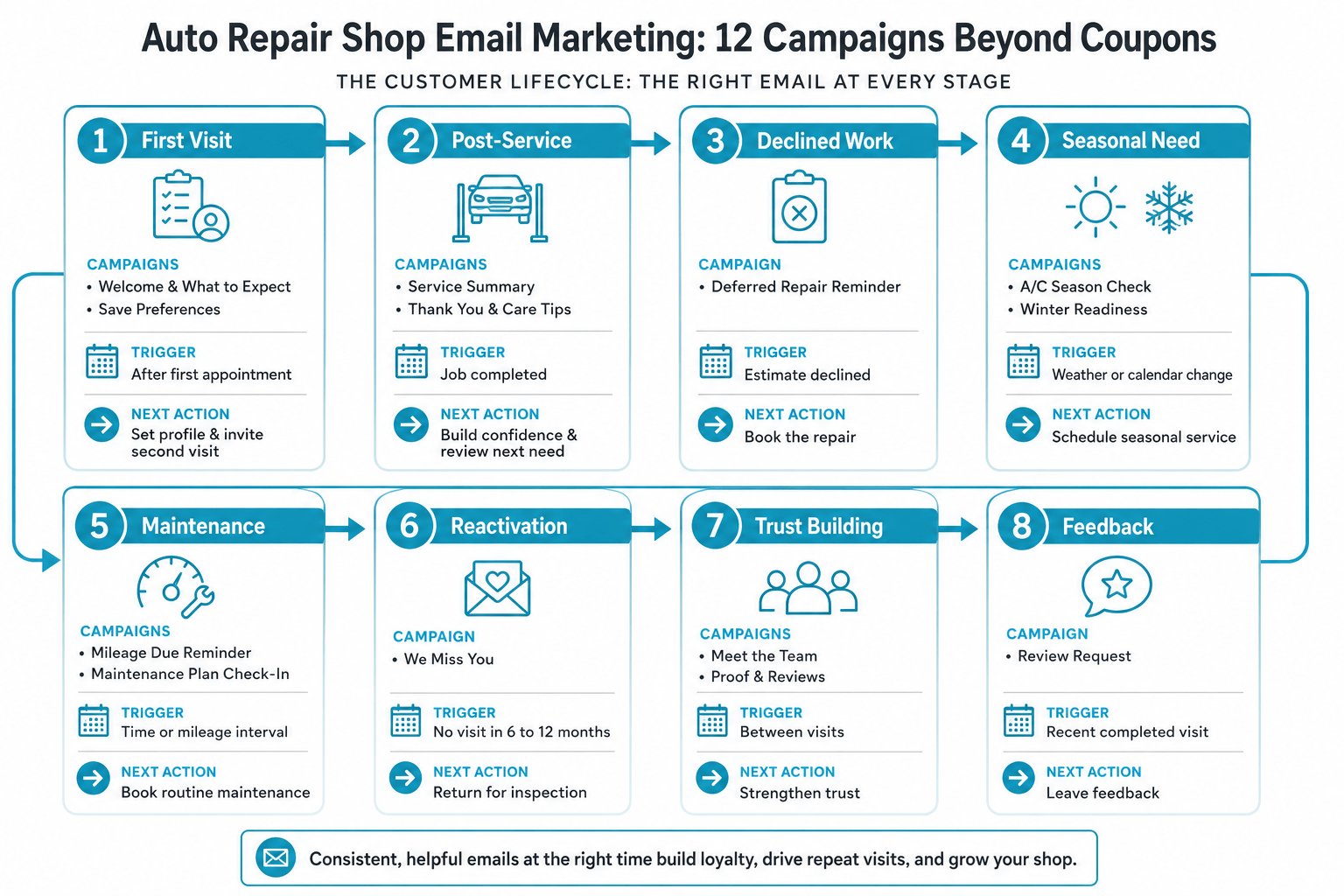
Open data can be noisy and does not tell the owner whether the campaign created work. Track the path from delivered message to completed repair order.
Use these campaign metrics:
- delivered emails;
- unique clicks or meaningful replies;
- appointment requests;
- booked appointments;
- arrived vehicles;
- completed repair orders;
- campaign-attributed revenue;
- campaign-attributed gross profit when reliable;
- unsubscribes, spam complaints, and bounces.
Simple campaign economics:
Campaign contribution = attributed gross profit – campaign cost – offer cost
Cost per completed RO = total campaign cost / completed campaign ROs
Do not count every customer who received an email and later visited. Use campaign links, booking source, reply tags, offer codes, or a defined matchback window. Document the attribution rule before reviewing the result. Element DMA’s marketing ROI calculator can support the math, but clean source data still matters.
Keep the Program Legal and Deliverable
In the United States, commercial email must follow the CAN-SPAM Act. The FTC’s compliance guide covers accurate sender information, non-deceptive subjects, a valid postal address, a clear opt-out method, and timely handling of opt-out requests. State laws and rules in other jurisdictions may add requirements; obtain legal advice for the markets and data practices that apply to the shop.
Deliverability also depends on technical setup and recipient behavior. Google’s current email sender guidelines address authentication, spam rates, and additional requirements for high-volume senders, including one-click unsubscribe for marketing messages. Configure SPF, DKIM, and DMARC with qualified technical support, use a domain the business controls, and monitor bounces and complaints.
Do not hide the unsubscribe link, send from a misleading identity, or continue marketing after an opt-out. A smaller responsive list is more useful than a large list that damages sender reputation.
Case Study Lesson: Email Cannot Fix an Unowned Lead
The Big Boys Body Shop case study reports that about eight calls were missed because owners were unavailable and workers did not answer. The published case is about paid search, website development, and tracking, not email performance. Its operational lesson applies directly: a follow-up channel needs an owner.
An email after a missed call can recover some opportunities, but only if the system captures the address, sends the right message, alerts a responsible person, and records the outcome. Element DMA’s EGL AI system is a natural fit when the business needs lead sources, handoffs, follow-up, call analysis, and reporting connected rather than managed as isolated campaigns.
Frequently Asked Questions
How often should an auto repair shop send marketing emails?
Auto repair shop email marketing frequency should follow relevance and capacity. Many shops can start with one or two segmented promotional or educational sends per month while lifecycle messages run from actual service events. Monitor complaints, unsubscribes, and booked work.
What is the best auto repair email marketing campaign?
There is no universal winner. Declined-work follow-up, first-visit onboarding, seasonal service, and lapsed-customer reactivation are strong starting points because each connects to a specific customer decision.
Should email and text messages say the same thing?
No. Use email for context, education, estimates, and messages that benefit from detail. Use text for short time-sensitive updates when the customer has given the required permission and the message fits applicable rules.
Should a shop buy an auto repair shop email list?
No. Purchased lists lack a service relationship, produce poor relevance, increase compliance and deliverability risk, and do not contain the vehicle history needed for useful segmentation.
How do I prove email revenue?
Track campaign links, replies, booking source, appointments, arrived vehicles, and completed repair orders. Set an attribution window and compare gross profit with campaign and offer cost. Do not stop at opens and clicks.
Build Campaigns Around the Next Useful Decision
Effective auto repair shop email marketing starts with the customer’s actual relationship to the shop. Clean the minimum data, define narrow segments, give every message one job, and connect the result to completed repair orders.
When the database, campaign, booking path, calls, and follow-up live in separate systems, reporting becomes guesswork. Element DMA can help design the retention campaigns and connect them to the broader lead and customer workflow so the shop knows which messages create useful conversations and completed work.