

Auto Repair Shop Business Plan: The Numbers Marketing Must Support

An auto repair shop business plan should explain how the operation turns technician capacity, parts, customer demand, and working capital into sustainable cash flow. A document that only describes “quality service” and lists marketing channels is not a plan. It is a collection of intentions.
This guide provides a practical structure for a startup, acquisition, expansion, or annual operating plan. It emphasizes the numbers marketing must support: repair orders, average repair order, gross profit, allowable customer acquisition cost, retention, and the capacity to complete the work being sold. Published auto repair business plan examples can help with section order, but their financial assumptions should never be copied into a real shop forecast.
Contents:
- Choose the Plan for the Decision
- Complete This One-Page Shop Snapshot First
- Copy This Financial Model Into Google Sheets
- Build the Revenue Model From Capacity
- Define the Market in Terms the Shop Can Serve
- Define Services by Economics and Strategic Role
- Model Gross Profit Before Marketing Spend
- Calculate the Repair Orders Marketing Must Create
- Set an Allowable Customer Acquisition Cost
- Build a Channel Plan With Leading and Lagging Metrics
- Use Three Scenarios Instead of One Forecast
- Plan Startup and Expansion Costs Separately
- Write the Nine Core Sections
- Case Study Lesson: Use Real Channel Data as an Input, Not a Benchmark
- Review the Plan Monthly
- Frequently Asked Questions
- Make the Plan Operable
Choose the Plan for the Decision
The U.S. Small Business Administration distinguishes between traditional and lean formats. Its business plan guidance notes that lenders commonly request a detailed traditional plan, while a lean plan can summarize the most important elements for a simpler or frequently changing business.
Use a traditional plan when you are seeking financing, buying a shop, signing a major lease, adding equipment, or presenting projections to a partner. Use a lean operating plan when the business is established and the immediate need is to align the owner, manager, service advisors, and marketing team.
When an owner searches for a business plan for auto repair shop financing, generic templates often overemphasize narrative and understate capacity. A lender-facing document still needs the standard sections, but repair-order and production math should drive the forecast.
The underlying math should agree in both versions.
Complete This One-Page Shop Snapshot First
Fill this out before writing the executive summary.
| Planning input | Your answer |
| Shop model | General repair, specialty, body, diesel, mobile, fleet, or mixed |
| Service area | Core ZIP codes, drive-time radius, fleet territory |
| Facility | Bays, lifts, parking, storage, office, lease constraints |
| Team | Technicians, advisors, manager, admin, planned hires |
| Capacity | Available and realistically billable hours per month |
| Job mix | Services to grow, maintain, limit, or stop marketing |
| Current economics | Monthly ROs, ARO, labor sales, parts sales, gross profit |
| Demand | Existing customers, local search, referrals, fleet accounts |
| Growth constraint | Leads, calls, approvals, technicians, parts, bays, cash, or process |
| 12-month decision | Open, stabilize, expand, reposition, acquire, or prepare to sell |
This snapshot prevents a common planning failure: asking marketing to create more demand when the actual constraint is staffing, parking, parts flow, estimate approval, or call handling.
Copy This Financial Model Into Google Sheets
Create three columns in Google Sheets: Metric, Formula, and Shop Assumption. Replace every example with verified shop data and keep conservative, base, and growth versions on separate tabs.
| Metric | Formula | Atlas example |
| Available labor hours | Technicians x workdays x available hours | 3 x 22 x 8 = 528 |
| Billed labor hours | Available hours x realistic billed-hour rate | 528 x 75% = 396 |
| Labor sales | Billed hours x effective labor rate | 396 x $140 = $55,440 |
| Total revenue | Labor + parts + sublet and other sales | $55,440 + $42,000 = $97,440 |
| Average repair order | Total revenue / completed ROs | $97,440 / 240 = $406 |
| Revenue gap | Target revenue – current revenue | $110,000 – $97,440 = $12,560 |
| Required additional ROs | Revenue gap / expected incremental ARO | $12,560 / $450 = 28 |
| Maximum acquisition spend | Target new completed ROs x allowable CAC | 28 x $85 = $2,380 |
Use the sample auto repair marketing plan to turn the resulting demand target into a 12-month channel calendar, then test spend with the marketing ROI calculator.
Build the Revenue Model From Capacity
Use two views and reconcile them.
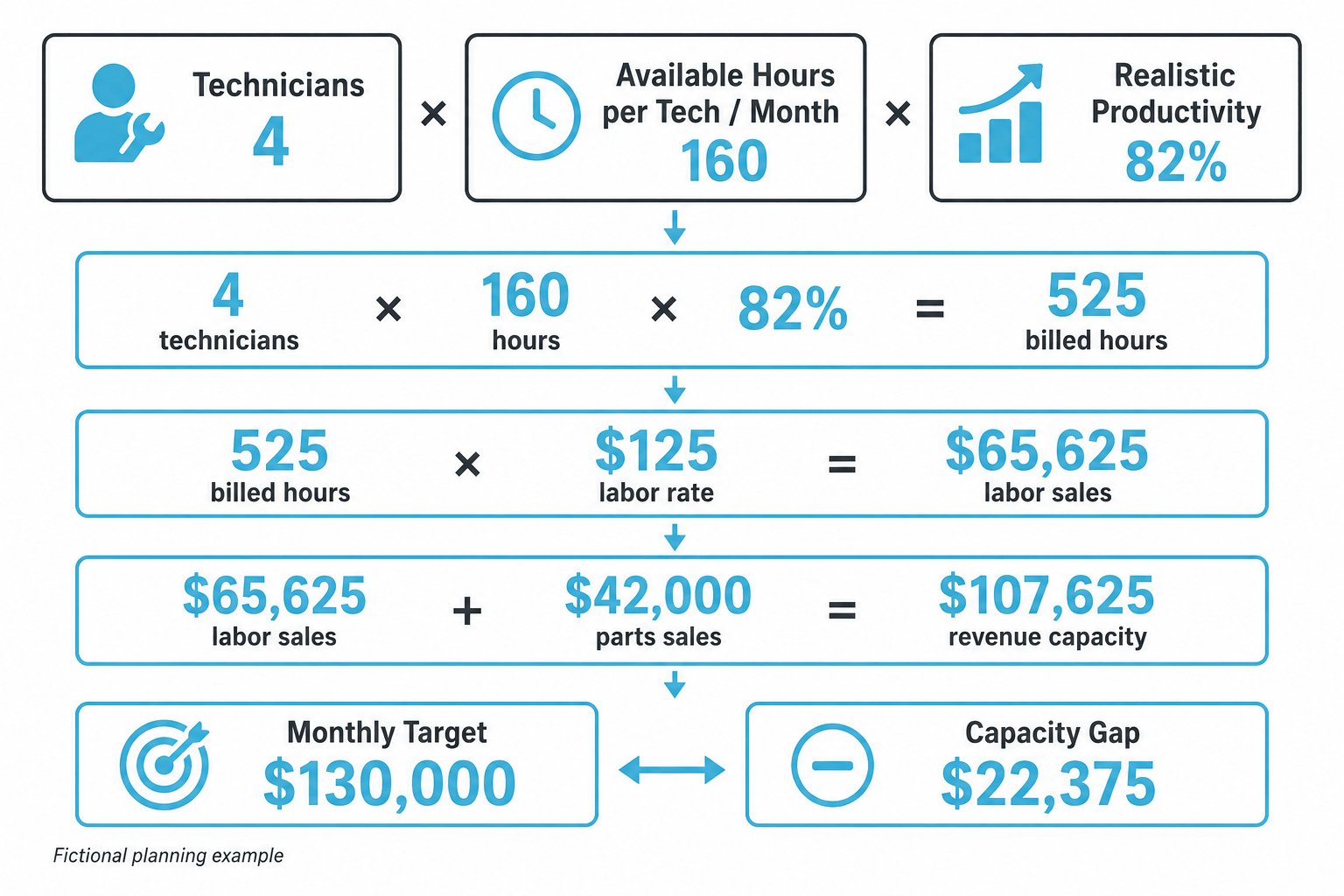
Repair-order view:
Monthly revenue = completed repair orders x average repair orderProduction view:
Monthly revenue = labor sales + parts sales + sublet and other salesThe repair-order view is easy to communicate. The production view reveals whether the target is physically and operationally plausible.
Fictional example: Atlas Auto Service
Atlas is a fictional three-technician general repair shop operating 22 days per month. It is used for planning illustration, not as a benchmark.
- Realistically billed labor hours: 396 per month
- Effective labor rate: $140
- Labor sales: 396 x $140 = $55,440
- Parts and sublet sales: $42,000
- Modeled monthly revenue: $97,440
- Completed repair orders: 240
- Modeled ARO: $97,440 / 240 = $406
If the owner writes a $130,000 monthly target without changing technicians, billed hours, job mix, pricing, parts sales, or capacity, the plan has no operational bridge to the goal.
Use Element DMA’s mechanic labor rate calculator to test labor assumptions, then verify them against the shop’s financial and management-system data.
Define the Market in Terms the Shop Can Serve
“Everyone who owns a car” is not a target market. Define demand by geography, vehicle type, service need, and customer behavior.
For a general repair shop, useful questions include:
- How far will a customer travel for routine maintenance versus a specialty repair?
- Which vehicle makes and age bands are common in the service area?
- Which services have enough local demand and fit the shop’s equipment and technicians?
- Which competitors dominate paid search, Maps, organic results, fleets, or referrals?
- What trust signals do strong competitors show before a customer calls?
- Which customer groups create scheduling, parts, warranty, payment, or margin risk?
Use the SBA’s market and competitive analysis guidance to structure primary and secondary research. Validate assumptions with actual calls, estimates, lost-job reasons, customer ZIP codes, vehicle data, and local search results.
Define Services by Economics and Strategic Role
A service menu belongs in the plan only when it connects to operations and economics.
| Service role | Planning question | Marketing treatment |
| Capacity anchor | Does it keep the right technicians and equipment productive? | Maintain predictable demand |
| High-value specialty | Is demand sufficient and is the shop qualified to deliver? | Build focused service pages and campaigns |
| Entry service | Does it create profitable future relationships? | Control offer and follow-up |
| Low-fit work | Does it create delays, comebacks, or weak margin? | Exclude or reduce promotion |
| Fleet service | Can the shop meet response, billing, and account requirements? | Use account-based outreach |
Do not market every possible job equally. The plan should state which work the business wants more of and why.
Model Gross Profit Before Marketing Spend
Revenue alone cannot fund payroll, occupancy, equipment, software, insurance, debt, and owner compensation. Build separate assumptions for labor, parts, tires, sublet, and other categories. Use the accounting definitions accepted by the shop’s bookkeeper or CPA and keep them consistent across historical and forecast periods.
For each scenario, show:
- revenue by category;
- direct cost by category;
- gross profit dollars and percentage;
- fixed operating expenses;
- debt service and capital expenditure;
- taxes and owner compensation assumptions;
- ending cash.
Avoid copying gross-margin percentages from a sample plan. Supplier terms, labor model, discounts, comebacks, warranty work, and service mix make each shop different.
Calculate the Repair Orders Marketing Must Create
Start with the revenue gap, then test capacity.
Required additional ROs = monthly revenue gap / expected incremental ARO
For fictional Atlas:
- Current modeled revenue: $97,440
- Target revenue: $110,000
- Revenue gap: $12,560
- Expected incremental ARO: $450
- Required additional completed ROs: $12,560 / $450 = 27.9, rounded up to 28
Now ask whether the shop can complete 28 more repair orders without extending cycle time, lowering quality, or overwhelming the front counter. If not, the plan may need higher-value job mix, better estimate approval, a hire, schedule changes, or a phased demand target before more lead generation.
Set an Allowable Customer Acquisition Cost
The plan needs an economic ceiling, not a generic rule that marketing should equal a fixed percentage of revenue.
Allowable first-visit CAC depends on:
- first-visit gross profit;
- expected repeat behavior;
- retention period;
- contribution after variable service and fulfillment costs;
- cash timing;
- confidence in attribution.
For a conservative launch, the owner may choose to recover acquisition cost from first-visit gross profit. An established shop with reliable retention data may intentionally accept a higher first-visit CAC. Document the rule and review actual cohorts instead of assuming every new customer has the same lifetime value.
Marketing capacity formula: Maximum acquisition spend = target new completed ROs x allowable CAC
If Atlas needs 28 additional ROs and sets a provisional allowable CAC of $85, the modeled acquisition budget is $2,380. That number is a fictional planning assumption. The real shop must replace it with its own gross-profit, close-rate, retention, and cash data.
Build a Channel Plan With Leading and Lagging Metrics
| Channel | Leading metric | Business metric |
| SEO and service pages | Qualified organic calls and forms | Completed ROs and gross profit |
| Google Business Profile | Calls, direction requests, booking actions | New-customer completed ROs |
| Paid search | Qualified calls and booked appointments | Cost per completed RO |
| Email retention | Replies, booking requests, reactivations | Repeat completed ROs |
| Reputation | Review requests and response coverage | Conversion and customer feedback trends |
| Referral or fleet outreach | Qualified conversations and proposals | Active accounts and contribution |
Call volume is not the final outcome. Use call tracking for auto repair to connect sources with conversations, then connect qualified opportunities to booked, arrived, and completed work.
Use Three Scenarios Instead of One Forecast
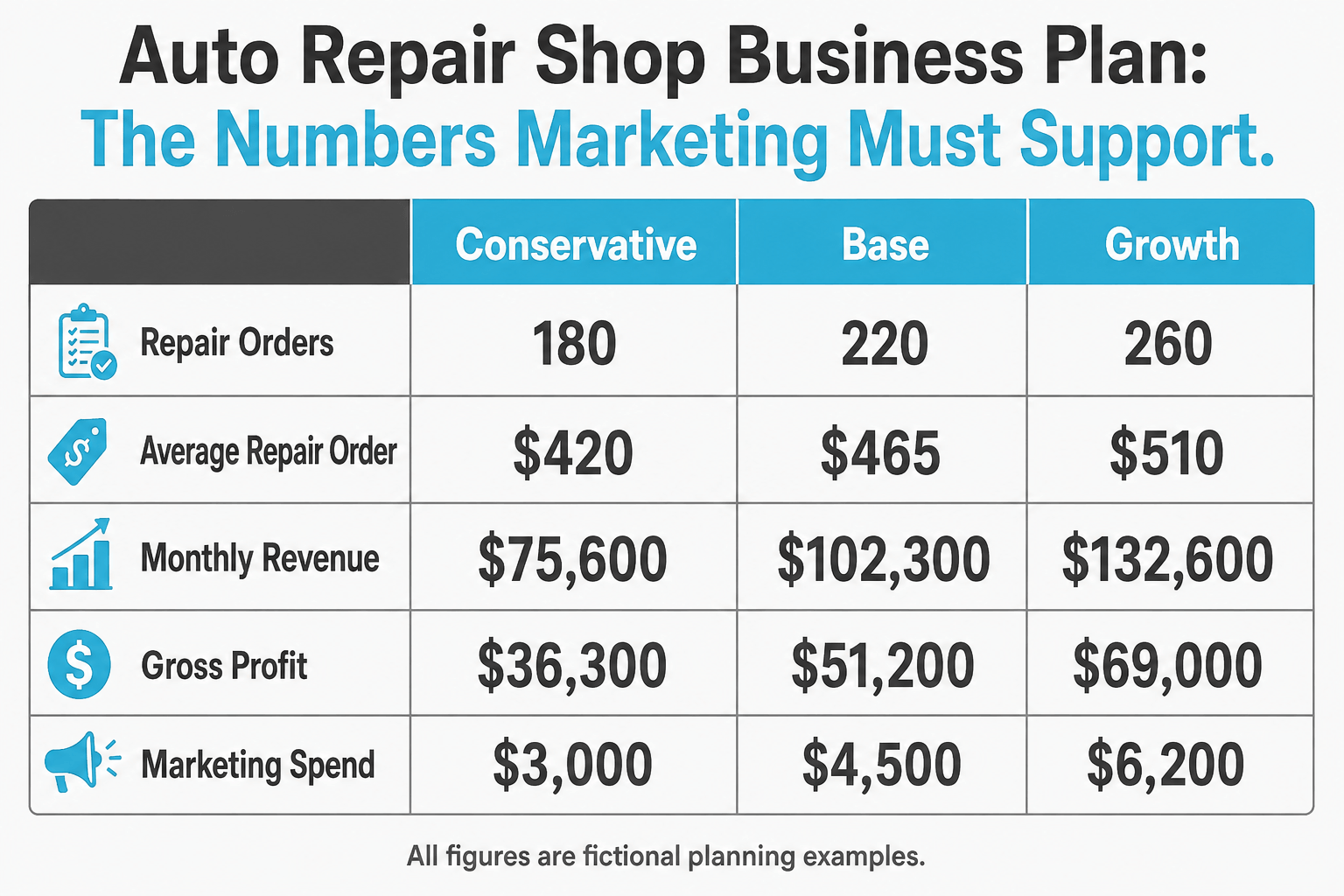
One forecast hides uncertainty. Build conservative, base, and growth cases from explicit drivers.
| Driver | Conservative | Base | Growth |
| Completed ROs | Current level or slight decline | Capacity-supported target | Requires stated hire or process change |
| ARO | Current mix | Planned pricing and mix | Requires specific specialty growth |
| Staffing | No successful hire | Planned start date | Additional recruiting and ramp cost |
| Marketing | Protect proven channels | Fund measured acquisition target | Add channel after capacity milestone |
| Cash | Longer collection and slower growth | Expected timing | Includes expansion and working capital |
Attach a trigger to each step. For example: increase paid-search budget only after call answer rate, schedule availability, and cost per completed RO meet the agreed threshold for four weeks.
Plan Startup and Expansion Costs Separately
The SBA recommends separating one-time and monthly expenses when calculating startup costs. For a repair business, categories may include lease deposits, build-out, lifts, diagnostic equipment, tools, initial parts and fluids, software, insurance, licenses, professional fees, signage, website, launch marketing, recruiting, payroll, utilities, waste services, and working capital.
Confirm permits, environmental obligations, zoning, insurance, tax, and licensing requirements with qualified local professionals. Costs and requirements vary by location and shop type.
Do not use all available cash for build-out and equipment while assuming customer revenue starts immediately. Model the time needed for hiring, training, opening, indexing, campaign learning, estimate approval, parts delivery, invoicing, and payment.
Write the Nine Core Sections
1. Executive summary
State the shop model, location, customer, differentiation, current stage, 12-month target, funding need, and the few numbers that make the plan credible. Write this last.
2. Company description
Explain ownership, legal structure, facility, history, certifications, and the decision the plan supports.
3. Market analysis
Define service area, demand, competitors, vehicle mix, customer segments, and evidence. Separate verified facts from assumptions.
4. Services and positioning
List core and specialty services, job roles, exclusions, pricing logic, warranties, and the customer problem each service solves.
5. Operations
Describe hours, scheduling, estimate approval, parts sourcing, quality control, comebacks, keys, vehicles, safety, waste, customer updates, and management systems.
6. Organization and staffing
Show current and planned roles, compensation assumptions, recruiting, training, productivity, and what happens if a critical hire is delayed.
7. Marketing and sales
Connect channel, service, audience, offer, call handling, booking, attribution, budget, and completed work. Element DMA’s auto repair lead generation should fit the capacity and economics in this section, not operate as an unrelated promise of more leads.
8. Funding request
State the amount, use of funds, timing, terms sought, owner contribution, collateral where relevant, and how repayment fits cash flow. Coordinate this section with qualified financial and legal advisors.
9. Financial projections and milestones
Include monthly detail for the first year when appropriate, annual projections for later years, assumptions, income statement, cash flow, balance sheet, capital expenditures, break-even analysis, and scenario triggers.
Case Study Lesson: Use Real Channel Data as an Input, Not a Benchmark
The Express 80 Services case study describes a nine-bay truck and trailer shop and reports a $2,940 monthly Google Ads budget, 200 monthly Google Ads calls at $14.82 per call, and 1,189 monthly Google Business Profile calls. Those results belong to that shop, market, service mix, period, and tracking setup.
The planning lesson is not to copy its budget or call targets. It is to define channel-level assumptions and measure them. A business plan should show how calls become qualified opportunities, how opportunities become completed work, and whether the facility has capacity for that work.
Review the Plan Monthly
A usable plan has a short operating review.
Track:
- completed ROs and ARO;
- billed labor hours and effective labor rate;
- revenue and gross profit by category;
- schedule availability and cycle time;
- qualified calls, booking rate, show rate, and completed ROs by source;
- new versus returning customers;
- marketing cost and cost per completed RO;
- staffing, comeback, and cash constraints;
- forecast versus actual and the reason for variance.
Change assumptions when evidence changes. Do not rewrite the target to hide a missed result.
Frequently Asked Questions
How long should an auto repair shop business plan be?
A lean internal plan may be one to five pages plus the financial model. A lender-facing traditional plan is usually longer because it must document the market, operations, funding request, assumptions, and projections. Length should follow the decision and reader.
What financials should an auto repair business plan include?
Include historical statements when available, revenue and gross-profit assumptions by category, payroll, operating expenses, cash flow, balance sheet, capital expenditures, funding, break-even analysis, and conservative, base, and growth scenarios.
How do I forecast auto repair shop revenue?
Reconcile completed repair orders times ARO with a production model based on billed labor hours, effective labor rate, parts, sublet, and realistic capacity. Investigate any large gap between the two views.
How much should a new shop spend on marketing?
There is no safe universal percentage. Work backward from required completed repair orders, allowable CAC, capacity, gross profit, cash, and channel evidence. Separate brand and launch infrastructure from ongoing acquisition spend.
Should marketing be included in a lender plan?
Yes. Explain target customers, channels, offers, sales and call handling, budget, attribution, and the economics of acquiring and retaining customers. Make sure those assumptions agree with capacity and financial projections.
Make the Plan Operable
A strong auto repair shop business plan makes tradeoffs visible. It shows what the shop can complete, which work it wants, how much demand is required, what a new customer can cost, when staffing or equipment must change, and how cash behaves while the plan develops.
Element DMA can build the marketing forecast, channel plan, tracking structure, and acquisition system around those operating realities. The right question is not simply how many leads the shop can generate. It is how many profitable repair orders the business can answer, book, complete, and retain.