

Auto Repair Shop Marketing Trends for 2026: What Produces Booked Jobs
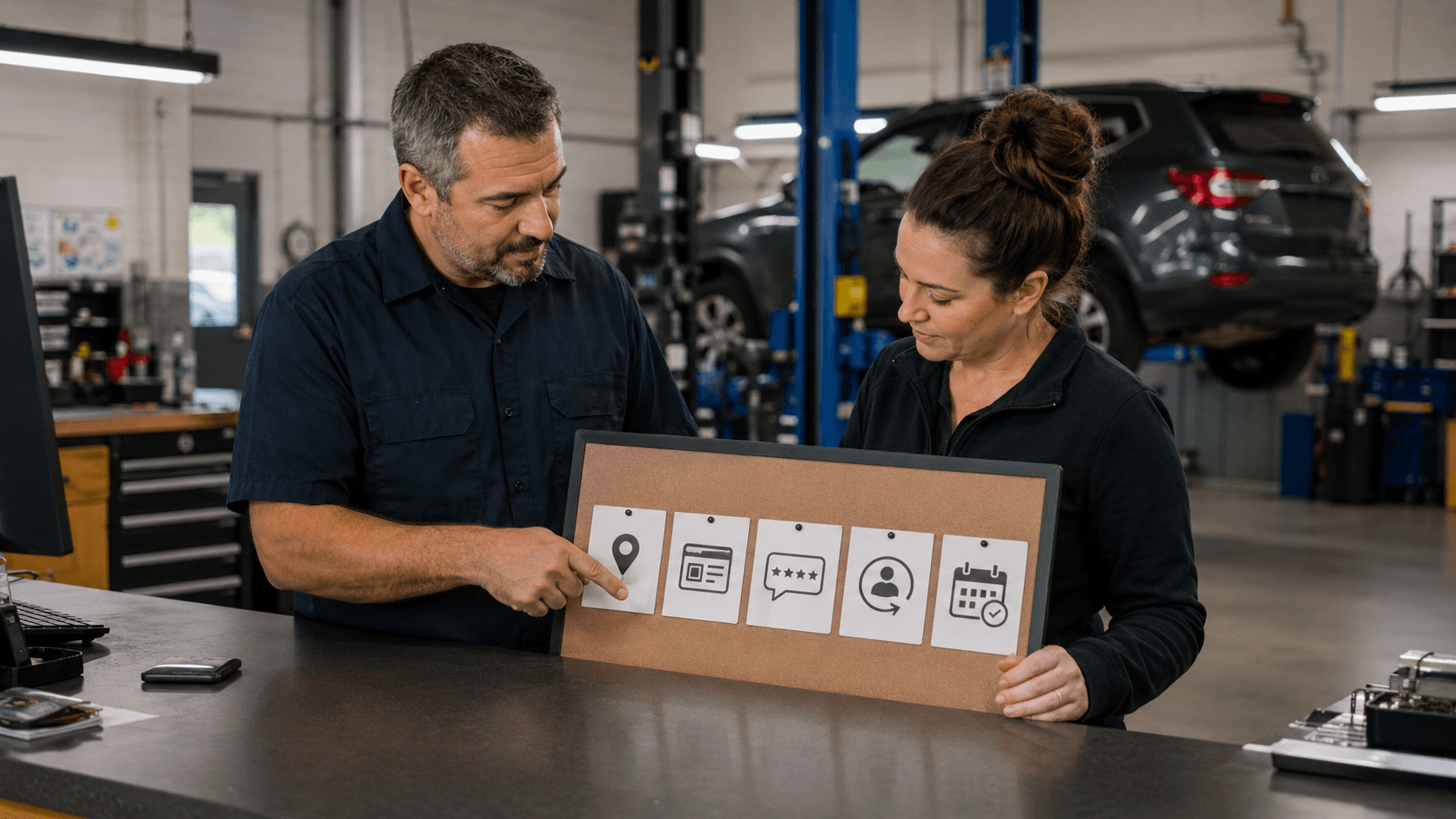
The useful auto repair shop marketing trends for 2026 are not new platforms to add to an already crowded to-do list. They are changes in how drivers choose a shop and how owners decide whether a channel deserves more time or budget. A shop still needs to be easy to find, credible to contact, and ready to turn the inquiry into a booked repair. The difference is that every channel now has to prove its place in that path.
For an independent shop, the practical question is simple: which part of the customer journey is weak right now? A shop with empty bays may need better local demand capture. A shop that gets calls but loses appointments may need clearer service pages and better phone handling. A shop with a full customer history may have more opportunity in reminders and declined-work follow-up than in another cold-audience campaign.
Use this annual review to choose one or two changes that fit the service mix, capacity, and customer questions the shop has today. It is not a replacement for a full marketing calendar or a long list of promotional ideas.
Contents:
- The 2026 Shift: Fewer Channels, Clearer Customer Paths
- 1. Local Visibility Needs a Matching Service Path
- 2. Paid Search Needs Service-Specific Measurement
- 3. Trust Signals Need to Answer the Same Question
- 4. Retention Starts With a Relevant Reason to Follow Up
- 5. AI Needs a Defined Handoff, Not an Unattended Customer Channel
- 2026 Channel Priority Matrix
- Run a 30-Day Channel Test Before Calling It a Trend
- Use Booked-Job Math Before Adding Budget
- Common Ways Shops Misread Marketing Trends
- FAQ
- Choose the Change That Fits the Shop
The 2026 Shift: Fewer Channels, Clearer Customer Paths
A channel is useful only when it gives a driver a reason to choose the shop and a clear next step. That is why the current priority is less about being present everywhere and more about keeping the message consistent from a search result or recommendation through the service page, phone call, estimate, and pickup experience.
| What is changing | What it means for a repair shop | A practical check |
|---|---|---|
| Drivers compare proof before they call. | Reviews, service details, photos, hours, and estimate expectations need to answer the same concern. | Can a first-time driver tell whether the shop handles their repair and what happens next? |
| Urgent searches are more specific. | A generic home page creates friction when the driver needs brakes, diagnostics, AC, or another defined service. | Does the paid or organic message lead to a matching service path? |
| Owned customer history matters more. | Past visits, declined work, and maintenance timing can reveal useful follow-up opportunities. | Can the team identify an appropriate reason to contact a known customer? |
| Automation is easier to access. | Tools can speed up preparation, but customer-facing promises still need human review and a clear handoff. | Would a service advisor stand behind the message if a customer calls about it? |
1. Local Visibility Needs a Matching Service Path
A complete local presence remains the starting point for a repair shop trying to capture nearby demand. But accurate hours and categories are only the beginning. The profile, website, and call process should give a driver the same answer about services, availability, and how to request help.
Google’s Business Profile guidelines set the baseline for representing the business accurately. In practice, a shop should check whether its service descriptions, photos, appointment path, and front-desk answers reflect what the profile promises.
- Choose a priority service the shop can schedule promptly, such as diagnostics, brakes, maintenance, or AC repair.
- Make the service page explain the concern, the booking step, and any information the driver should prepare before calling.
- Check that profile hours, service area, phone number, and service language match the website and front desk.
- Review missed calls and wrong-service inquiries for questions the local presence does not answer clearly.
For the profile audit itself, use this Google Business Profile guide for auto repair shops.
2. Paid Search Needs Service-Specific Measurement
Paid search is most useful when the shop needs near-term demand for work it can fulfill. It becomes expensive when a broad message attracts people looking for unrelated services, price-only information, jobs, DIY instructions, or locations outside the workable area. The annual trend is not simply to spend more on automation. It is to make the service, geographic fit, landing path, and call outcome visible enough to improve.
Set up Google Ads conversion measurement for the lead actions that matter, then reconcile those actions with booked appointments and completed work. A click, form, or phone call can be a useful diagnostic, but it is not the final result.
| Campaign question | Weak setup | Useful 2026 setup |
|---|---|---|
| What work do we want? | One generic auto repair campaign. | A defined service or customer problem the shop can schedule and quote appropriately. |
| Where does the click go? | A home page with every service listed. | A page that answers the searched repair concern and gives one clear contact path. |
| What is measured? | Clicks and cost only. | Qualified calls, booked jobs, completed work, gross profit, and capacity fit. |
| What changes after a weak result? | More budget or a new offer immediately. | One variable at a time: query quality, message, landing path, call handling, or capacity. |
A published A&V Auto Repair case study shows why the path should be reviewed as a system: the work combined targeted service and location-based Google Ads, service pages, Google Business Profile work, and phone communication. The reported cost per call and call volume are specific to that shop, market, budget, and campaign period, not a benchmark to promise another shop.
3. Trust Signals Need to Answer the Same Question
Drivers often need reassurance before they need another marketing message. A diagnostic customer may want to know whether the shop explains findings before repair approval. A commuter may need to understand drop-off and timing. A specialty customer may be looking for evidence that the team handles that vehicle or problem. Reviews, service pages, photos, and advisor language should support the same promise.
Keep claims about speed, guarantees, prices, rankings, or outcomes truthful and supportable. The FTC’s advertising guidance is a useful standard when turning a real service process into marketing language.
This does not mean every page needs a long trust section. It means the proof should be specific. A real diagnostic process, actual service limits, current hours, relevant credentials, and review themes are more useful than a generic claim that the shop is the best in town.
4. Retention Starts With a Relevant Reason to Follow Up
New-customer demand matters, but it is not automatically the first priority. Shops with a usable history of maintenance visits, declined recommendations, or seasonal service needs can often find a more relevant next conversation among people who already know the business. The message should be tied to a service need, not a generic discount sent to everyone.
| Customer signal | Relevant follow-up | Avoid |
|---|---|---|
| A maintenance interval is approaching. | A timely reminder that explains the service and an easy booking option. | A vague blast with no reason the customer received it. |
| Recommended work was declined. | A clear follow-up on the original concern, timing, and next step when appropriate. | Reframing every declined job as an urgent promotion. |
| A seasonal service need is predictable. | A useful check or service message tied to local conditions and the shop’s real availability. | Creating urgency the team cannot support with appointments. |
| A customer had a good recent visit. | A respectful review request or referral conversation at the right moment. | Offering incentives that encourage misleading or pressured feedback. |
5. AI Needs a Defined Handoff, Not an Unattended Customer Channel
AI-assisted tools can help organize call notes, prepare draft messages, summarize recurring questions, or speed up routine analysis. That can save time. The risk appears when a generic answer promises a price, repair timing, warranty, availability, or technical conclusion that the shop has not approved.
Set a simple handoff rule: use automation for preparation and routing, but let a trained team member approve customer-facing repair advice, offers, and schedule commitments. Track the questions the tool cannot answer cleanly. Those questions often reveal an unclear service page, intake script, or appointment process worth fixing.
2026 Channel Priority Matrix
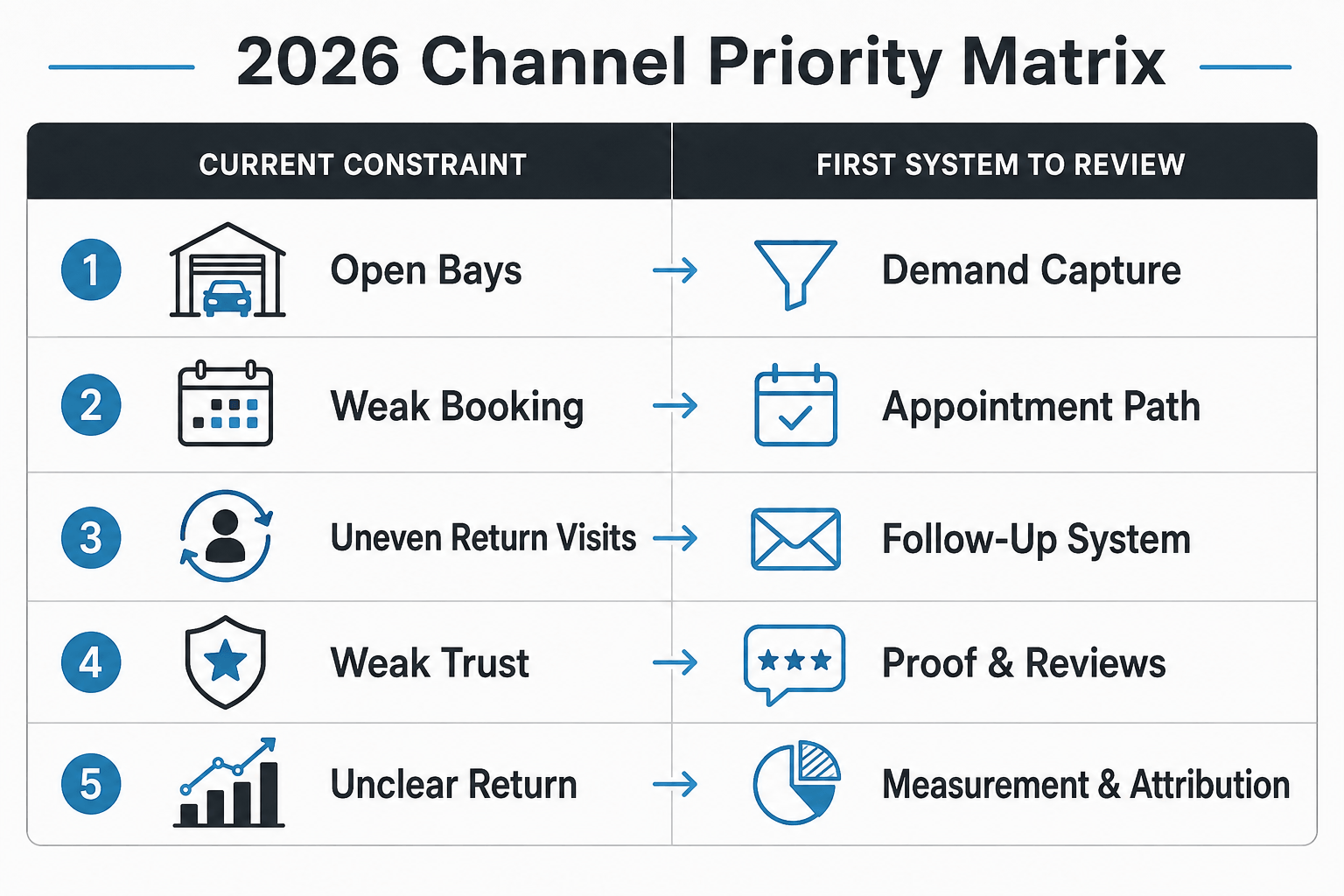
Use this matrix as the article’s working tool. Pick the row that matches the shop’s current constraint, then run one measured change before adding another channel.
| Current constraint | First channel or system to review | What a good result looks like |
|---|---|---|
| Open capacity for a defined repair service | Local profile, matching service page, and high-intent search demand. | More qualified inquiries for work the shop can book promptly. |
| Plenty of inquiries but weak booking | Landing-page clarity, phone handling, estimate expectations, and appointment flow. | A higher share of suitable calls becoming scheduled work. |
| Strong customer history but uneven return visits | Relevant reminders, declined-work follow-up, and service-based communication. | More repeat work without relying only on new-customer promotions. |
| Good service but weak local trust | Accurate business information, proof, reviews, photos, and consistent explanations. | Fewer basic objections and clearer reasons drivers choose the shop. |
| Unclear marketing return | Call source tracking and booked-job reporting before expanding spend. | A repeatable view of which channel produces completed work. |
Run a 30-Day Channel Test Before Calling It a Trend
- Choose one customer problem and the repair work the shop wants to book.
- Record a baseline for qualified calls, booked jobs, completed jobs, gross profit, and available capacity.
- Change one part of the path, such as the service message, profile detail, landing page, follow-up timing, or call script.
- Review the same measures after 30 days, separating urgent repair demand from routine maintenance and repeat work.
- Keep, revise, or stop the test based on booked work and capacity fit, not attention metrics alone.
Use Booked-Job Math Before Adding Budget
A channel can look active while still failing the shop’s economics. Set a simple threshold before a new campaign, content series, or follow-up effort starts. The figures below are an example, not an industry benchmark.
| Input | Example | Why it matters |
|---|---|---|
| Total test cost | $2,500 | Include media, creative, tools, and any landing-page work. |
| Gross profit per completed job | $250 | Use the job type the effort is intended to produce. |
| Break-even completed jobs | 10 jobs ($2,500 / $250) | Sets a minimum completed-work threshold. |
| Qualified-call to booked-job rate | 50% | Shows whether the message, intake, or offer needs attention. |
| Available capacity | 12 additional jobs | Prevents promoting work the shop cannot serve promptly. |
Use the Ads Revenue Calculator to model the inputs for the shop’s own service mix and margin.
Common Ways Shops Misread Marketing Trends
- Adding a social channel because it is popular while the local profile, service pages, or phone response still create friction.
- Treating a new AI feature as a strategy without deciding who approves messages and how outcomes are measured.
- Chasing low-cost clicks that do not become qualified calls, booked jobs, or completed work.
- Sending the same offer to every past customer instead of using a relevant maintenance, repair, or follow-up reason.
- Expanding a campaign before the shop can schedule the promoted work and answer the questions it creates.
- Counting reviews, followers, or form fills as the final result instead of checking whether the work fits the shop’s capacity and margin.
FAQ
What are the most important auto repair shop marketing trends for 2026?
The most useful trends are practical: better local demand capture, service-specific paths, visible trust proof, relevant customer follow-up, measured paid demand, and human review of automated customer communication. The right priority depends on where the shop currently loses suitable work.
Should an auto repair shop use AI for marketing?
AI can assist with preparation, analysis, and routing, but a team member should review customer-facing repair advice, pricing, availability, offers, and commitments. Use it to reduce routine work, not to make unsupported promises.
Which marketing channel should a small auto repair shop start with?
Start with the constraint. A shop with open bays may need accurate local visibility and a clear service path. A shop with a healthy customer history may benefit more from service reminders and follow-up. Measure qualified calls and booked jobs before adding channels.
How should a repair shop measure marketing performance?
Track qualified inquiries, booked appointments, completed jobs, gross profit, capacity fit, repeat work, and recurring objections. Channel metrics such as clicks and impressions can help diagnose a problem, but they are not the final outcome.
Are reviews still important for auto repair marketing?
Yes. Reviews are most useful when they reinforce a specific, real reason to choose the shop, such as clear explanations, relevant expertise, convenience, or reliable communication. Keep review requests respectful and do not use misleading incentives or claims.
Choose the Change That Fits the Shop
The auto repair shop marketing trends that matter in 2026 are the ones that make it easier for the right driver to find the shop, trust the next step, and book work the team can deliver well. Start with the current constraint, improve one customer path, and keep the change only when it produces suitable booked work.
For a broader set of tactics once the priority is clear, see auto repair shop marketing ideas. Shops that need help connecting local visibility, paid demand, conversion paths, and call measurement can review auto repair lead generation.
When a trend review shows that local service pages are not visible for the work the shop wants, explore SEO for auto repair shops.