

Auto Repair Keywords That Drive Calls for Mechanic Shops
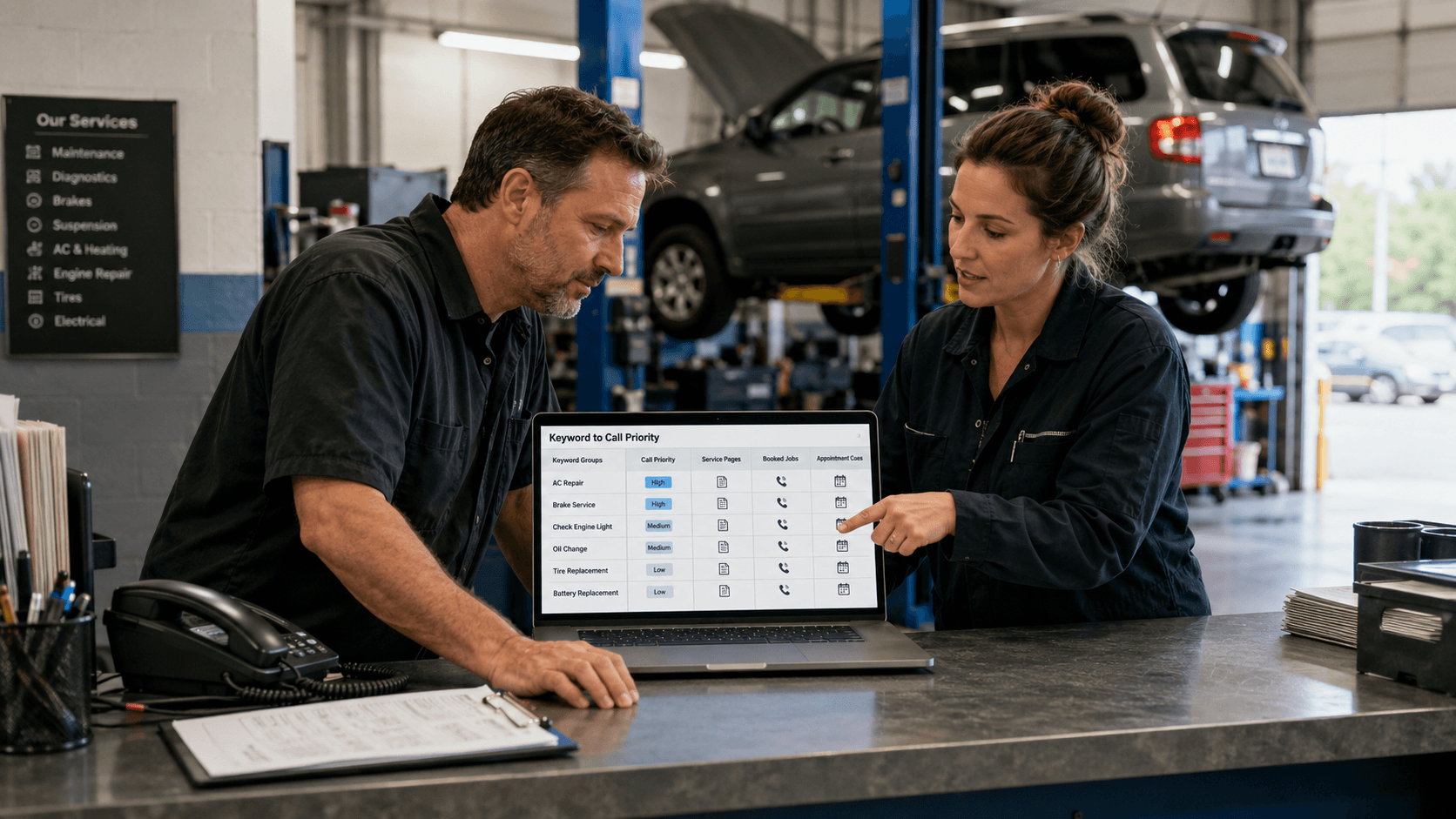
The best auto repair keywords are the searches that turn into qualified phone calls, booked inspections, and repair orders. They usually combine high-intent Google searches, a clean Google Business Profile, focused service pages, strong reviews, and call tracking that shows which phrases become booked work.
That matters because a busy phone is not always a profitable phone. A shop can spend money on Google Ads, rank for broad searches, and still get calls about jobs it does not want, towns it does not serve, DIY advice, employment, parts, or price shopping. The keyword list has to match the work the shop can actually book.
This guide keeps the focus narrow: keywords that drive qualified mechanic-shop calls. For a broader channel-by-channel plan, use the separate guide to auto repair shop marketing ideas. Here, the job is to decide which search phrases deserve ad budget, service pages, tracking, and follow-up.
Contents:
- Start With Calls, Not Keyword Volume
- Use Search Volume as a Filter, Not the Target
- Group Keywords by Repair Intent
- Match Each Keyword to a Page and Phone Outcome
- Use Negative Keywords Before You Scale Spend
- Estimate Cost per Booked Job Before Calling a Keyword Good
- A 30-Minute Keyword Cleanup Checklist
- FAQ
- Choose Keywords the Shop Can Actually Serve
Start With Calls, Not Keyword Volume
Keyword volume is useful, but it is not the main scorecard for a repair shop. A low-volume search like brake repair open now can be more valuable than a high-volume research query when the driver is local, the shop performs brake work, and the call happens while a service advisor can answer.
The first filter should be business fit. Before adding a phrase to Google Ads or building a landing page, ask four questions:
- Does the phrase describe a service the shop wants more of?
- Does it imply the driver is local enough to become a customer?
- Does it suggest urgency, appointment intent, or a specific repair need?
- Can the shop answer the call, explain next steps, and book the job?
Google describes Search campaigns as a way to reach people searching for products or services, and its Keyword Planner can help generate ideas and estimate performance. Those tools are useful, but they still need repair-shop judgment. A phrase is good when it can become a qualified call, inspection, estimate, or appointment.
If the shop still needs a full channel plan, send broad planning work to auto repair shop marketing ideas. Keep this page focused on search phrases, call quality, pages, negatives, and booked-job math.
Use Search Volume as a Filter, Not the Target
A keyword list is easier to manage when each phrase has a business role. Google Keyword Planner is useful for checking demand, but national volume should not decide the page strategy by itself. The better question is whether the phrase can become a qualified call for a shop that actually performs the work.
| Intent bucket | Verified U.S. examples | Avg. monthly searches | Best use |
|---|---|---|---|
| Core local | mechanic near me; auto repair near me; mechanic shop near me | 823,000; 450,000; 165,000 | GBP, home/location pages, local proof, reviews, phone CTAs |
| Service-specific | oil change near me; wheel alignment near me; brake repair near me; car AC repair near me | 1,500,000; 110,000; 74,000; 74,000 | Dedicated service pages and tightly grouped paid-search campaigns |
| Open-now urgency | auto repair near me open now; car repair near me open now; mechanic open now; brake repair open now | 9,900; 1,300; 720; 20 | Hours, call ads, GBP updates, after-hours routing, missed-call process |
| Diagnostic/problem | check engine light diagnostic; check engine light diagnostic near me; engine diagnostic service | 3,600; 590; 480 | Diagnostics page, symptom FAQs, inspection CTA, service advisor scripts |
| Truck/fleet | truck repair near me; diesel repair near me; fleet maintenance near me | 60,500; 14,800; 390 | Separate pages only if the shop serves trucks, diesel, or fleet accounts |
| Price/value | affordable mechanic near me; brake repair cost | 9,900; 2,900 | FAQ sections, estimate language, negative keyword review, margin guardrails |
The seed phrase auto repair keywords has much smaller direct search volume than customer-facing repair searches, but it is the right organizing idea for this guide. Use that seed to decide which customer searches matter, then route each phrase to the right page, ad group, call path, or exclusion list.
Group Keywords by Repair Intent
The strongest groups usually combine a service, a problem, and a local modifier. A shop does not need every possible phrase. It needs the phrases that match profitable work, available bays, technician capability, and the calls the front desk can close.
Emergency Keywords
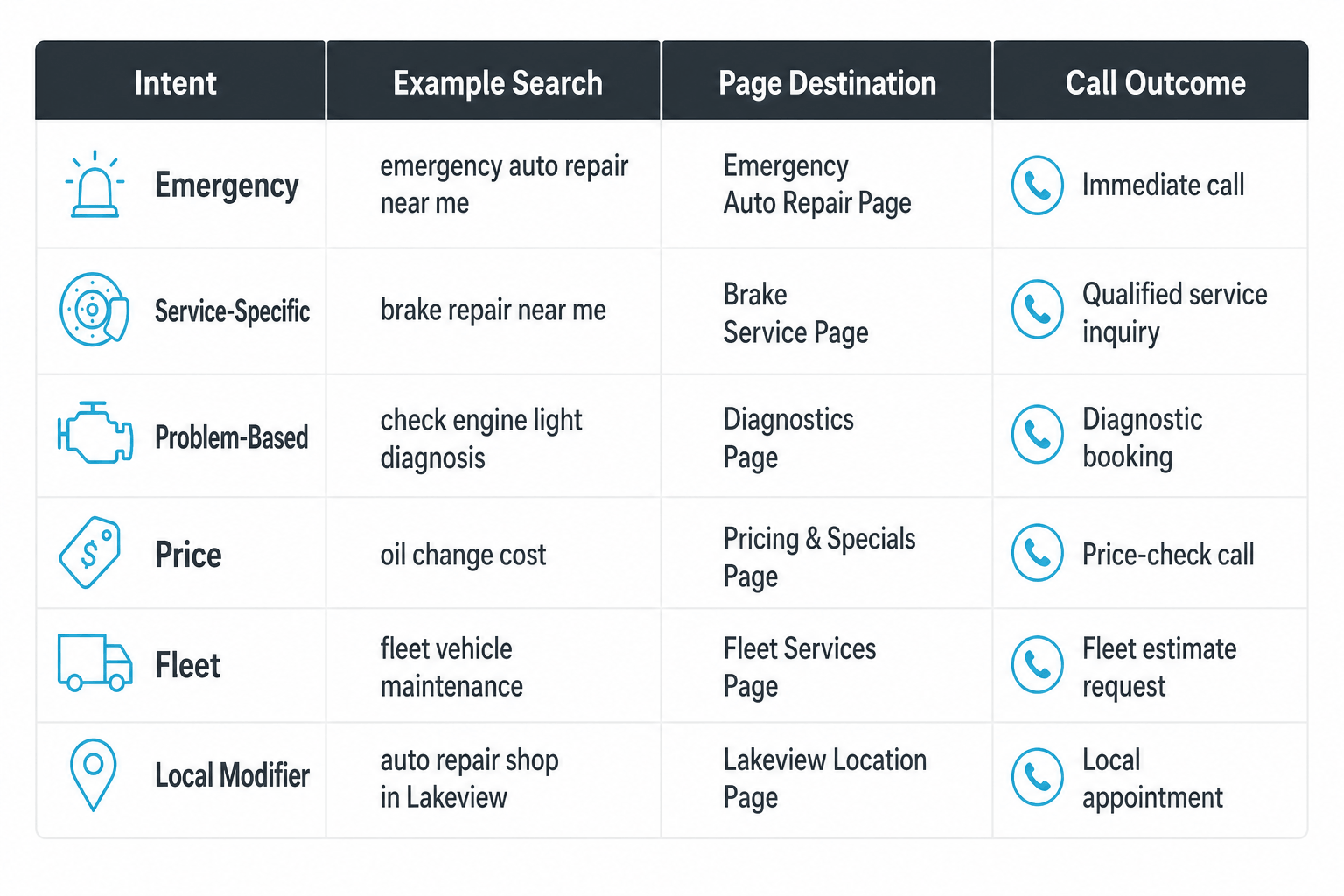
Emergency keywords work when the shop can answer quickly and set expectations. Use them for services that can realistically be handled today or next business day. Good examples include mechanic open now, brake repair open now, car won’t start near me, AC repair today, tire repair near me, and mobile mechanic near me only if mobile service is actually offered.
Service-Specific Keywords
Service-specific keywords are the backbone of most repair SEO and paid search. Build lists around brake repair, diagnostics, check engine light, oil change, transmission repair, AC repair, tire repair, wheel alignment, battery replacement, suspension repair, and factory scheduled maintenance. Then split by vehicle type only where the shop can support the claim.
Problem-Based Keywords
Problem-based searches catch customers before they know the service name. A driver may search why is my car shaking when braking instead of brake rotor replacement. The page should answer the symptom plainly, explain when inspection is needed, and route the visitor to a diagnostic or service appointment.
Commercial, Truck, and Fleet Keywords
Commercial intent is valuable only for the right shop. Fleet maintenance, diesel truck repair, box truck repair, company vehicle maintenance, and mobile fleet repair can produce stronger accounts than one-time retail work, but they need a dedicated page, proof, process details, and a different follow-up rhythm.
Avoid stuffing every group into one page. A brake repair page should not try to rank for fleet maintenance, and a general blog post should not own every service term. Each keyword group needs a page or ad destination that matches the driver’s next question.
Match Each Keyword to a Page and Phone Outcome
The page behind the keyword has to make the call easy and credible. Google’s SEO starter guide emphasizes useful search result titles and page content. For a repair shop, that means the page title, heading, service explanation, reviews, location proof, and call-to-action should all match the service query.
| Keyword group | Best destination | Proof the page should include | Phone outcome to track |
|---|---|---|---|
| Brake repair | Brake repair service page | Symptoms, inspection process, parts/labor expectations, brake reviews, nearby service area | Qualified brake call, inspection booked, estimate requested |
| Check engine light | Diagnostics or check engine light page | Scan/diagnostic process, common causes, technician credentials, appointment options | Diagnostic appointment, no-start call, warranty or emissions question |
| AC repair | Auto AC repair page | Seasonal urgency, recharge versus repair explanation, leak test details, comfort-focused reviews | AC inspection booked, price-only call, wrong vehicle type |
| Fleet maintenance | Fleet or commercial service page | Scheduling process, account handling, vehicle types, downtime reduction language | Fleet inquiry, account setup call, one-off repair call |
| Near me / city terms | Home page, location page, or service page with local proof | Address, service area, hours, parking, reviews, photos, appointment path | Local call, directions request, after-hours message |
If the site lacks these destinations, prioritize the pages that support profitable repairs first. Element DMA’s SEO for auto repair shops service is built around that kind of page and intent mapping.
When the goal is immediate phone volume, pair the page map with auto repair lead generation campaigns so paid search, local proof, call tracking, and follow-up are measured together.
Use Negative Keywords Before You Scale Spend
Negative keywords are one of the fastest ways to protect budget. Google defines them as terms that prevent ads from being triggered by certain words or phrases. In plain repair-shop language, they stop the ad from showing when the search is not a realistic customer call.
The search terms report is where the cleanup starts. Google Ads uses that report to show the actual searches that triggered ads and how those searches performed. Review it weekly when campaigns are new, then at least monthly once the account is stable.
| Exclude if irrelevant | Examples | Why it matters |
|---|---|---|
| Jobs and training | mechanic jobs, auto repair salary, mechanic school, certification | These searches rarely become customer repair orders. |
| DIY and tutorials | how to fix brakes, YouTube, manual, PDF, diagram | They attract research traffic instead of calls. |
| Parts-only intent | brake pads for sale, used engine parts, junkyard, OEM part number | They may not fit a service-based shop. |
| Unavailable services | towing, body shop, windshield, motorcycle repair, RV repair | Exclude services the shop does not provide. |
| Wrong geography | cities outside the service area, distant zip codes, airport locations | Local repair intent loses value when the customer is too far away. |
| Bad economics | free, cheapest, no cost, coupon only | Some value searches convert, but unqualified discount traffic can erode margin. |
Do not block every price-related search automatically. Repair customers often want a range before they call. The better move is to separate useful estimate language from impossible-price language, then measure call quality before making broad exclusions.
Estimate Cost per Booked Job Before Calling a Keyword Good
A keyword that produces calls is not automatically profitable. Track the path from click to call to booked repair. This is where many shops misread performance: they celebrate call volume while ignoring missed calls, wrong-service calls, low-ticket work, and no-shows.
| Metric | Example | Formula or meaning |
|---|---|---|
| Ad spend | $800 | Monthly spend for one keyword group or campaign |
| Clicks | 100 | People who clicked the ad or listing |
| Average CPC | $8 | Ad spend divided by clicks |
| Calls | 20 | Phone calls attributed to the campaign or page |
| Cost per call | $40 | $800 divided by 20 calls |
| Qualified calls | 12 | Calls from people in the service area who need work the shop performs |
| Booked jobs | 7 | Appointments or repair orders created from the qualified calls |
| Cost per booked job | $114.29 | $800 divided by 7 booked jobs |
| Repair revenue | $3,150 | 7 jobs multiplied by a $450 average repair order |
The exact numbers will vary by market, service mix, season, and close rate. The point is the discipline: judge keywords by booked-job economics, not by clicks alone. A phrase with fewer clicks can win if it creates higher-value work and fewer wasted calls.
Use the Ads Revenue Calculator to pressure-test spend, call volume, close rate, average repair order, and revenue assumptions before increasing budget.
Published Element DMA work shows why this kind of measurement matters. In the A&V Auto Repair case study, a $1,500 monthly budget produced a reported $12.24 cost per call and 128 calls from Google Ads per month, supported by 25 optimized pages and service- and location-based ad groups. Those details are more useful than a generic keyword list because they connect search structure to phone outcomes.
A 30-Minute Keyword Cleanup Checklist
A shop owner or marketing manager can improve a keyword account quickly without rebuilding the whole system. Use this cleanup once a month, or weekly during the first month of a new campaign.
- Pull the top search terms from Google Ads and group them by service, problem, location, price, and irrelevant intent.
- Mark each search as keep, test, exclude, or page needed.
- Compare the top call-driving searches with call recordings, call notes, or CRM outcomes.
- Add negatives for jobs, schools, DIY searches, parts-only searches, services the shop does not offer, and cities it does not serve.
- Move strong service terms into tighter ad groups or service pages instead of leaving them in a broad campaign.
- Check whether the page title, H1, phone CTA, reviews, and service proof match the strongest search group.
- Record cost per call, cost per qualified call, and cost per booked job for the top keyword groups.
- Pause or cap groups that create calls the team cannot answer or jobs the shop does not want.
The result should be a shorter, cleaner keyword list. More keywords are not the goal. More qualified calls, better appointment fit, and stronger repair-order economics are the goal.
FAQ
What is the best marketing for auto repair shop owners who need calls?
For call generation, the strongest approach is usually local search: Google Business Profile, service-specific SEO pages, paid search for high-intent terms, reviews, call tracking, and fast phone follow-up. Social media and email can help, but search captures drivers who already need repair.
Should a shop target auto repair near me?
Yes, but not as the only keyword. Auto repair near me is broad and competitive. Pair it with service terms like brake repair near me, check engine light diagnostic near me, AC repair near me, and oil change near me so the page or ad matches a real repair need.
Are cheap or affordable mechanic keywords bad?
Not always. Some customers use price language because they want confidence before booking. The risk is attracting callers who only want the lowest possible price. Track booked jobs, average repair order, and close rate before deciding whether to exclude or keep those terms.
How many service pages does an auto repair shop need?
Start with the services that matter most to revenue and capacity. Most full-service shops should consider separate pages for brakes, diagnostics, check engine light, oil changes or maintenance, tires or alignment, AC, suspension, transmission, and fleet work if those are real priorities.
What negative keywords should an auto repair shop start with?
Start with employment, training, DIY, parts-only, free, manual, PDF, school, salary, YouTube, junkyard, and services or locations the shop cannot serve. Then add campaign-specific negatives from real search term data.
Do keywords matter for Google Business Profile calls?
Yes, but not through keyword stuffing. The profile should accurately list services, categories, hours, location, photos, reviews, and business details. Google Business Profile performance can show calls and other actions, but the shop still needs call tracking or CRM notes to know which calls became customers.
Choose Keywords the Shop Can Actually Serve
The best keywords for a mechanic shop are not the biggest list or the broadest phrases. They are the searches that match real services, real geography, real availability, and real profit potential. Start with the phone outcome, build the page and ad around that outcome, then keep refining the list with call quality data.
Element DMA can help connect keyword research, service pages, Google Ads, call tracking, and reporting into one repair-shop growth system. Start with auto repair lead generation or book a consultation when the shop is ready to turn search demand into measured calls and booked jobs.