

Best Advertising Strategies for Auto Repair Shops
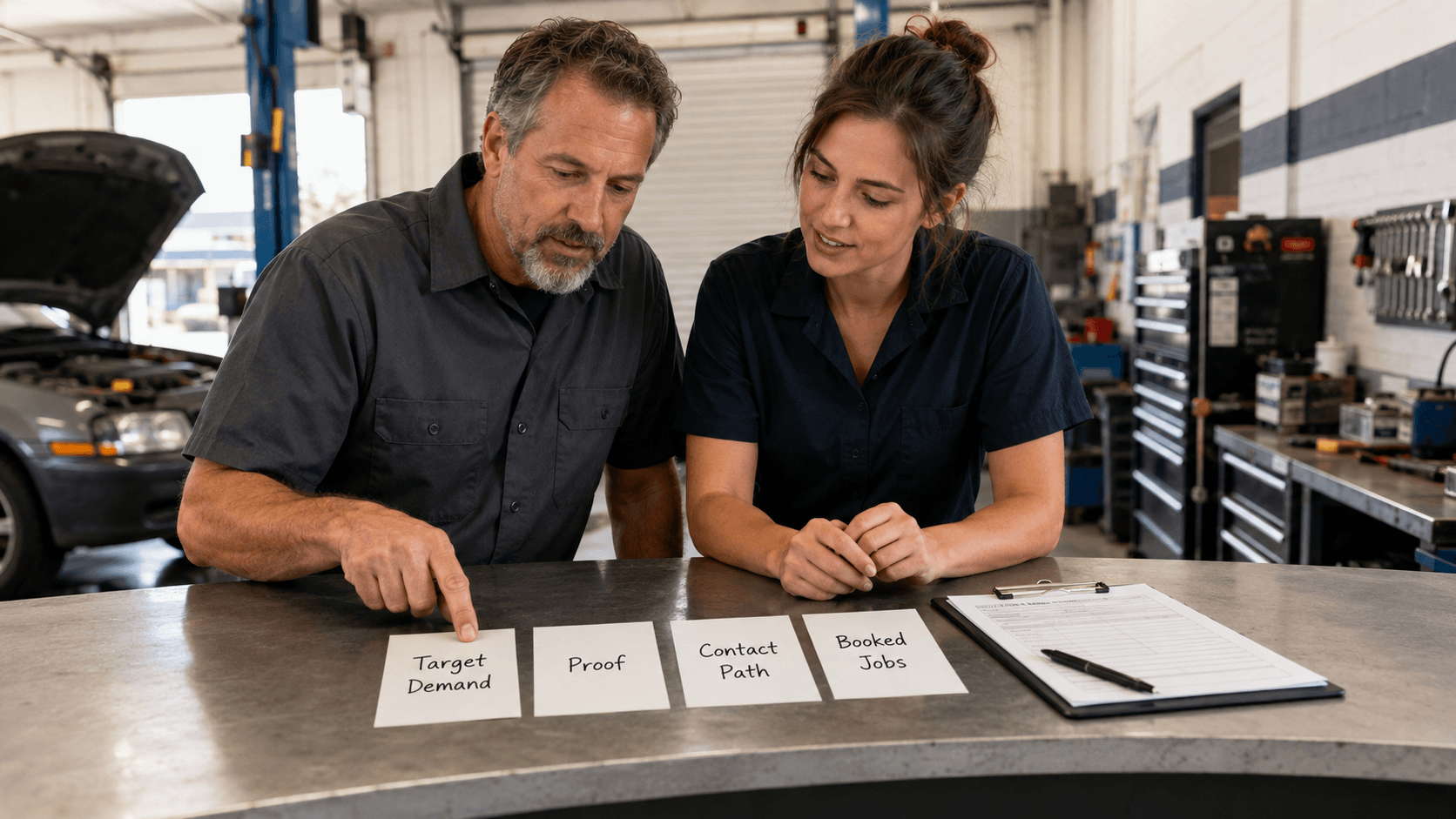
The best advertising strategies for auto repair shops create the right kind of call, not simply more activity. A brake repair searcher, a driver comparing diagnostic shops, a customer who missed a maintenance reminder, and a new household in the service area do not need the same message or channel. Treating all of them as a generic audience is how advertising starts to feel expensive without filling the bays with the work the shop wants.
Start with a decision: which service, customer problem, and booking window can the shop handle well right now? Then choose the advertising method that makes that offer easy to find, credible to trust, and simple to schedule. The strongest campaign connects the ad, proof, contact path, and front-desk response instead of treating them as separate projects.
This guide focuses on paid and promotable demand channels. It does not replace a full marketing plan, a broad ideas list, or a local SEO checklist.
Contents:
- Choose an Advertising Strategy by the Demand You Need
- 1. Use Search Ads for Repairs Drivers Need Now
- 2. Make the Local Listing a Trust Layer for Every Campaign
- 3. Use Direct Mail When the Geography and Offer Are Specific
- 4. Build Social Proof Into the Advertisement, Not Just the Home Page
- 5. Promote Referrals and Follow-Up With a Clear Reason
- 6. Use Retargeting Only When the Next Message Is More Helpful
- Use the Advertising Brief Card Before You Launch
- Three Message Examples to Adapt, Not Copy
- Measure the Advertising Outcome, Not Only the Lead
- A Real Example of an Advertising System
- Common Auto Repair Advertising Mistakes
- FAQ
- Choose Advertising That Fits the Shop
Choose an Advertising Strategy by the Demand You Need
The best advertising strategy depends on what is limiting the shop. Use this matrix before committing a budget, creating an offer, or adding another platform.
| Current need | Advertising strategy to consider | What must be ready |
|---|---|---|
| Urgent demand for a defined repair | Service-specific search ads and a matching service page. | Accurate availability, relevant phone coverage, and a page that answers the repair concern. |
| Local awareness for a shop drivers have not used | Accurate Business Profile, local proof, and selected community or direct-mail outreach. | Real photos, clear service limits, current hours, and a credible first-visit experience. |
| More work from an existing customer base | Maintenance reminders, declined-work follow-up, and a service-specific offer where appropriate. | Useful service history, appropriate consent, and a clear opt-out process. |
| A specialty service with a narrow audience | Focused search, referral relationships, and targeted local outreach. | Proof of capability, service limits, and a trained person to qualify the inquiry. |
| Many calls but weak booking | Call handling and landing-path improvement before buying more reach. | Call review, advisor scripts, scheduling process, and a way to record outcomes. |
1. Use Search Ads for Repairs Drivers Need Now
Search advertising is useful when a driver is actively looking for a repair the shop wants to book. The message should name the service or problem, stay within a workable location, and lead to a page that makes the next step clear. A generic auto repair ad sent to a generic home page can generate inquiries, but it gives the driver little evidence that the shop fits the concern.
Set up Google Ads conversion measurement for calls, forms, and bookings that matter to the business. Then review whether those actions turned into suitable appointments and completed jobs.
- Choose services the shop can schedule, quote, and fulfill without creating a bottleneck.
- Match the keyword, ad language, and landing-page headline to the same repair concern.
- Use negative keywords and location controls to reduce irrelevant inquiries.
- Review recordings or notes from qualified and unqualified calls before changing the offer or increasing budget.
2. Make the Local Listing a Trust Layer for Every Campaign
A paid campaign often causes a driver to check the business name, map listing, photos, reviews, and hours before calling. That means the local listing is part of the advertising experience even when the click came from another channel. It should confirm the same service, location, and customer expectation promised in the ad.
Follow Google’s Business Profile guidelines and keep the business representation accurate. Review the profile after any campaign change: a driver should not see different services, hours, or booking instructions than the ad suggested.
For the operational profile work, see this Google Business Profile guide for auto repair shops.
3. Use Direct Mail When the Geography and Offer Are Specific
Direct mail is worth considering when the shop can define a realistic delivery area and has one offer or service reason that makes sense for that household. It is not a substitute for broad local search, and it should not use a vague message such as “we fix everything.” A seasonal maintenance check, a specialty service, or a first-visit reason can be easier to understand and track.
USPS provides Every Door Direct Mail as one way to plan a geographic mailing. Before sending a piece, make sure the shop can track the response through a unique phone number, booking form, code, or front-desk question.
For audience, offer, and measurement choices, use the detailed auto repair direct mail marketing guide.
Advertising has to overcome uncertainty quickly. Drivers may not know whether a shop handles the repair, explains findings clearly, or follows through after approval. The proof in an ad and its landing path should answer one of those concerns with something a driver can verify: relevant reviews, actual shop photos, a clear diagnostic process, a defined specialty, or a real convenience feature.
Claims about prices, speed, guarantees, rankings, or outcomes must be truthful and supportable. The FTC’s advertising guidance is a useful standard for turning a real shop practice into customer-facing copy.
Do not borrow a competitor’s claim or create a guarantee that the service advisor cannot explain. A smaller, factual promise usually produces a better call than a broad promise the customer immediately doubts.
5. Promote Referrals and Follow-Up With a Clear Reason
Referral offers and customer follow-up work best when they extend a good service experience rather than trying to manufacture urgency. A recent satisfied customer may be willing to recommend the shop. A customer who postponed a relevant repair may need a clear reminder. A driver due for maintenance may need an easy booking option. Each message should have one reason, one action, and a team process for handling the response.
| Audience | Advertising message | Measurement |
|---|---|---|
| Recent satisfied customer | A respectful review or referral request tied to the completed visit. | Referral source, first visit, and completed work. |
| Customer with a maintenance need | A timely reminder naming the relevant service and booking step. | Bookings and completed service from the reminder. |
| Customer with declined work | A clear, non-alarmist follow-up on the original recommendation when appropriate. | Return calls, booked work, and recurring objections. |
| Past customer who has gone quiet | A useful reactivation message with a reason to reconnect. | Reactivated appointments, not only opens or clicks. |
6. Use Retargeting Only When the Next Message Is More Helpful
Retargeting can remind a driver who visited a service page but did not book. It becomes wasteful when it repeats a generic message after the customer has already shown a specific concern. If a driver viewed a brake service page, the next message should be relevant to brake service, the booking process, or a real proof point, not a broad claim about every repair the shop offers.
Keep the audience window short enough to reflect the repair decision, and make sure the landing page and phone team can support the message. Do not treat retargeting as a way to repair an unclear offer, incomplete service page, or missed-call problem.
Use the Advertising Brief Card Before You Launch
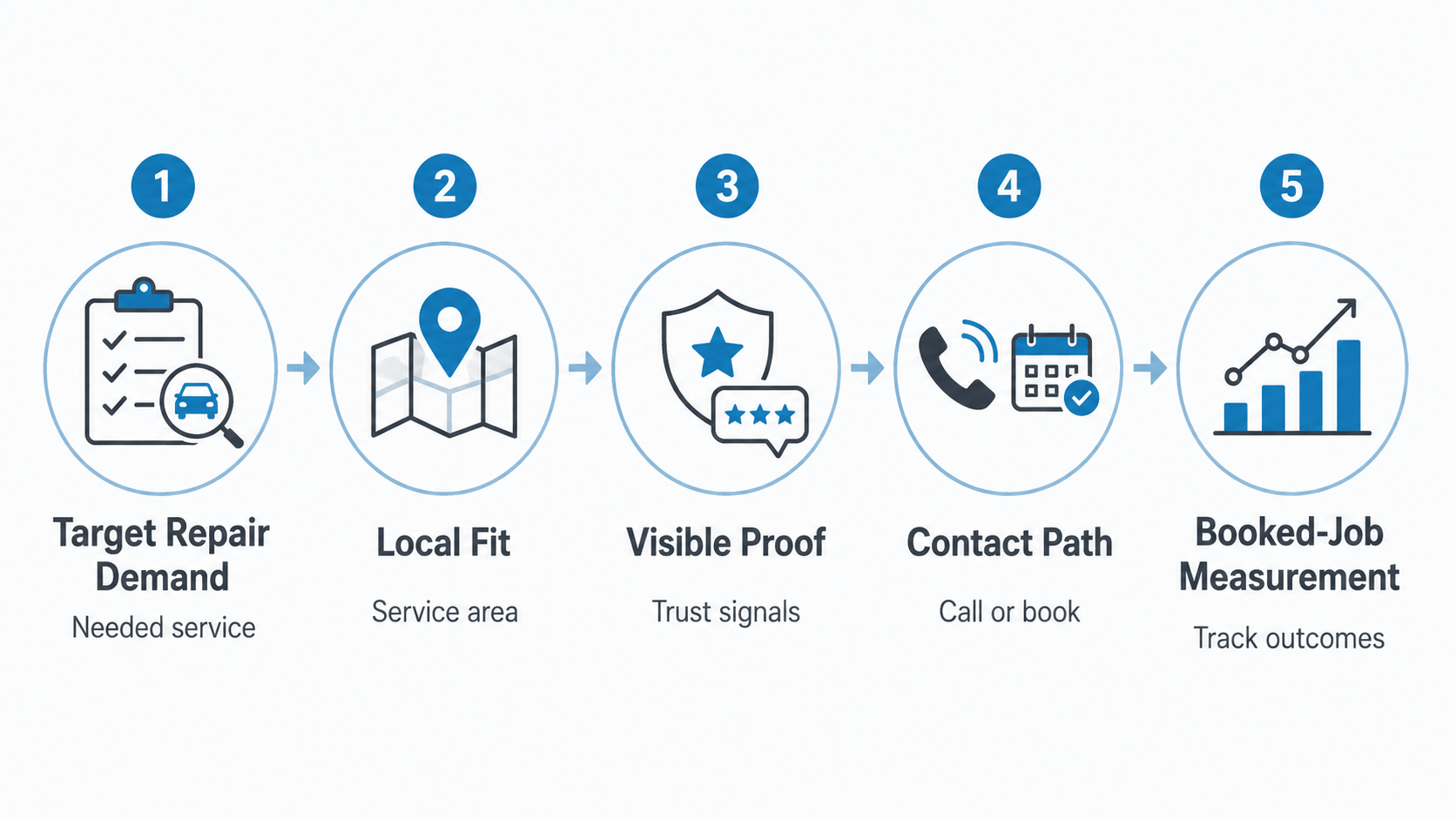
This one-page campaign brief card is the practical asset for the campaign. Complete it for one service or customer problem at a time. If a line cannot be answered, the campaign is not ready yet.
| Brief card | Decision to write down | What to verify after launch |
|---|---|---|
| Target demand | Which service, concern, or customer type do we want more of? | Did inquiries match the intended demand? |
| Local fit | Which area can the shop serve promptly and profitably? | Were calls within the workable area? |
| Proof | What can the driver verify before contacting the shop? | Did callers understand the service and why the shop fits? |
| Contact path | Should the driver call, book, request an estimate, or ask a qualifying question? | Did the next step create scheduled work? |
| Booked-job threshold | How many completed jobs and how much gross profit justify the cost? | Did the campaign meet the threshold without exceeding capacity? |
Three Message Examples to Adapt, Not Copy
The message should name a real customer concern and point to proof the shop can provide. Adapt these examples to the shop’s actual service process, hours, availability, and local area before publishing or paying to promote them.
| Channel | Message direction | Proof and next step |
|---|---|---|
| Search ad for brake work | Concern-first: “Brake noise or soft pedal? Get a clear brake inspection.” | A brake service page that explains the inspection, current availability, and how to call or request an appointment. |
| Direct mail for seasonal AC service | Local and timely: “Before hot-weather driving, schedule an AC performance check.” | A defined service area, a clear offer if one is genuinely available, and a trackable phone number or booking code. |
| Reactivation for known customers | Service-history-led: “If your last maintenance visit was a while ago, we can help you plan the next recommended service.” | Use only where the customer relationship and service record support the message; give one easy booking action. |
Measure the Advertising Outcome, Not Only the Lead
A call or form can be valuable, but it is only the beginning of the outcome. The shop needs a consistent way to tell whether an inquiry was qualified, booked, completed, and profitable enough for the service mix. This is especially important when two channels create different types of work.
| Input | Example | Decision use |
|---|---|---|
| Campaign cost | $2,400 | Include media, creative, tools, and landing-page costs. |
| Gross profit per completed job | $240 | Use the service the campaign is intended to produce. |
| Break-even completed jobs | 10 jobs ($2,400 / $240) | Sets the minimum completed-work threshold. |
| Qualified-call to booked-job rate | 50% | Shows whether the message, intake, or offer needs work. |
| Available capacity | 12 additional jobs this month | Prevents advertising work the team cannot schedule. |
Use the Ads Revenue Calculator to model the shop’s own margin, capacity, and response assumptions before committing to a larger budget.
For source-level call review, see automotive call tracking.
A Real Example of an Advertising System
The published Fair Cars USA case study describes a hybrid repair shop that combined a new website and service pages, targeted Google Search campaigns, Google Business Profile work, and improved phone handling. Its reported call figures and cost per call apply to that specific market, budget, campaign period, and service niche. The useful lesson is the system: demand capture, service-page relevance, local proof, and call handling were treated as connected parts of one customer path.
Common Auto Repair Advertising Mistakes
- Buying broad reach before deciding which repair work the shop wants and can serve.
- Sending every click to the home page instead of a service-specific contact path.
- Using price, speed, guarantee, or ranking claims the team cannot support.
- Expanding an ad budget while calls are missed, unqualified, or not recorded consistently.
- Using the same follow-up offer for every customer regardless of service history or current need.
- Judging a campaign by clicks, impressions, or leads without checking booked and completed jobs.
FAQ
What is the best advertising for an auto repair shop?
The best advertising is the channel that reaches a clear customer need and produces work the shop can deliver profitably. Search ads can fit urgent, defined repairs; direct mail can fit a precise local area and offer; customer follow-up can fit known maintenance or declined work. Measure booked jobs before expanding.
Should an auto repair shop advertise on Google?
Google advertising can be useful when the shop has a specific service, local targeting, a matching page, and a reliable call or booking process. Review qualified calls and completed work rather than assuming every click or lead is valuable.
How do auto repair shops track advertising results?
Track the source, qualified calls, booked appointments, completed jobs, gross profit, capacity fit, and recurring objections. Use unique tracking numbers, tagged forms, offer codes, and consistent front-desk source questions where appropriate.
Does direct mail still work for auto repair shops?
It can work when the geography, service reason, offer, and tracking method are specific. A shop should test a manageable area and measure booked work, not assume a response from a broad mailing will be profitable.
Should a repair shop use discounts in advertising?
A discount is useful only when it supports the desired service mix and margin. Test it against other messages such as convenience, diagnostic clarity, availability, relevant expertise, or a defined service process. Do not use a discount to compensate for an unclear customer path.
Choose Advertising That Fits the Shop
The strongest advertising strategy creates a relevant reason for the right driver to call, then gives the team a workable path to book and complete the job. Choose one customer need, build proof around it, measure the result through completed work, and improve the weak link before adding another channel.
Shops that need help connecting search demand, local visibility, conversion paths, and call measurement can review auto repair lead generation.
For hands-on management of Google Ads and Local Services Ads after the campaign brief is clear, review auto repair PPC advertising.
When the advertising brief exposes missing service pages or weak local visibility, explore SEO for auto repair shops.