

Auto Repair Referral Program: A Margin-Safe Shop Guide

An auto repair referral program should not be a standing discount that every customer learns to expect. It should be a simple system for recognizing a new customer who arrived because someone trusted the shop enough to recommend it. The program works only when the team can identify the referral, protect the economics of the first job, and deliver the reward after the promised condition is met.
For independent repair shops, word of mouth often already exists. The operating problem is that it arrives as a name mentioned at check-in, a note in an advisor’s head, or an untracked coupon. A repeatable program turns that informal signal into a completed-job record without replacing the trust that created it.
Contents:
- Start With a Readiness Check, Not a Reward
- The Referral Program Economics Worksheet
- Define a Qualified Referral Before You Promote It
- Copy-and-Customize Referral Program Terms
- Make the Staff Handoff Easy to Repeat
- Customer Messages That Do Not Sound Like a Review Request
- Three Counter Scenarios for Staff
- Keep Referrals Separate From Reviews
- Run a 90-Day Pilot Before Scaling
- Measure Completed Jobs, Not Referral Activity
- Common Referral Program Mistakes
- FAQ
- Make Word of Mouth Visible
Start With a Readiness Check, Not a Reward
A referral offer cannot repair a weak customer experience, unanswered calls, or unclear estimates. Before asking customers to introduce friends and family, confirm that the shop can give those referrals a reason to return.
A shop is ready to pilot a program when it can answer yes to these questions:
- Do completed repair orders show a consistent service experience the team is comfortable putting its name behind?
- Can the front counter identify a new customer, the referring customer, and the service that was actually completed?
- Does the shop know the minimum job value or gross-profit threshold that can support a reward?
- Can an advisor explain the offer in one sentence without promising a discount before the referral is verified?
- Is one person accountable for reviewing pending referrals and issuing earned rewards?
If the answer is no, fix the repair-order record or pickup process first. A referral program magnifies the experience customers are already describing to others, whether that experience is strong or inconsistent.
The Referral Program Economics Worksheet
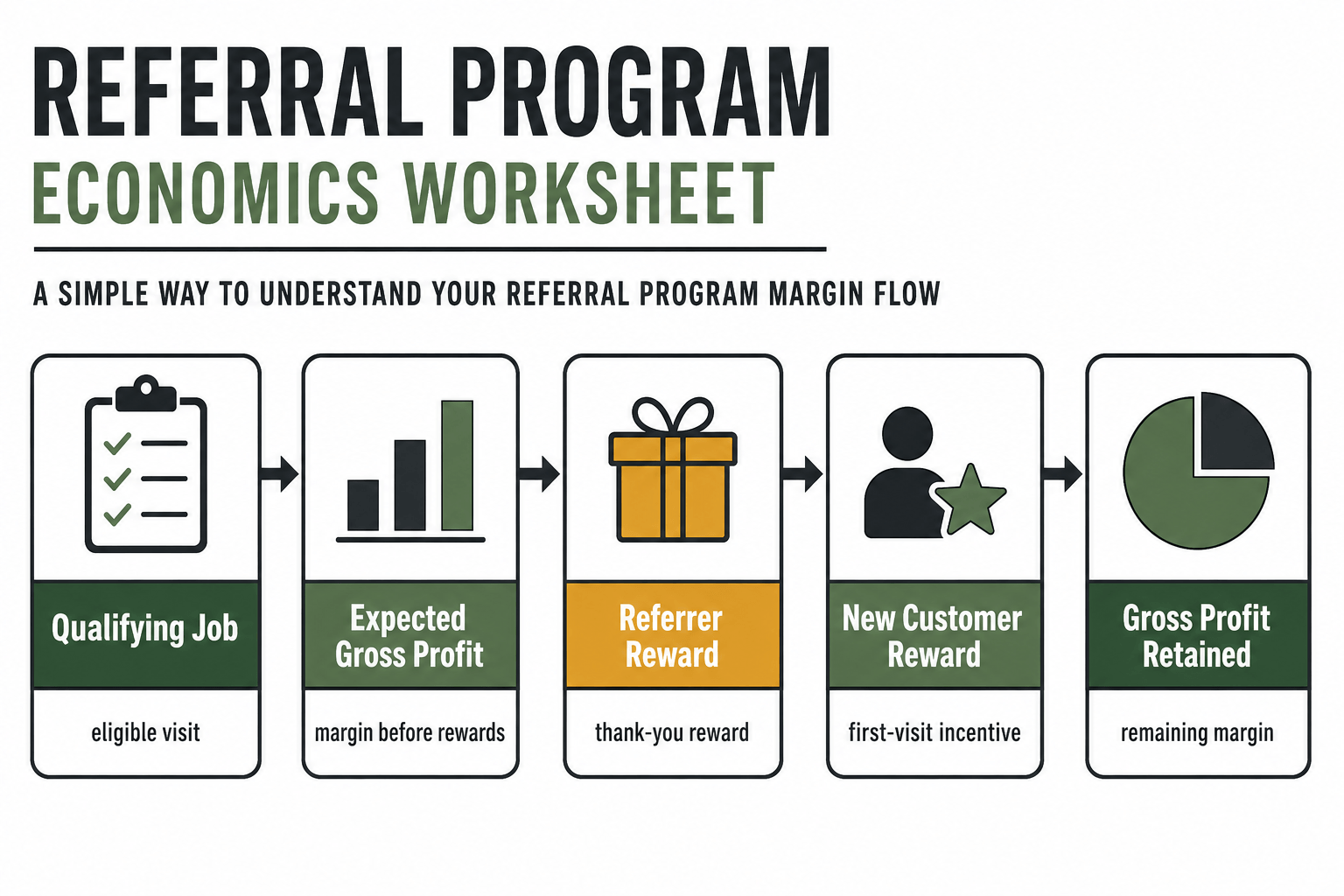
The primary asset is a simple worksheet that sets the maximum cost of acquiring a referred completed repair. Use the shop’s own numbers. Do not choose a reward because another shop advertises the same dollar amount.
| Field | How to calculate it | Decision it supports |
| Qualifying job | Choose the first completed repair order that meets the program’s minimum amount and eligibility rules. | Prevents rewards for a quote, no-show, warranty-only visit, or low-value transaction the shop did not intend to subsidize. |
| Expected gross profit | Qualifying repair revenue multiplied by the shop’s own expected gross-profit percentage. | Shows how much contribution is available before a referral cost is added. |
| Total referral cost | Referrer reward plus new-customer reward plus any card, software, or administration cost. | Sets a ceiling that does not rely on an advertised discount alone. |
| Gross profit retained | Expected gross profit minus total referral cost. | Confirms the program can support the service mix and capacity it is meant to fill. |
Example only: a qualifying repair order of $450 at an expected 55% gross profit produces $247.50 before referral cost. A $25 credit for the referrer, a $25 first-visit credit for the new customer, and $5 of administration cost leave $192.50 before fixed overhead. The numbers are not a recommended universal reward. They show why the shop should decide the reward after it knows the minimum job it wants to attract.
Use credits with a clear expiry only when the shop can honor them without creating pressure on the customer or hiding material terms. If the program uses a discount, gift card, contest, or other promotion, have qualified local counsel review the final terms and the applicable consumer-protection rules.
Define a Qualified Referral Before You Promote It
A referral is not simply a name typed into a form. The shop needs a definition that advisors can apply consistently. Otherwise, customers will hear different rules at booking, pickup, and reward delivery.
| Rule | Recommended decision |
| Who counts | A genuinely new customer who identifies the referrer before or at check-in. Define whether household members, fleet accounts, employees, and prior customers are excluded. |
| What job counts | A completed and paid repair order that meets the shop’s stated minimum service or revenue rule. Do not trigger a reward from an appointment alone. |
| When it is confirmed | After payment and repair-order closeout, when the front counter can verify customer identity, work completed, and the correct referrer. |
| What the reward is | State the exact credit, discount, or other benefit, who receives it, expiry, exclusions, and whether it can be combined with other offers. |
| Who resolves exceptions | Assign a manager or owner to duplicate claims, no-shows, cancelled work, disputes, and goodwill exceptions. Advisors should not invent exceptions at the counter. |
For a dual-sided offer, make the two benefits different if that better protects margin. The referred customer may receive a first-visit credit after a qualifying repair; the referrer may receive a credit toward a future approved service. The key is clarity, not symmetry.
Copy-and-Customize Referral Program Terms
Use this as a starting point, then have the shop’s qualified local adviser review the final wording: “A referral is earned when a new customer identifies the referring customer at or before check-in and completes a paid repair order of at least [minimum amount]. After closeout, the new customer receives [new-customer reward] and the referring customer receives [referrer reward]. Rewards expire [date or period], cannot be combined with [excluded offers], and do not apply to [excluded services or accounts]. One reward applies per qualifying new customer. The shop may verify customer eligibility and resolve duplicate claims before issuing a reward.”
Make the Staff Handoff Easy to Repeat
The program succeeds or fails at ordinary moments: check-in, estimate approval, pickup, and repair-order closeout. The customer should not have to find a special referral page or explain the same relationship to three people. Use a small set of fields on the repair order or CRM.
Record these fields for every claimed referral:
- Referrer’s name, phone or customer ID, and the new customer’s confirmation of the relationship.
- Referral source: code, name, phone number, referral card, partner, or another defined path.
- Date claimed, advisor who recorded it, and the repair order attached to the claim.
- Eligibility state: pending, qualified, completed, reward issued, declined, or exception under review.
- Reward type, amount, issue date, expiry date, and any reason the claim was not accepted.
A pickup prompt can remain natural: “Were you referred to us by someone we should thank?” That question is enough to capture a name before the repair order is closed. It does not require the advisor to sell a program while the customer is deciding whether to approve work.
Use both a code path and a name-or-phone path. Codes are easy to automate, but customers often recommend a shop in conversation rather than by forwarding a link. A manual path protects that real-world behavior and avoids losing a valid referral because the customer did not carry a code.
Customer Messages That Do Not Sound Like a Review Request
| Moment | Copy-and-customize message |
| After a qualifying pickup | Thanks for trusting us with your [vehicle]. If someone you know needs repair, have them mention your name or share this code: [code]. When they complete a qualifying repair, you will both receive the program reward. Terms: [link or short terms]. |
| When a referral is recorded | Thanks, [Name]. We recorded [referrer name/code] with your repair order. We will confirm eligibility after the qualifying repair is completed and paid. |
| When a reward is issued | Your referral has been confirmed. Your [reward] is now available through [expiry date]. Thank you for recommending the shop. |
Do not add a star-rating request, review link, or public-post condition to these messages. The reward is for a completed referral, not an endorsement.
Three Counter Scenarios for Staff
- Name-only referral: The new customer says a friend recommended the shop but has no code. The advisor records the friend’s name and phone number, marks the claim pending, and verifies the record after the qualifying repair closes.
- Code-based referral: The customer presents a code at booking or check-in. The advisor attaches the code to the repair order, confirms the program terms, and does not promise a reward until payment and eligibility are verified.
- Duplicate claim: Two customers claim the same new repair order. The advisor records both claims, explains that a manager will review the program record, and does not decide the exception at the counter.
Keep Referrals Separate From Reviews
A referral reward is for introducing a new customer who completes qualifying work. It should never depend on a positive review, a star rating, a public social post, or the removal of negative feedback. These are different customer actions with different trust and compliance concerns.
The FTC explains that incentives for consumer reviews cannot be conditioned on a particular sentiment, such as a positive review. Review the FTC’s consumer-review guidance before combining any customer reward with a review request.
If a customer is rewarded and then chooses to make a public endorsement or social post, disclosure may also matter. The FTC’s Endorsement Guides Q&A explains why material connections can affect how audiences evaluate an endorsement.
The cleanest operating rule is to let a customer refer a friend without requiring any public praise. Ask for honest reviews separately, without a referral reward attached, and manage both activities under their own written policies.
Run a 90-Day Pilot Before Scaling
Start with one location, one qualifying rule, and one way to record referrals. A smaller pilot exposes unclear language and missing repair-order fields before the shop distributes cards, texts, or links to its entire customer base.
- Days 1-30: choose the qualifying job rule, reward cap, exception owner, repair-order fields, and customer-facing terms. Train the front counter with five sample referral scenarios.
- Days 31-60: offer the program only after completed jobs that meet the readiness standard. Review every pending claim weekly and correct duplicate or missing records quickly.
- Days 61-90: compare completed referred jobs with the reward cost, gross profit retained, booking capacity, and customer-service burden. Keep, revise, or pause the program using the scorecard below.
Do not scale because cards were handed out or links were clicked. Scale only when the shop can see completed jobs, a supportable reward cost, and a process the team can execute without arguing at the counter.
Measure Completed Jobs, Not Referral Activity
The scorecard should distinguish a claimed referral from a completed qualifying repair. That separation gives the owner a fair comparison with other acquisition paths and prevents a high number of unverified referrals from looking like success.
| Measure | Formula or record | Question for the weekly review |
| Claim-to-booked rate | Referred customers with an accepted appointment divided by referral claims. | Are claims becoming real visits, or is the offer attracting curiosity without commitment? |
| Booked-to-completed rate | Completed qualifying referred repair orders divided by referred bookings. | Is the service path, estimate process, or eligibility rule stopping referrals from becoming work? |
| Referral acquisition cost | Total rewards and program cost divided by completed qualifying referred jobs. | Does the cost fit the shop’s expected gross profit and available capacity? |
| Reward issue accuracy | Correctly issued rewards divided by rewards reviewed. | Are advisors, the CRM, and the accounting record using the same program rules? |
| Repeat or referral quality | Service mix, repair-order value, and return behavior of completed referred customers, viewed as a trend. | Is the program bringing work the shop wants more of, not just more transactions? |
A referral program is one acquisition option, not a replacement for every demand channel. Use the auto repair marketing ideas guide to compare it with search, local visibility, follow-up, and other choices based on the shop’s actual bottleneck.
Common Referral Program Mistakes
- Paying the reward at booking instead of after a qualifying completed repair, then trying to recover it when the job cancels.
- Offering one broad discount without a minimum job, expiry, combination rule, or margin check.
- Treating every familiar customer as new because the front counter cannot see prior repair history.
- Combining the referral reward with a request for a positive review or social endorsement.
- Using automated messages before the shop has decided who owns replies, exceptions, opt-outs, and customer questions.
- Reporting the number of referral codes sent instead of completed referred jobs and reward cost.
FAQ
What is an auto repair referral program?
It is a structured way for a repair shop to recognize and track new customers referred by existing customers. The program defines who qualifies, what completed work triggers a reward, what each person receives, and how the shop records the result.
Should a referral reward be paid when the appointment is booked?
Usually, no. Tie the reward to the qualifying repair order after payment and closeout. That protects the shop from no-shows, cancelled work, unapproved estimates, and referrals that do not meet the program rule.
What referral reward should an auto repair shop offer?
Choose a reward after calculating the qualifying job’s expected gross profit and the full program cost. A service credit, first-visit credit, or other benefit can work when the terms are clear and the shop can honor them. Avoid copying a competitor’s dollar amount without checking margin.
Can a referral program also ask for reviews?
Keep the actions separate. A program may thank a customer for a completed referral, but it should not require a positive review, a rating, or a public post. Ask for honest feedback under a separate process and review applicable platform and legal rules.
Does a repair shop need referral software?
Not for a pilot. A repair order, CRM fields, and a weekly ledger can show whether the program is working. Software becomes useful when the shop has a stable definition, enough volume, and a manual process that is creating errors or missed rewards.
Make Word of Mouth Visible
Start with one completed-job rule, one reward cap, and one repair-order workflow. Then run the program long enough to see completed referred repairs, not just referral claims. When the shop can connect a customer’s recommendation to a completed job and a supportable cost, word of mouth becomes a channel the owner can improve without turning trust into a generic discount campaign.
When referrals are working but the shop needs to compare them with paid search, local visibility, and tracked calls, review Element DMA’s auto repair lead generation approach.