

Social Media for Auto Repair Shops: A 30-Day Trust-to-Booking System
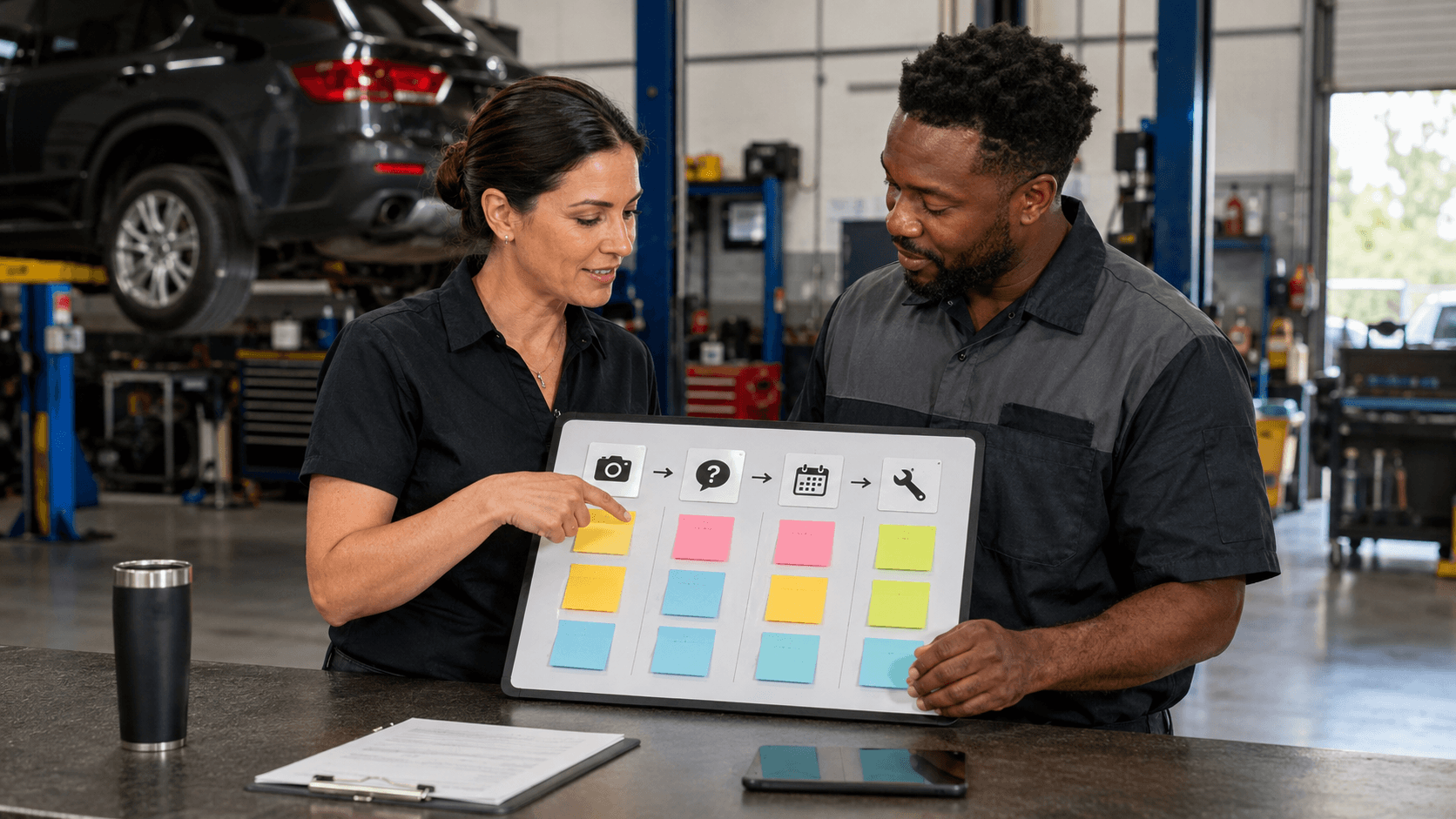
Social media for auto repair shops is usually a trust and recall channel, not the place a driver starts when a vehicle has already failed. That distinction changes the work. A post does not need to manufacture an emergency repair search. It needs to make a local customer more comfortable choosing the shop when they later compare options, ask a friend, see a review, or visit the website.
The goal is not a larger follower count or a feed full of generic maintenance tips. It is a repeatable system that shows real proof of the shop’s work, gives the front counter a simple response path, and records whether social activity assisted a booked job. This guide is for an independent repair shop with limited owner and advisor time.
Social is one part of a wider local acquisition mix. Use the shop’s auto repair marketing ideas guide to decide whether social, search, reviews, retention, or another channel addresses the current bottleneck.
Contents:
- Start With the Problem Social Can Actually Solve
- Choose a Trust Role Before You Choose a Platform
- Run the 30-Day Trust-to-Booking Plan
- Use Two Platforms, Not Every Platform
- Create Five Kinds of Proof Instead of Filling a Calendar
- Make the Post-to-Booking Handoff Obvious
- Measure an Assisted Booked Job, Not Likes
- Protect Customer Trust in Photos, Testimonials, and Reviews
- Use the 30-Day Calendar and Assisted Booking Scorecard
- Six Reply Scripts for Comments and Direct Messages
- Proof Capture Checklist Before a Post Goes Live
- Choose a Content Role by Shop Type
- Frequently Asked Questions
- Make Social Proof Earn Its Place
Before assigning posts, name the decision social is meant to influence. Urgent demand is normally better served by search visibility, a clear service page, and an answered phone.
| What the shop needs | Can social help? | The right first move | What to measure |
| More calls today for an urgent repair | Usually not as the primary channel. | Fix the search, service-page, call-answering, and availability path first. | Qualified calls, booked jobs, missed calls. |
| Drivers to trust the team before choosing | Yes. Show genuine work, people, process, and local proof. | Build a proof-led post series linked to a useful next step. | Profile visits, direct questions, assisted bookings. |
| Past customers to remember the shop | Yes, when the message is relevant and the shop can respond. | Use seasonal, service-specific, or community content. | Repeat-customer inquiries and completed work. |
| A slow specialty service to fill | Sometimes. It needs capacity, an honest offer, and a landing path. | Run a short, tracked campaign for one service. | Requests, booked jobs, gross profit when reliable. |
This keeps social media marketing for auto repair shops from becoming a vague promise to ‘get more customers.’ A shop earns better decisions when each post has a role and an outcome it can observe.
Choose a Trust Role Before You Choose a Platform
Choose one proof problem and state it clearly. Example: ‘We make brake and suspension recommendations easier to understand by showing inspection evidence and the next decision.’
| Trust role | Evidence to collect | Best next step | Do not turn it into |
| Technical confidence | Non-sensitive before/after evidence, technician explanation, diagnostic process. | Ask a service-specific question or view the relevant page. | A remote diagnosis or a safety promise. |
| Human familiarity | Advisor introductions, shop standards, local participation, behind-the-scenes work. | Call, message, or save the shop for later. | Staff pressure to perform or staged testimonials. |
| Decision clarity | What an inspection includes, how estimates are explained, how appointments work. | Request a time or ask a process question. | A price guarantee that the shop cannot honor. |
| Repeat-customer recall | Seasonal service context, maintenance education, capacity-based reminder. | Book a relevant visit. | A generic discount every week. |
Run the 30-Day Trust-to-Booking Plan
Use two platforms, three posts a week, and one response owner.
| Week | Work to complete | Publish | Owner and review |
| 1: Set the baseline | Check profiles, phone, booking link, service focus, photo permission process, and response owner. | One team/process post and one service-proof post. | Manager tests every contact path; advisor logs questions. |
| 2: Build proof | Collect three real work moments without customer data or plate numbers. | One explanation, one before/after, one team or process post. | Technician supplies context; advisor checks accuracy. |
| 3: Test one offer | Choose a service the shop has capacity to fulfill and define the booking path. | One tightly scoped offer plus two proof posts. | Campaign owner tags inquiries and pauses if capacity fills. |
| 4: Review outcomes | Compare post activity with inquiries, calls, bookings, and staff workload. | Repeat the proof format that produced useful questions. | Manager keeps, changes, or stops the next month’s plan. |
Do not schedule a month of content before week one exposes a broken link, an unclear service promise, or a response problem. The plan is a feedback loop, not a production quota.
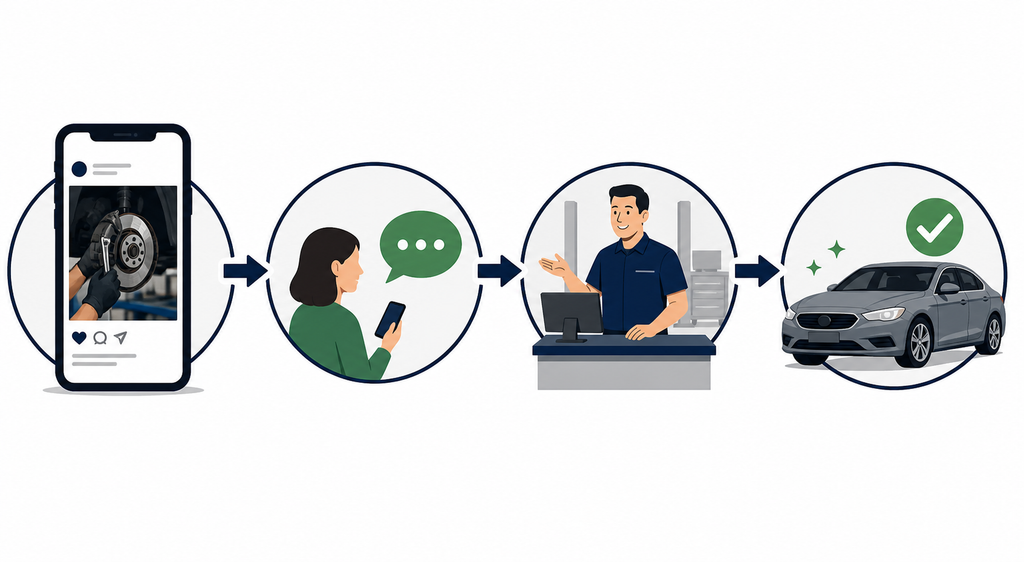
Workflow: real repair proof creates a customer question, an owned advisor handoff, and an assisted booked-job outcome.
Use Two Platforms, Not Every Platform
Choose platforms based on the customers the shop already serves and the proof it can create reliably. Maintain an accurate, responsive presence instead of claiming every network.
- Choose one home for local conversation and one home for visual proof; cross-post only when the format still makes sense.
- Use the same shop name, service area, contact path, and core service positioning everywhere a customer can compare you.
- Do not use platform features as a substitute for a useful website or a verified business profile.
- Reserve paid social for a defined audience, offer, capacity limit, landing path, and booked-job review. It is not the same article as the future Facebook-ads campaign guide.
Google’s guidelines for representing your business are a useful reference when the same business information appears across local surfaces.
Create Five Kinds of Proof Instead of Filling a Calendar
Use content that answers a real customer uncertainty. Each example must be truthful, approved, and stripped of identifying information.
| Content job | What to show | Caption angle | Practical CTA |
| Inspection clarity | A non-sensitive component or process step. | What the team checks before recommending work. | Ask about an inspection or call to discuss a symptom. |
| Repair evidence | A genuine before/after or completed repair with permission. | What changed and what decision the customer made. | See the service process or request a visit. |
| Team credibility | Technician/advisor role, training, or a shop standard. | Who handles a specific part of the customer experience. | Meet the team or ask a service question. |
| Local relevance | Weather, road-trip, towing, fleet, or community context that is actually timely. | Why one check matters in this local context. | Plan a relevant appointment. |
| Process transparency | Estimate, drop-off, update, or pickup process. | What a customer can expect before arriving. | Call or use the booking path. |
Use evidence to reduce uncertainty, never to diagnose another vehicle or create anxiety.
Make the Post-to-Booking Handoff Obvious
Every campaign needs one primary handoff: call, booking page, message, or service page. Assign the response owner before publication.
| Customer action | Response standard | Record | Escalate when |
| Comment asks a service question | Acknowledge publicly without diagnosing; invite the right private or phone path. | Service type and contact outcome. | Safety concern, pricing dispute, or vehicle-specific diagnosis is requested. |
| Direct message requests a time | Confirm what service is needed, offer the actual booking path, and set the next expectation. | Source post, requested service, booking result. | The schedule, vehicle condition, or estimate needs an advisor. |
| Post drives a call | Ask how the caller found the shop without turning it into an interrogation. | Social-assisted call and completed-job outcome. | The caller needs immediate towing, safety, or warranty guidance. |
| Offer capacity fills | Pause or edit the offer immediately. | Date, volume, and remaining capacity. | The post continues to attract work the shop cannot fulfill. |
When the constraint is a shortage of first-time, high-intent demand rather than trust or retention, assess the broader auto repair lead-generation system instead of expecting organic posts to carry the entire acquisition target.
Measure an Assisted Booked Job, Not Likes
Likes, reach, and views are diagnostics. They may help the shop decide which format earned attention, but they do not prove revenue. Add one simple source question to the call, form, or advisor workflow: ‘Did you see us on social, search, a referral, or somewhere else?’ Record social as assisted when the customer mentions it, follows a tagged link, sends a message, or arrives through a campaign-specific booking path. Do not force a customer to choose one source when the path was mixed.
| Stage | Minimum field | Weekly decision |
| Content | Post type, service focus, CTA, and publish date. | Which proof format generated questions worth answering? |
| Contact | Comment, message, call, or tracked link; response owner; response outcome. | Was the handoff fast and clear enough? |
| Booking | Requested service, appointment status, capacity fit, source or assisted source. | Did social activity create work the shop could actually schedule? |
| Completed job | Completed work and gross profit only when attribution is reliable. | Should the shop repeat, refine, or stop this topic or offer? |
Avoid a universal return-on-investment benchmark. Establish a baseline for one shop, one service focus, and one response process. A lower-reach post that causes three qualified brake questions may be more valuable than a high-reach post that produces no workable conversation.
Protect Customer Trust in Photos, Testimonials, and Reviews
The easiest proof is often a customer’s words or vehicle. It is also where a rushed content process can create avoidable issues. Use a clear internal permission process, remove identifying information, and let the customer decide whether their name, image, vehicle, or comment is used. Never script a customer review, offer a reward conditional on a positive review, or edit a testimonial until it changes the customer’s meaning.
The Federal Trade Commission’s Endorsement Guides explain why endorsements and material connections require care. Treat them as a practical governance reference, not as legal advice for a specific shop.
- Create a simple approval record before publishing customer photos, quotes, or video.
- Blur or exclude plates, VINs, personal documents, contact details, and private repair-order information.
- Let the advisor route complaints, warranty questions, and vehicle-specific diagnosis away from public comments.
- Review who has admin access and remove former employees or vendors promptly.
Use the 30-Day Calendar and Assisted Booking Scorecard
The accompanying workbook records the post’s proof role, service focus, CTA, reply owner, contact source, booking result, and completed-job outcome. Start with one service focus.
Six Reply Scripts for Comments and Direct Messages
These scripts give the front counter a consistent next step without diagnosing a vehicle in public. Replace bracketed text with the shop’s actual service, booking path, and availability.
| Customer moment | Reply script | Owner action |
| Public price question | Thanks for asking. Pricing depends on the vehicle and what inspection shows. Send us the year, make, model, and concern by message, or call [number]. | Move specifics to the advisor path. |
| Public symptom question | We are glad to help you plan the right next step. Because symptoms can have different causes, call [number] or request an inspection at [link]. | Do not diagnose in comments. |
| DM asks for a time | Thanks for reaching out. What service or concern would you like us to schedule? We can check available times after we confirm the vehicle details. | Record social-assisted source. |
| Comment after a repair-proof post | Thank you. This repair started with an inspection and a clear estimate. If your vehicle has a similar concern, call [number] or use [link]. | Use only when the comparison is honest. |
| Complaint or warranty concern | We want to review this properly. Please send your best contact number and repair-order details by private message, and [name/role] will follow up. | Route to the named resolution owner. |
| Offer capacity is full | Thank you for the interest. The current [service] times are filled; call [number] and we will discuss the next available option. | Pause or edit the post immediately. |
Proof Capture Checklist Before a Post Goes Live
Use this short check while the repair is still in the bay. It prevents the team from building a content calendar out of vague photos or customer information.
- The post shows a real service, process, or team standard the shop can explain accurately.
- The image contains no plate, VIN, invoice, phone number, customer name, or private message.
- The claim is limited to what the shop inspected or completed; it does not diagnose another vehicle or promise an outcome.
- The CTA leads to one working call, message, or booking path with a named reply owner.
Choose a Content Role by Shop Type
| Shop context | Prioritize | Avoid |
| Small general-repair shop | Estimate transparency, approachable team proof, and seasonal maintenance reminders. | Daily discounts or content that implies same-day capacity. |
| Diagnostic or specialty shop | Inspection process, technician explanation, and evidence that shows how decisions are made. | Remote diagnosis, technical jargon without context, or generic oil-change content. |
| Fleet-focused shop | Process reliability, planned maintenance, service communication standards, and capabilities the shop can fulfill. | Consumer-style promotions that distract from fleet decision-makers. |
This remains an organic-social guide, not a paid Facebook campaign guide.
Frequently Asked Questions
Does social media work for auto repair shops?
It can work when the shop uses it to build proof, local familiarity, retention, or a tightly scoped offer. It is usually not the first remedy for an empty calendar caused by weak search visibility, unanswered calls, or a broken booking path. Measure useful conversations, booked work, and staff capacity instead of treating follower count as success.
What should an auto repair shop post on social media?
Post truthful evidence that reduces customer uncertainty: inspection clarity, real repair process, team expertise, transparent service expectations, and locally relevant maintenance context. Do not post identifying vehicle data, generic filler, copied testimonials, or claims that amount to a diagnosis without an inspection.
How often should an auto repair shop post?
Start with a cadence the shop can sustain and answer. Three useful posts a week on one or two channels is more valuable than daily content that the team cannot verify or follow up. Increase frequency only after the shop can show that its posts and responses create relevant booked work.
Should an auto repair shop run paid social ads?
Paid social can support a capacity-limited offer, retargeting, or local awareness when the audience, landing path, response owner, and booked-job measure are defined. It should not be confused with search advertising for urgent repair intent, and it needs its own campaign structure and budget review.
The social media system that helps an independent repair shop is small, visible, and accountable. Show real evidence of how the shop works, make the next customer action simple, give every response an owner, and review completed jobs rather than vanity metrics. When a post cannot serve one of those purposes, it does not need to be published.