

A practical guide to radio advertising for auto repair shops
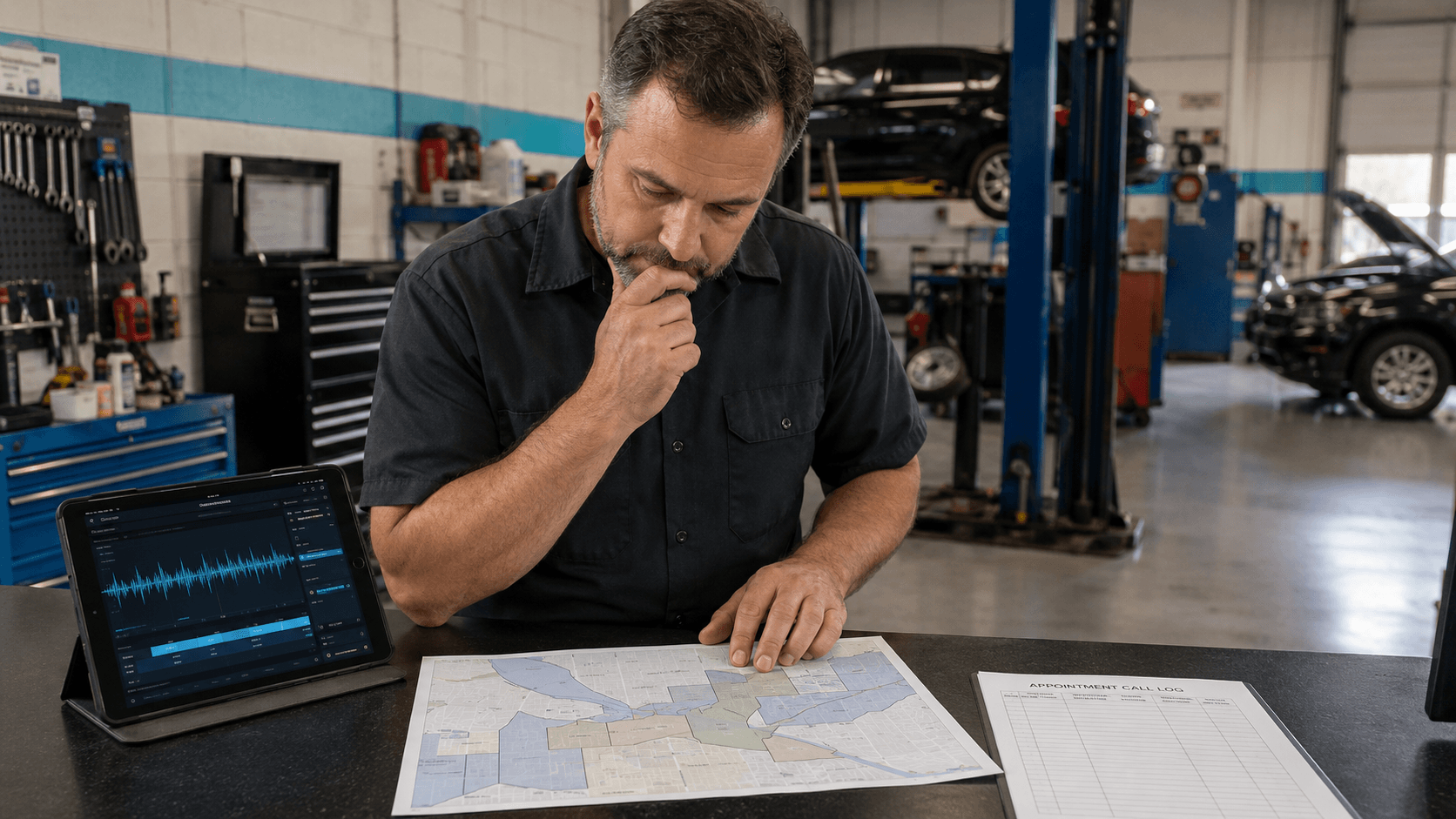
Radio advertising can put an auto repair shop name in front of local drivers repeatedly, but reach alone does not make it profitable. A station can cover a large area while most listeners live outside the shop’s practical service area. A memorable spot can create interest while the phone line, offer, or landing page makes it impossible to prove whether that interest became a booked job.
The right question is not whether radio works in general. It is whether one local campaign can reach the kind of customer the shop wants, for a service the shop can deliver, with enough tracking to make a clear keep-or-change decision. That makes radio advertising for auto repair a local operations decision as much as a media decision.
Before buying, check radius fit, choose an offer that fits radio, build a response path, and compare campaign cost with completed gross profit rather than raw impressions.
Contents:
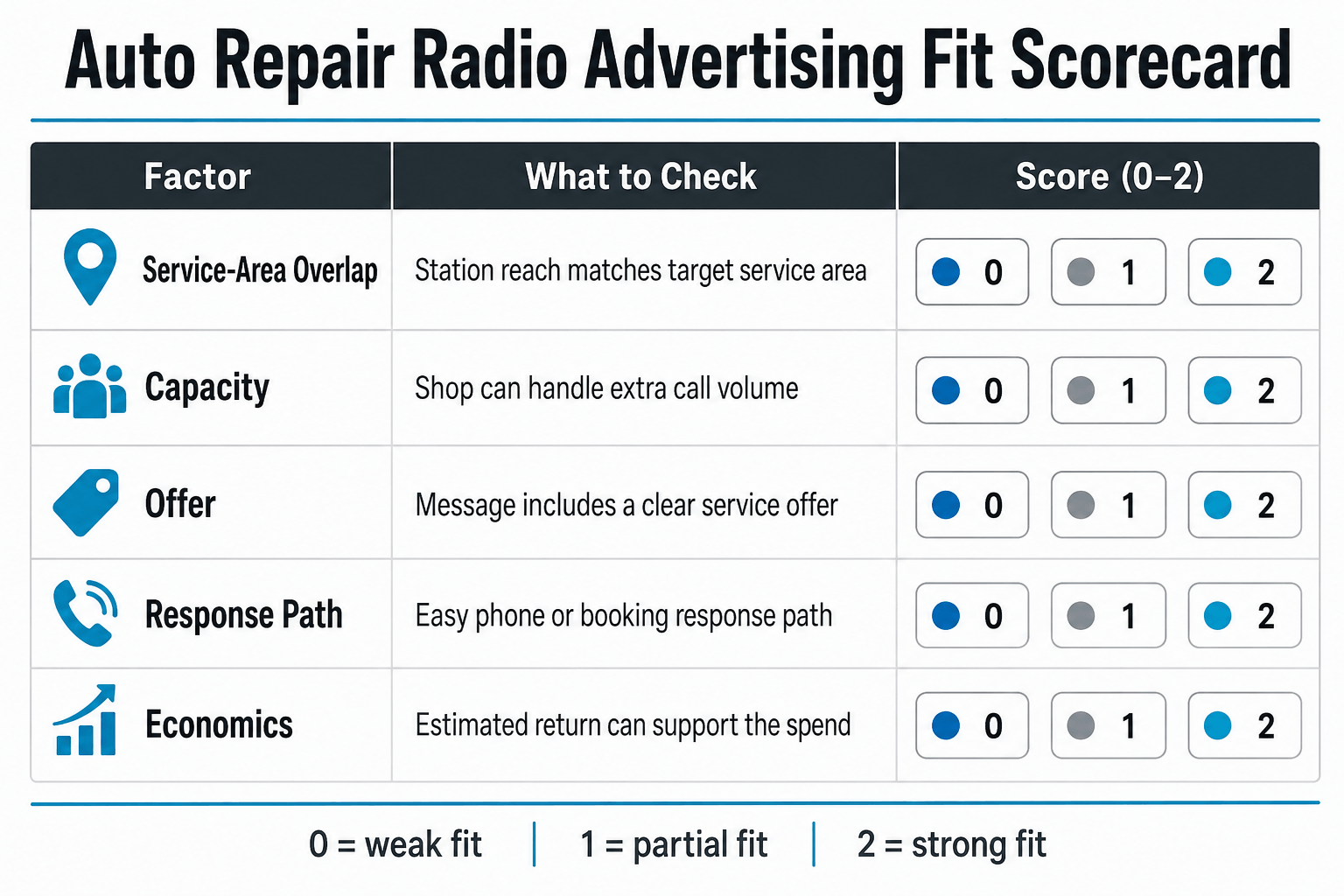
- Start With a Radio Fit Scorecard
- 1. Define the Radius Where Radio Can Produce Repeat Work
- 2. Give the Campaign One Job
- 3. Build a Spot Drivers Can Recall Safely
- 4. Buy Reach and Frequency Inside the Local Fit
- 5. Set Up Attribution Before the First Spot Airs
- 6. Use Booked-Job Math Before Calling the Test a Win
- 7. Pair Radio With the Places Drivers Check Next
- Common Radio Advertising Mistakes for Repair Shops
- A Simple Launch Sequence
- FAQ
- Treat Radio as a Measurable Local Test
Start With a Radio Fit Scorecard
Score each line from 0 to 2 before asking a station for a proposal. A low score means fix the weak condition first or test a more targeted channel.
| Check | 0 points | 1 point | 2 points |
|---|---|---|---|
| Service-area overlap | Most listeners are outside the practical drive area | Station reaches some priority ZIP codes | Station audience aligns with priority ZIP codes or neighborhoods |
| Capacity | Schedule is already constrained | Some capacity in selected services | Open bays and a clear service mix to promote |
| Offer | Generic ‘we fix cars’ message | One service plus a vague promotion | Specific local service, proof, and easy next action |
| Response path | No unique number, page, or code | One tracking method only | Tracked phone number, URL/code, and front-desk logging |
| Economics | No gross-profit or booked-job target | Rough target only | Break-even jobs and review date agreed before launch |
A practical rule: 8 to 10 points is a reasonable test candidate, 5 to 7 calls for a narrower buy or a stronger offer, and 0 to 4 usually means solve local fit or attribution before committing. The point of the scorecard is disciplined planning, not a universal media-buy formula.
1. Define the Radius Where Radio Can Produce Repeat Work
Not every caller is equally valuable to a neighborhood repair shop. Before the buy, pull the previous six to twelve months of repair orders and group customers by ZIP code, neighborhood, or drive time. Look for where repeat maintenance, profitable repairs, and dependable appointments actually come from.
- Mark the ZIP codes or neighborhoods that supply repeat customers and the services they commonly buy.
- Separate a destination repair, such as a specialist diagnostic or a fleet job, from routine maintenance that customers usually obtain closer to home.
- Ask the station for coverage by daypart and geography, not only a total audience estimate.
- Compare the station’s core coverage with the shop’s priority areas before comparing rates.
- Keep a separate note for areas where the shop cannot reliably serve the driver because of distance, towing limits, or schedule constraints.
A specialty transmission, diesel, European, collision, or fleet shop may have a broader practical radius than a general-maintenance shop. The useful radius is therefore based on service mix and customer behavior, not a fixed number of miles copied from another business.
2. Give the Campaign One Job
Radio is easier to evaluate when it has one job. A shop can use it to build local recall, fill capacity for a seasonal service, introduce a new location, or support a specific repair category. Trying to sell every service, every convenience feature, and every discount in one spot makes the message difficult to remember and the result difficult to measure.
| Campaign job | Good radio message | Response path | Avoid |
|---|---|---|---|
| Seasonal demand | AC inspection before sustained heat or winter-ready inspection | Dedicated phone number and appointment page | A long list of unrelated repairs |
| New-location awareness | Location, neighborhood, services, and a trust reason | Simple map page and unique code | Pretending every listener needs an immediate repair |
| Higher-value service | Diagnostics, brakes, tires, diesel, or fleet service the shop truly performs | Service-specific call script | Cheap offer that attracts work the shop does not want |
| Local recall | Shop name, area served, proof point, and repeated message | Brand-search and direct-call trend review | Calling every result a direct response |
Urgent breakdowns can be hard to capture with a radio message because the listener may not need the service while hearing it. That does not make radio useless. It means the message should build recall for a future maintenance or repair need, while search visibility and local proof handle the moment a driver actively starts looking.
For a broader way to choose channels by the shop’s current constraint, see auto repair shop marketing ideas.
3. Build a Spot Drivers Can Recall Safely
A 30-second spot needs fewer claims than most owners expect. Use plain language, one service or problem, one proof point the shop can substantiate, and one next step. A technician’s credential, a real warranty term, years serving a neighborhood, same-day diagnostic availability, shuttle service, or a true customer quote can work when it is accurate.
| Time | What to say | Repair-shop example |
|---|---|---|
| 0-5 seconds | Name a local driver problem | Car AC blowing warm during the afternoon drive? |
| 5-15 seconds | Name the relevant service and reason to trust it | Main Street Auto Repair diagnoses and repairs AC systems with clear estimates before work begins. |
| 15-25 seconds | Give a concrete local proof or convenience point | Serving drivers near Oakwood and Westview with early drop-off appointments. |
| 25-30 seconds | Say one action and repeat the shop name | Call the AC line at 555-0100 or visit MainStreetAuto.com/air. |
Use a real shop fact, not a slogan that sounds interchangeable with every competitor. Do not claim to be the cheapest, fastest, highest-rated, or best unless the shop can substantiate the statement. The FTC’s guidance on advertising endorsements and testimonials also applies to radio: testimonials and endorsements must be truthful and not misleading.
4. Buy Reach and Frequency Inside the Local Fit
Do not buy a package only because it includes many spots or a well-known host. Ask how the proposed schedule reaches the priority local audience, which dayparts it uses, whether the station can separate its broadcast signal from online audio inventory, and what reporting will be available after the campaign begins.
| Format | Best fit | Tracking priority |
|---|---|---|
| Broadcast radio | Broad local recall where station coverage matches the service area | Dedicated phone number and front-desk source field |
| Streaming audio | Tighter geography or audience filters | Tagged landing page and dedicated phone number |
| Podcast placement | Niche local or enthusiast audience | Unique URL and campaign code |
Request the exact run dates, inventory type, geography, dayparts, spot length, and any added-value placements in writing. Keep the first test narrow enough to compare one offer and one service area. Use the same core message in the audio creative, landing page, and front-desk script, then review booked work on the date agreed before launch.
5. Set Up Attribution Before the First Spot Airs
Radio rarely gives the clean click trail of paid search, so use more than one signal. The front desk should ask a short source question, the campaign should use a dedicated tracking number when possible, and the campaign page or station social link should be unique. A single method can miss real responses; several consistent methods make the decision more credible.
| Signal | How to set it up | What it tells you | Limitation |
|---|---|---|---|
| Tracking phone number | Use one number only in the spot | Calls and call quality from the campaign | Some listeners will call the main number |
| Memorable URL | Create a short page for the promoted service | Direct visits and appointment actions | Listeners may search the brand instead |
| Station social or web link | Use a tagged URL for the station placement | Visits from a clickable placement | It does not measure over-the-air listening |
| Front-desk source field | Ask every new caller how they heard about the shop | Self-reported radio awareness and context | Staff must ask and record it consistently |
| Offer or campaign code | Use a code tied to one campaign | Redeemed appointments and completed jobs | A discount is not required for a code to work |
For a station social post or campaign landing-page link, use Google Analytics campaign parameters consistently. Google recommends setting source, medium, and campaign values so traffic is not fragmented across reports.
The call log should capture date, caller ZIP code when volunteered, requested service, new or existing customer status, appointment outcome, completed job, revenue, and gross profit where the shop tracks it. A missed call or unbooked estimate belongs in the same review because the campaign cannot pay back when the response path breaks after the phone rings.
A shop that needs source-to-booked-job visibility can review call tracking for auto repair.
6. Use Booked-Job Math Before Calling the Test a Win
A campaign can generate a jingle, a rise in calls, or a station report and still fail to cover its cost. Set the break-even point before the campaign begins.
The SBA’s marketing guidance recommends setting clear goals and reviewing marketing cost against the revenue it generated. For a repair shop, gross profit and booked jobs make that review more useful than activity alone.
| Input | Example | Why it matters |
|---|---|---|
| Campaign cost | $4,000 media plus production | Use all committed campaign costs |
| Gross profit per completed job | $300 | Use gross profit, not only top-line repair order value |
| Break-even completed jobs | 14 jobs ($4,000 / $300 = 13.3, rounded up) | The minimum result needed to cover the campaign |
| Booked-job rate | 20 bookings from 35 qualified calls | Shows whether phone handling or offer fit needs work |
| Decision | Keep, revise, or stop after the agreed review date | Prevents indefinite spend without evidence |
The numbers above are an example, not a benchmark. A shop with a different labor mix, parts margin, capacity limit, or customer lifetime value should calculate its own threshold. Use the Ads Revenue Calculator to test spend, expected calls, close rate, average repair order, and revenue before approving a campaign.
7. Pair Radio With the Places Drivers Check Next
Many listeners will not respond while driving. Later, they may search the shop name, look at reviews, check hours, or compare service pages before calling. That makes the rest of the local presence part of radio campaign readiness, without turning radio into a substitute for search visibility or customer trust.
- Confirm the business name, phone number, hours, and location are consistent wherever a driver is likely to verify them.
- Make the promoted service easy to find on the website, with a clear call or appointment action.
- Keep current photos, real reviews, and service information available for a driver who checks the shop after hearing the name.
- Train the front desk to recognize the campaign, use the right offer details, and record the source without making the call feel scripted.
When the radio campaign exposes gaps in service pages and local search visibility, review SEO for auto repair shops alongside the campaign results.
Common Radio Advertising Mistakes for Repair Shops
- Buying a broad audience without checking overlap with the shop’s profitable neighborhoods.
- Promoting every service in one spot instead of one memorable customer problem.
- Using a main phone number only and expecting the team to remember every source.
- Measuring station impressions while ignoring qualified calls, booked jobs, and completed gross profit.
- Offering a large discount without checking whether the service can support it or whether the shop can handle the response.
- Continuing the campaign after a weak first review without changing the offer, geography, schedule, or response path.
A Simple Launch Sequence
- Map the shop’s priority service area from real repair-order and repeat-visit patterns.
- Choose one campaign job, service, offer, and next action.
- Score local fit, capacity, message, attribution, and economics before buying.
- Create the spot, unique call path, URL or code, front-desk source field, and job-level call log.
- Launch a defined test, review booked jobs and completed gross profit on the agreed date, then keep, revise, or stop.
FAQ
Does radio advertising work for auto repair shops?
It can work when the station reaches the shop’s practical service area, the campaign promotes a clear service or local message, and the shop can track calls, appointments, and completed jobs. It is a weaker fit when most reach falls outside the shop’s useful radius or the shop cannot connect responses to the campaign.
What should an auto repair shop say in a radio ad?
Use one local driver problem, the relevant service, one truthful reason to trust the shop, and one simple next action. Keep the shop name and phone number or memorable URL easy to hear. Avoid piling every service and promotion into one 30-second message.
How do you track radio advertising for an auto repair shop?
Use a dedicated phone number where possible, a short campaign URL or code, tagged digital links, and a consistent front-desk source question. Review qualified calls, booked jobs, completed work, and gross profit together because no single tracking method captures every response.
Should a small repair shop buy radio ads?
A small shop should start only when it has capacity, a defined local audience, a service it wants more of, and a trackable test budget. If missed calls, weak local proof, or poor booking follow-up are unresolved, fixing those issues may produce a better first return.
How long should a radio campaign run before review?
Set the review date before launch based on the scheduled flight and expected booking cycle. Review early enough to catch a broken response path, but evaluate the completed-job result only after customers have had a fair chance to book and finish the promoted service.
Treat Radio as a Measurable Local Test
Radio advertising for auto repair is most useful when it reaches the right local drivers, gives them one credible reason to remember the shop, and feeds into a response path the team can measure. Start with service-area fit, prepare the phone and website before the first spot airs, and judge the test by profitable completed jobs rather than reach alone.

With a background in psychology, Valeriu has worked in sales and marketing for 8+ years, and learned through experience that the best way to do business is to serve clients well, and solve their problems. He has joined Element DMA in September of 2025, attracted by the honest nature of the work and attitude of auto & truck repair shops. In this role, he helps shop owners across the U.S. see the ROI of properly done advertising, and the growth this brings to their shops, regardless of niche or state.