

Marketing Strategy for Auto Repair Shops: 6 Steps to More Booked Jobs
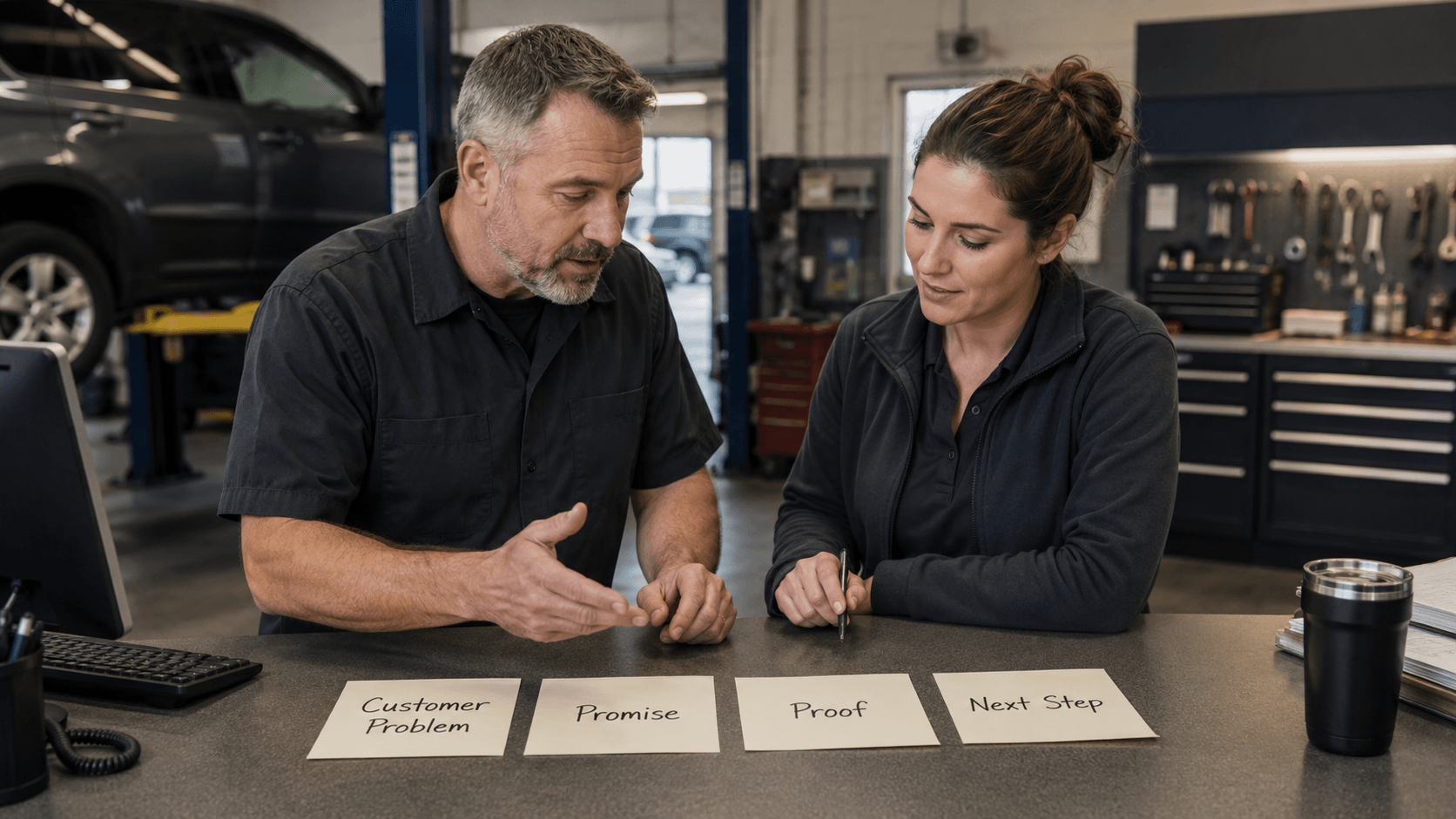
A marketing strategy for an auto repair shop is not a list of channels to try. It is a decision about which customers the shop is best prepared to help, what they should remember, and what proof makes that promise credible. Without those choices, a shop can buy ads, post on social media, collect reviews, and still sound exactly like every competitor nearby.
The goal is not to claim that the shop does everything better. It is to build a practical position around the jobs the team wants, the capacity it has, and the experience it can deliver consistently. The channels come after that.
The six steps in this guide cover the strategic levers behind a useful auto repair marketing strategy: customer fit, promise, proof, service mix, channel choice, and booked-job measurement. Use them before building a marketing plan or campaign calendar.
Contents:
- Strategy Is a Choice, Not a Channel List
- Start With a Local Competitor Field Note
- Build a Problem-Promise-Proof Map
- Choose the Service Mix Before the Offer
- Match the Channel to the Position
- Use Booked-Job Math to Protect the Strategy
- Complete the One-Page Strategy Scorecard
- Run a Short Strategic Review, Not Random Campaign Changes
- Common Strategy Mistakes
- FAQ
- Choose a Position the Shop Can Keep
Strategy Is a Choice, Not a Channel List
Local search, reviews, paid ads, reminders, referral activity, and direct mail can all have a role. They are tactics. Strategy decides which customer problem they reinforce and which work they should produce. A general shop may be known for patient explanations and reliable maintenance; a diagnostic specialist may be known for solving hard-to-find faults; a fleet-focused operation may be known for minimizing downtime. None of those positions can be borrowed from a competitor’s headline.
| Question | Weak answer | Strategic answer |
|---|---|---|
| Who are we trying to attract? | Anyone who needs car repair. | Drivers within a workable area who need the service mix the shop can profitably schedule. |
| Why would they choose us? | Great service and fair prices. | A specific, provable experience such as clear diagnostic explanations, specialty capability, or dependable convenience. |
| What should marketing create? | More leads. | Qualified calls and booked jobs for a defined service or customer type. |
| How will we know it works? | More views and likes. | Booked jobs, gross profit, capacity fit, call quality, and repeat work. |
The SBA’s marketing guidance recommends setting clear goals before selecting marketing activities. For a repair shop, those goals should be tied to work the business can actually deliver, not only awareness metrics.
Start With a Local Competitor Field Note
Do not begin by copying competitor offers. Review the shops a local driver can realistically choose between, then look for a promise that is both relevant and supportable. The useful gap is often an experience gap rather than an unserved repair category.
| Observe | What to record | What it can reveal |
|---|---|---|
| Search and Maps listings | Categories, service emphasis, hours, photos, review themes, booking paths. | Which services and trust signals are already crowded or poorly explained. |
| Websites and service pages | Promises, specialties, proof, estimate language, appointment flow. | Where a driver gets vague answers or cannot tell whether the shop fits. |
| Calls and front-desk notes | Questions, objections, wrong-service calls, missed calls, price-only requests. | The uncertainty marketing should answer before a customer calls. |
| Repair-order data | Service mix, gross profit, repeat work, open capacity, geography. | The jobs and customer segments worth building the position around. |
Do not present yourself as the cheapest, fastest, highest-rated, or best unless the claim is current and demonstrable. The FTC’s advertising guidance is a useful reminder that marketing claims must be truthful and supportable.
Build a Problem-Promise-Proof Map
This is the core asset for the strategy. Complete one row for each priority service or customer type, then choose one primary position. The map prevents a shop from using a broad promise that the website, ads, and service advisors cannot support.
| Customer problem | Promise | Proof the customer can see | Best next step |
|---|---|---|---|
| I do not know what is wrong with my car. | Clear diagnostic findings before approved repairs. | Diagnostic service page, estimate process, review themes, advisor script. | Book a diagnostic appointment. |
| I need maintenance without disrupting work. | Convenient maintenance with a clear handoff process. | Accurate hours, drop-off details, scheduling page, actual availability. | Choose a service time. |
| My fleet loses money when vehicles are down. | A defined fleet workflow for the vehicle types the shop accepts. | Fleet page, service limits, communication process, real capacity. | Ask about fleet fit. |
| I need a shop that understands my vehicle or repair. | Relevant expertise for the specialty the team truly handles. | Tools, trained staff, documented services, specific customer proof. | Describe the concern or vehicle. |
A promise must be narrow enough to be repeated by the staff, but broad enough to guide several customer touchpoints. If the team cannot point to the proof, change the promise before changing the ad copy.
Choose the Service Mix Before the Offer
A common strategy failure is promoting the easiest discount instead of the work the shop needs. An oil-change offer may be useful for a maintenance-focused shop with open capacity. It may be a poor strategic fit for a shop trying to grow diagnostics, brakes, electrical work, or fleet maintenance. The message, appointment path, and advisor handoff should match the service mix.
| Business condition | Strategic priority | Avoid |
|---|---|---|
| Open bays for routine work | Maintenance or seasonal service with a simple booking path. | A complex specialty offer the shop cannot schedule quickly. |
| High-value diagnostic capacity | Problem-based messaging and clear diagnostic expectations. | A generic discount that filters in only price shoppers. |
| Strong repeat-customer base | Reactivation, maintenance reminders, and declined-work follow-up. | Spending every dollar on cold acquisition before using the house list. |
| New or weak local awareness | Accurate local presence, proof, and one memorable service reason. | Broad city claims or a long list of unrelated services. |
Match the Channel to the Position
A channel is useful when it helps the customer see the promise and take the next step. It is not useful simply because another repair shop uses it. Start with a small number of channels that reinforce the same position, then add only when the current response path can be measured.
| Strategic need | Channel role | What must be ready first |
|---|---|---|
| Capture urgent local demand | Service pages, Google Business Profile, and high-intent search campaigns can make fit and contact paths visible. | Accurate services, hours, phone response, and a page matching the searched repair. |
| Build trust before a later repair need | Reviews, local proof, helpful service content, and selected community touchpoints create familiarity. | Real proof, consistent message, and a reason the customer can verify. |
| Bring back known customers | Email, SMS where appropriately consented, reminders, and direct outreach can support maintenance and follow-up. | Useful customer data, relevant timing, and a clear opt-out and contact process. |
| Support a specialty or fleet offer | Focused service pages, referral relationships, targeted outreach, and proof of capability can qualify demand. | Defined service limits, capacity, and a staff process that handles the inquiry. |
For the profile and local-service layer of this work, Google provides a Business Profile overview. The profile should confirm the same services and customer expectations the strategy promotes.
Use Booked-Job Math to Protect the Strategy
A strategy can sound right and still fail the shop if the campaign cost, close rate, capacity, or gross profit does not work. Set a simple threshold before a campaign starts. The purpose is not to predict a universal result; it is to decide what result this shop needs from this offer.
| Input | Example | Decision use |
|---|---|---|
| Campaign cost | $2,400 | Include creative, media, tools, and list or landing-page costs. |
| Gross profit per completed job | $240 | Use the service mix the campaign is meant to create. |
| Break-even completed jobs | 10 jobs ($2,400 / $240) | Sets the minimum completed-work threshold. |
| Qualified-call to booked-job rate | 50% | Shows whether the message, call handling, or offer needs work. |
| Capacity | 12 additional jobs this month | Prevents marketing a service the shop cannot deliver promptly. |
Use the Ads Revenue Calculator to model spend, expected response, booked jobs, and revenue before committing to an offer or channel.
Complete the One-Page Strategy Scorecard
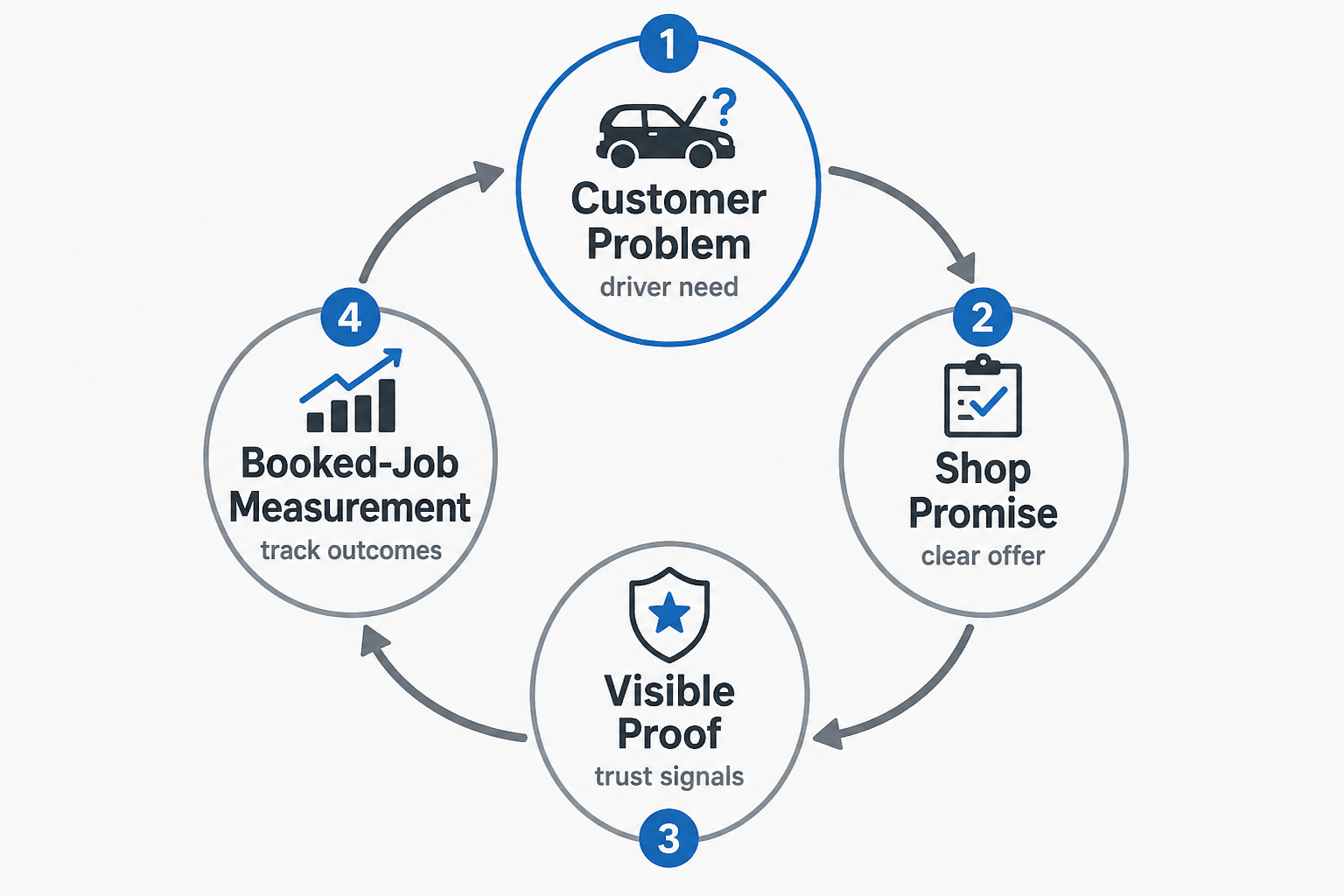
Complete this scorecard before launching a campaign or adding a channel. It turns a broad marketing discussion into decisions the owner, service advisor, and marketing partner can use consistently.
| Decision | Write this before launch | Check after the test window |
|---|---|---|
| Priority customer | Who needs this service and is within the shop’s workable area? | Were the calls and appointments from that customer type? |
| Priority service mix | Which repair or maintenance work should this effort produce? | Did completed jobs match the intended work and margin? |
| Promise and proof | What can the team repeat, and what can a driver verify? | Did callers mention the promise or still need basic reassurance? |
| Channel and next step | Where will the driver see the message and what should happen next? | Did the channel create qualified calls and booked appointments? |
| Booked-job threshold | How many completed jobs and how much gross profit make the effort worthwhile? | Did results clear the threshold without exceeding capacity? |
Run a Short Strategic Review, Not Random Campaign Changes
- Choose one priority customer problem and one service mix the shop can serve now.
- Write the promise and list the proof a driver can verify before contacting the shop.
- Check local competitors for message gaps without copying their claims or offers.
- Choose one or two channels that make the promise visible and measurable.
- Set booked-job, gross-profit, capacity, and call-quality thresholds before launch.
- Review the same measures after the test window, then change one weak variable at a time.
A full 12-month budget and activity calendar belongs in the separate auto repair marketing plan. This strategy page owns the positioning decision that should guide that plan, not the calendar itself.
Common Strategy Mistakes
- Copying a competitor’s promise without the proof, service process, or capacity to deliver it.
- Trying to attract every driver instead of choosing a priority customer problem and service mix.
- Calling a discount a strategy when it does not support the shop’s margin or desired repair work.
- Using different messages on the profile, website, ads, and calls until the customer cannot tell what the shop stands for.
- Treating views, clicks, or follower counts as success while ignoring call quality, booked jobs, and completed gross profit.
- Adding channels before the shop can answer calls, schedule work, and measure the source of the appointment.
FAQ
What is a marketing strategy for an auto repair shop?
It is the set of choices that defines which customer problem the shop will solve, the promise it can keep, the proof customers can verify, the work it wants to book, and the channels that make that position visible. It is broader than one ad campaign but narrower than trying every marketing tactic at once.
How do I choose a marketing strategy for my repair shop?
Start with repair-order data, open capacity, customer questions, review themes, and local competitors. Choose a position around a service mix and experience the team can repeatedly deliver. Then select only the channels that can explain and measure that promise.
Should a small auto repair shop focus on new customers or retention?
It depends on capacity and the current customer base. A shop with an underused house list and overdue maintenance work may gain more from reactivation and reminders than broad acquisition. A new shop or a shop with open bays may need more local visibility and demand capture. Measure the booked work from each path.
How many marketing channels should an auto repair shop use?
Start with the few channels that match the chosen position and can be measured. Many independent shops need a credible local presence, a clear website path, review proof, and one demand or retention channel before adding more. More channels do not fix an unclear promise.
How should a repair shop measure marketing strategy success?
Track qualified calls, booked appointments, completed jobs, gross profit, capacity fit, repeat work, and recurring objections. Use channel metrics as diagnostics, not as the final result. A strategy is working when it brings the kind of work the shop chose to grow.
Choose a Position the Shop Can Keep
The strongest marketing strategy for an auto repair shop gives customers a clear reason to choose the business and gives the team a practical standard to deliver. Start with one customer problem, make a credible promise, show the proof, choose channels that reinforce it, and judge the result by booked work rather than activity.
For a broader menu of channel tactics after the position is clear, see auto repair shop marketing ideas. Shops that need the full system across local visibility, website conversion, paid demand, and call measurement can review auto repair lead generation.
When the strategic position exposes gaps in service pages and local demand capture, explore SEO for auto repair shops.