

How to Get More Customers for Your Auto Repair Shop in 2026-2027
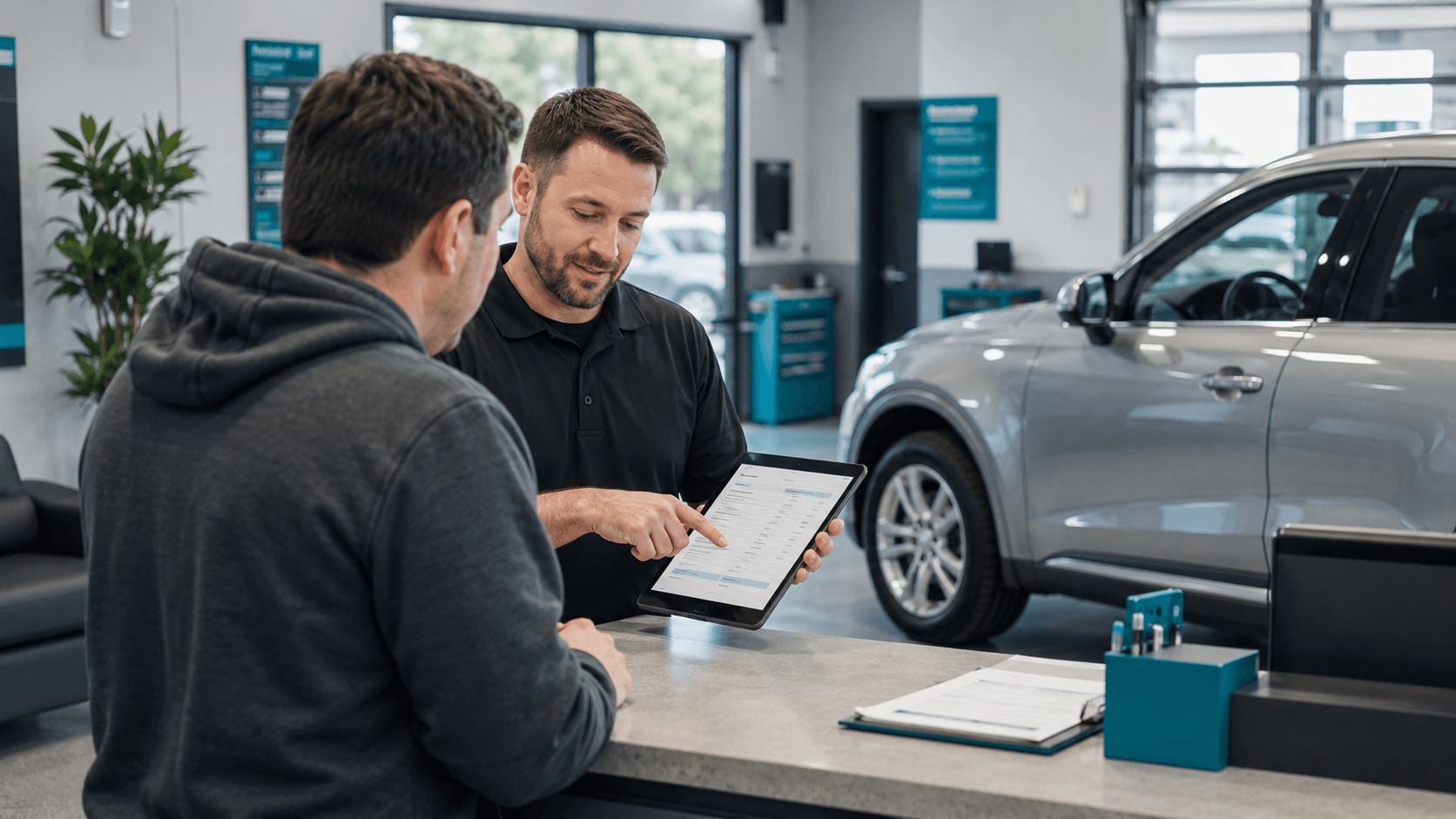
How Element DMA uses the EGL method to connect marketing, qualified calls, and appointment opportunities.
Your shop has the equipment. Your technicians can handle more work. But the schedule still has gaps, and you want a dependable way to bring more customers through the door.
Perhaps you already run Google Ads. Your Google Business Profile gets some attention, and the website generates occasional calls. Yet it is difficult to explain why one week is busy and the next is quiet—or which part of your marketing deserves more investment.
To get more customers for an auto repair shop, you need to connect local visibility, relevant advertising, a convincing website, and effective call handling. Then you need to measure what happens at each stage.
At Element DMA, we organize that work through EGL—the Element Growth Loop.
Our method connects customer acquisition with the conversations it produces. We use those conversations to understand lead quality, identify missed opportunities, and improve the next round of marketing.
Here is how we do it.
Contents:
- Why Your Auto Repair Shop May Have Empty Bays
- What Is the EGL Method?
- 1. We Start With the Repair Work You Want to Grow
- 2. We Put Your Shop in Front of Relevant Local Demand
- 3. We Help Website Visitors Take the Next Step
- 4. We Measure the Quality of the Calls
- 5. We Identify Opportunities to Improve Call Handling
- 6. We Feed the Results Back Into Marketing
- A Real Example From MPB Auto Repair
- What Working With Element DMA Looks Like
- Frequently Asked Questions
- Find Out What Is Limiting Your Shop’s Growth
- Let’s turn empty bays into your next growth opportunity.
Why Your Auto Repair Shop May Have Empty Bays
Empty bays can have several causes. Before increasing an advertising budget, we need to understand which one is limiting your shop.
A business that receives very few inquiries has a different problem from a shop that gets suitable calls but rarely turns them into appointments.
| What is happening | What we investigate |
|---|---|
| Few relevant customers are calling | Local visibility, search demand, targeting, advertising coverage |
| People visit the website but rarely contact the shop | Service information, credibility, mobile experience, contact options |
| Calls concern vehicles or services the shop does not handle | Search terms, campaign targeting, business listings, page wording |
| Suitable customers call but do not book | Answer rates, qualification, price communication, scheduling |
| The shop is busy with work it does not want more of | Service priorities, campaign allocation, capacity and margins |
| Marketing reports look positive, but the owner cannot see the business impact | Lead definitions, attribution, booking records and completed repair data |
These situations require different responses.
For example, imagine a shop receiving plenty of oil-change inquiries while its diagnostic technician has open time. More calls of the same kind may increase the workload at the counter without filling that technician’s schedule.
The marketing needs to support the work the shop can profitably accept.
What Is the EGL Method?
EGL is Element DMA’s approach to connecting the stages of customer acquisition and using the results to improve the system.
It brings together:
- Google Ads and eligible Local Services Ads.
- Google Business Profile and local visibility.
- Website and service-page improvements.
- Call tracking and source attribution.
- AI analysis of lead quality and call handling.
- Feedback that informs campaign and website changes.
The process continues after a customer calls. We examine whether the inquiry fits the shop, how the conversation develops, and what can improve.
You can explore the components on our EGL AI client growth system page. elementdma.com
1. We Start With the Repair Work You Want to Grow
Before selecting campaigns and keywords, we need to understand your business.
A general repair shop looking for brake and suspension work needs a different plan from a diesel specialist pursuing fleet customers. Even two general repair shops in the same city may have different priorities because of their staffing, equipment, margins, and available capacity.
We start with questions such as:
- Which services do you want more of?
- Which vehicles can your team confidently service?
- Where do you have available technician time?
- How far are customers realistically willing to travel?
- What is your average repair order for the services being promoted?
- What acquisition cost can those jobs support?
This gives the campaign a clear purpose.
If you want more diagnostic work, the targeting, advertisements, landing pages, and customer conversations should support that objective. If a service is already fully booked, its advertising priority may need to change.
Connecting the Budget to the Shop’s Economics
Consider this illustrative example, rather than a client result:
| Stage | Example result | Advertising cost per outcome |
|---|---|---|
| Advertising spend | $2,000 | — |
| Qualified repair opportunities | 50 | $40 |
| Booked appointments | 25 | $80 |
| Completed repair orders | 20 | $100 |
Each row answers a different question.
The advertising may produce qualified opportunities efficiently, while the shop loses customers between the call and appointment. Or appointments may be booked, but customers do not arrive.
To evaluate profitability, we also need the gross profit from completed repairs and the full marketing cost, including management and tools.
The purpose of this calculation is to connect marketing decisions with the work your shop actually completes.
2. We Put Your Shop in Front of Relevant Local Demand
Once we know the priorities, we build the acquisition plan around the customers who need those services.
Google Ads for Customers Actively Looking for Repairs
Search advertising can reach drivers when they are looking for help with a specific problem.
Someone searching for “brake repair near me” has a different need from someone searching for “diesel engine diagnostics.” The advertisement and destination page should reflect that difference.
Our campaign work connects:
- The service being promoted.
- The geographic area the shop can serve.
- Relevant search intent.
- A clear advertisement.
- A suitable landing page.
- The quality of the resulting inquiries.
We review search terms alongside call information. If a campaign produces repeated requests for unsupported services, we investigate the targeting and messaging. If it generates suitable inquiries, we consider the cost, available demand, and shop capacity before expanding it.
Where the business category and location are eligible, Local Services Ads can also form part of the acquisition mix.
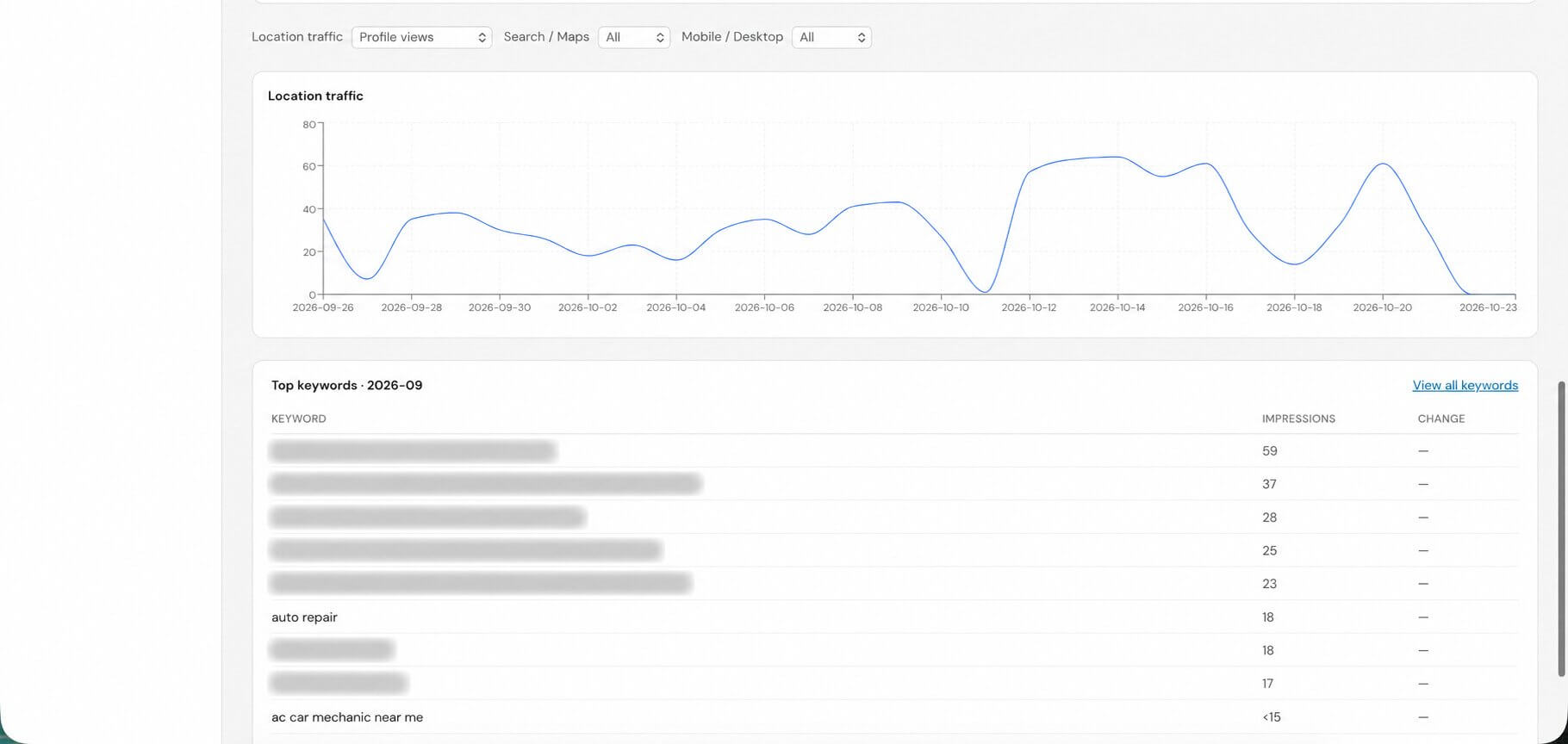
Google Maps for Local Discovery and Trust
Your Google Business Profile helps customers evaluate the shop before they visit the website or call.
We work on the details that help people understand the business: accurate services, hours, contact information, photos, reviews, and consistent local information.
Google explains that local rankings depend mainly on relevance, distance, and prominence. That means the work must reflect the actual shop and competitive environment. A profile update cannot guarantee the same visibility throughout an entire city. support.google.com
SEO for the Services You Want to Be Found For
Website SEO supports discovery through useful service pages, technical improvements, and clear site structure.
For a repair shop, useful content should help a driver establish whether the business can handle their vehicle and problem. It should also make contacting the shop easy.
We connect this work with the service priorities established at the beginning. A page about engine diagnostics should support a real capability and a clear customer need.
3. We Help Website Visitors Take the Next Step
Once someone reaches your website, they need enough confidence to contact you.
A driver with a brake problem may want to know:
- Does this shop work on my vehicle?
- Can it inspect the symptoms I am experiencing?
- Where is it located?
- What does the inspection process involve?
- Do other customers trust it?
- How do I arrange a visit?
We structure service pages around those decisions.
A useful brake repair page might explain the inspection process, show genuine reviews, clarify the location, and provide an easy mobile calling option. Availability, warranty, and certification claims should match the shop’s actual offering.
We Use Calls to Improve the Website
Customer conversations can reveal information the page is missing.
If people repeatedly ask whether you work on European vehicles, the vehicle information may need to be clearer. If callers expect a service you do not provide, the advertisement, page wording, or business listing may be creating the wrong expectation.
That feedback makes website improvements more focused. We can address questions customers are actually asking.
4. We Measure the Quality of the Calls
A phone call can represent many different things:
- A new customer with a repair need.
- An existing customer checking job status.
- Someone asking for a service you do not offer.
- A vendor selling something.
- A wrong number.
- A customer ready to arrange a visit.
Counting all of these as equivalent leads makes it harder to evaluate marketing.
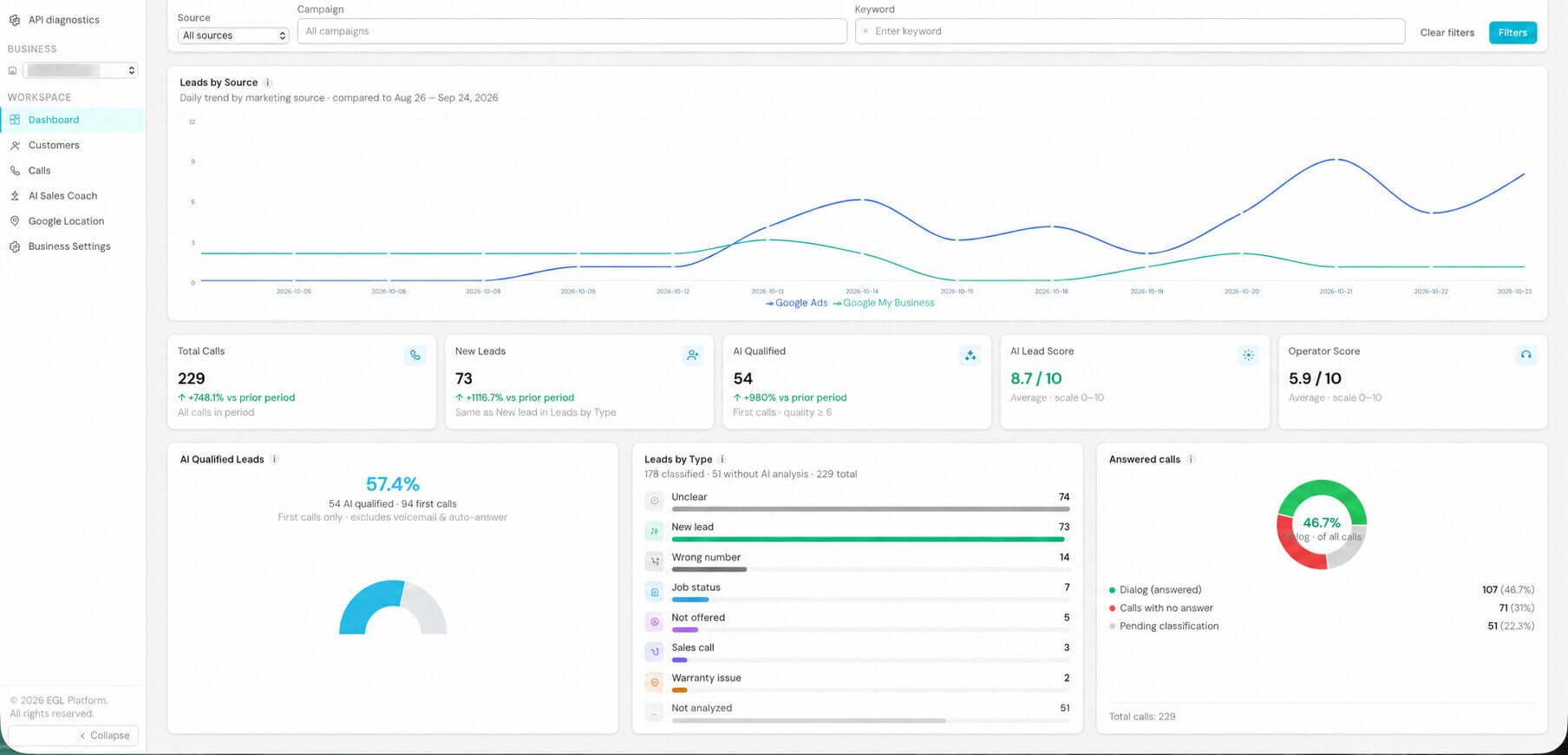
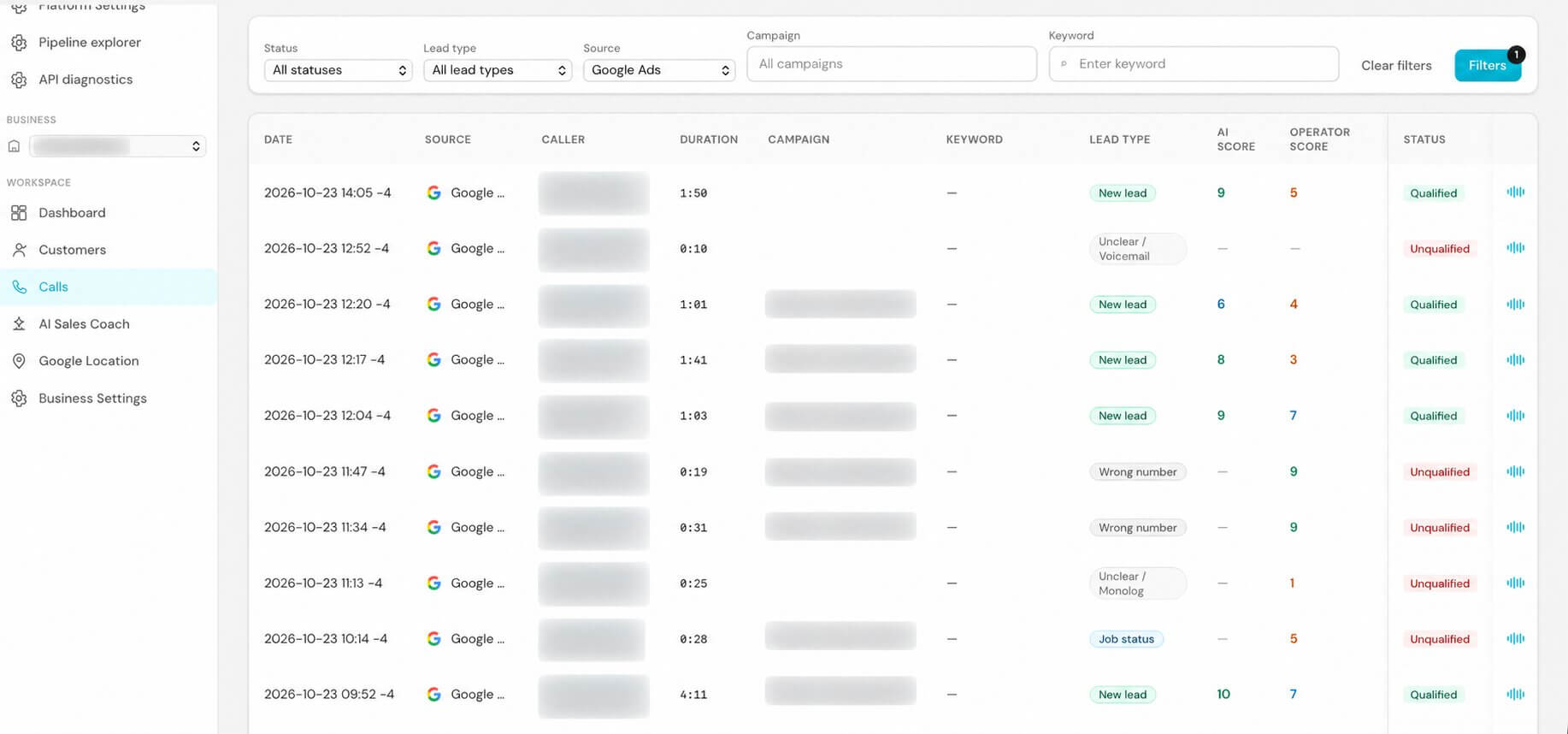
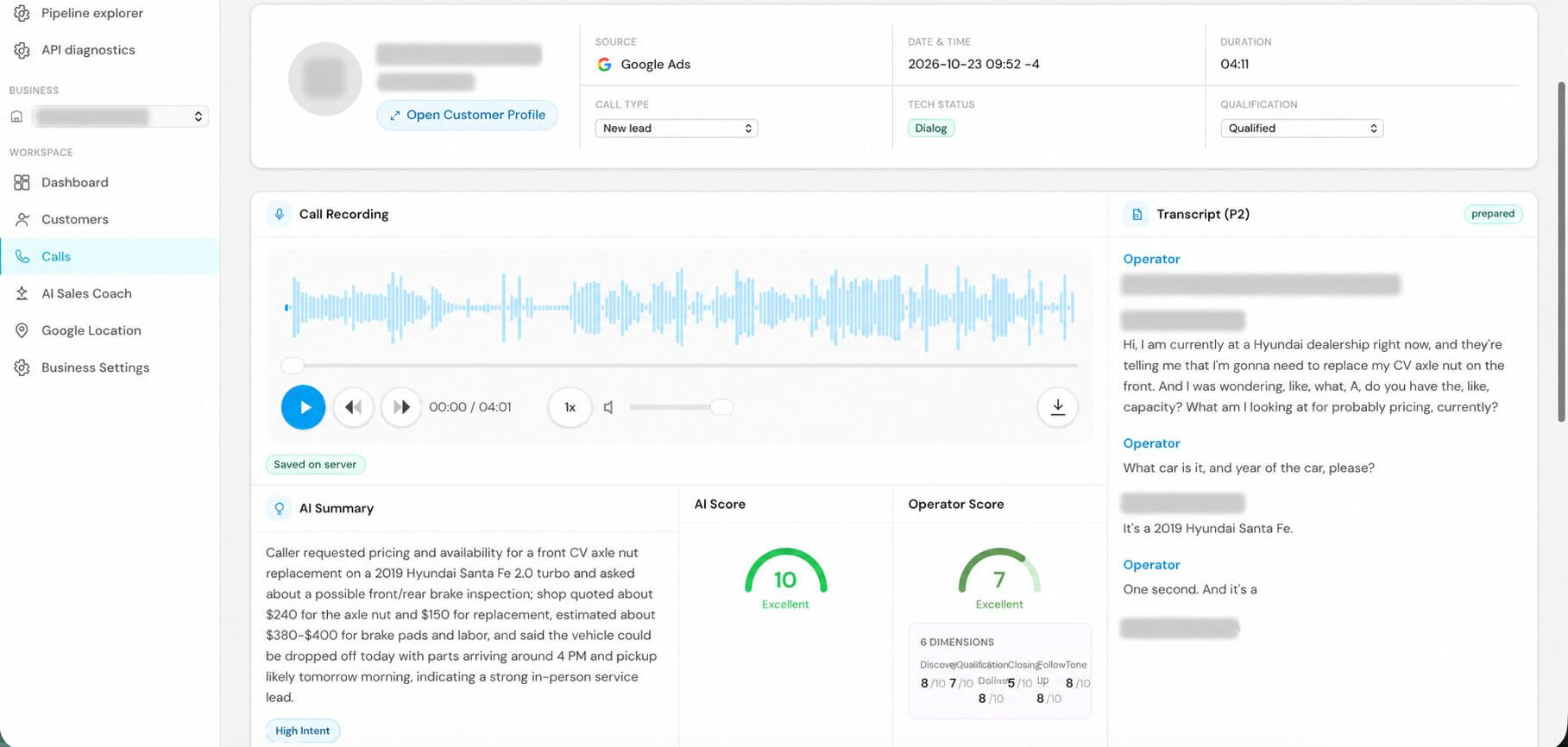
Call tracking helps establish where the inquiry came from. EGL adds analysis of the conversation so we can better understand the opportunity.
What AI Qualified Means
Under our published methodology, eligible first-time calls receive a lead-quality score from 1 to 10. A score of 6 or higher qualifies when the conversation establishes repair intent and shop capability.
Qualification does not automatically mean an appointment has been booked. Booking, arrival, and completed repair are separate outcomes.
What Our Own Research Shows
For ASMB 2026, we analyzed calls across 10 U.S. automotive repair businesses between May 1 and August 21, 2026.
| Measure | Result |
|---|---|
| Total calls analyzed | 21,699 |
| Eligible first-time calls | 6,095 |
| AI Qualified repair opportunities | 3,198 |
| Qualified share of eligible first-time calls | 52.5% |
These findings describe the businesses in our dataset, rather than the entire U.S. repair industry. They show why total call volume needs a closer look before it is treated as customer acquisition. elementdma.com
For campaign management, two of our central measures are AI Qualified volume and Cost per AI Qualified opportunity.
A price question alone does not make someone a poor prospect. We need the surrounding conversation: what the customer needs, whether the shop can help, and how the discussion develops.
5. We Identify Opportunities to Improve Call Handling
A suitable customer has called. The next task is helping them decide what to do.
Consider this illustrative conversation:
A driver asks whether the shop can inspect a suspension noise. The advisor confirms that it can and explains the diagnostic charge. The customer says, “Okay, thanks,” and the call ends.
The inquiry was relevant, but no visit was arranged.
A useful next question could have been:
“Would you like to schedule an inspection? I can check our next available drop-off time.”
That question gives the customer a clear path forward.
How EGL Sales Coach Helps
EGL Sales Coach evaluates conversations and identifies areas where the advisor could improve, including understanding the need, qualification, explaining price, follow-up, and agreeing on a next step.
In ASMB 2026, Closing averaged 4.5 out of 10 among applicable, evaluable conversations—the lowest-scoring Sales Coach category. This is a coaching score, not an appointment conversion rate. elementdma.com
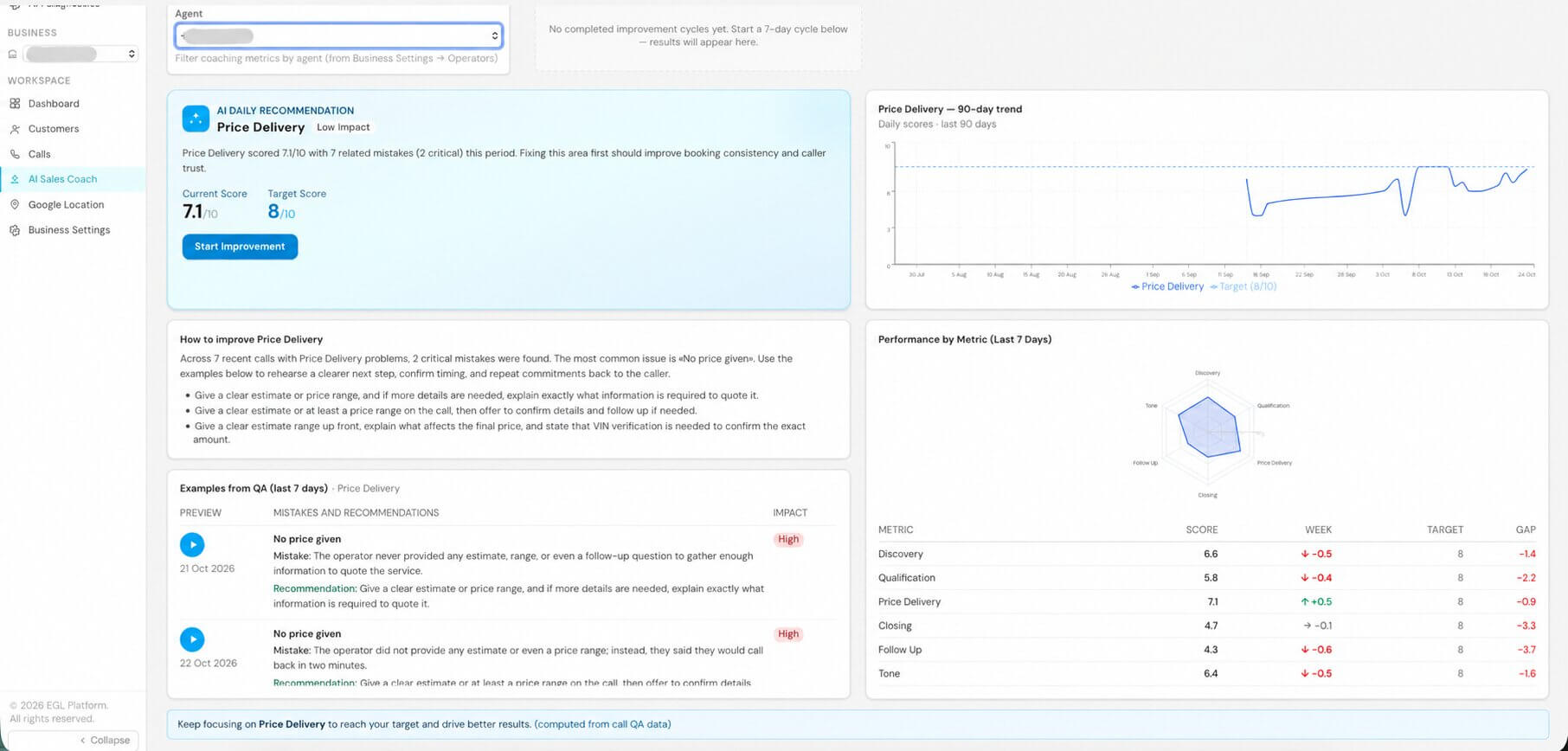
This visibility helps separate two situations:
The campaign is attracting unsuitable customers.
We need to investigate acquisition.
The campaign is attracting suitable customers, but conversations stall.
The shop has an opportunity to improve handling and scheduling.
The owner and advisors can use specific examples to guide coaching. Your team continues to own the customer interaction, availability, and service delivery.
6. We Feed the Results Back Into Marketing
The feedback stage completes the Element Growth Loop.
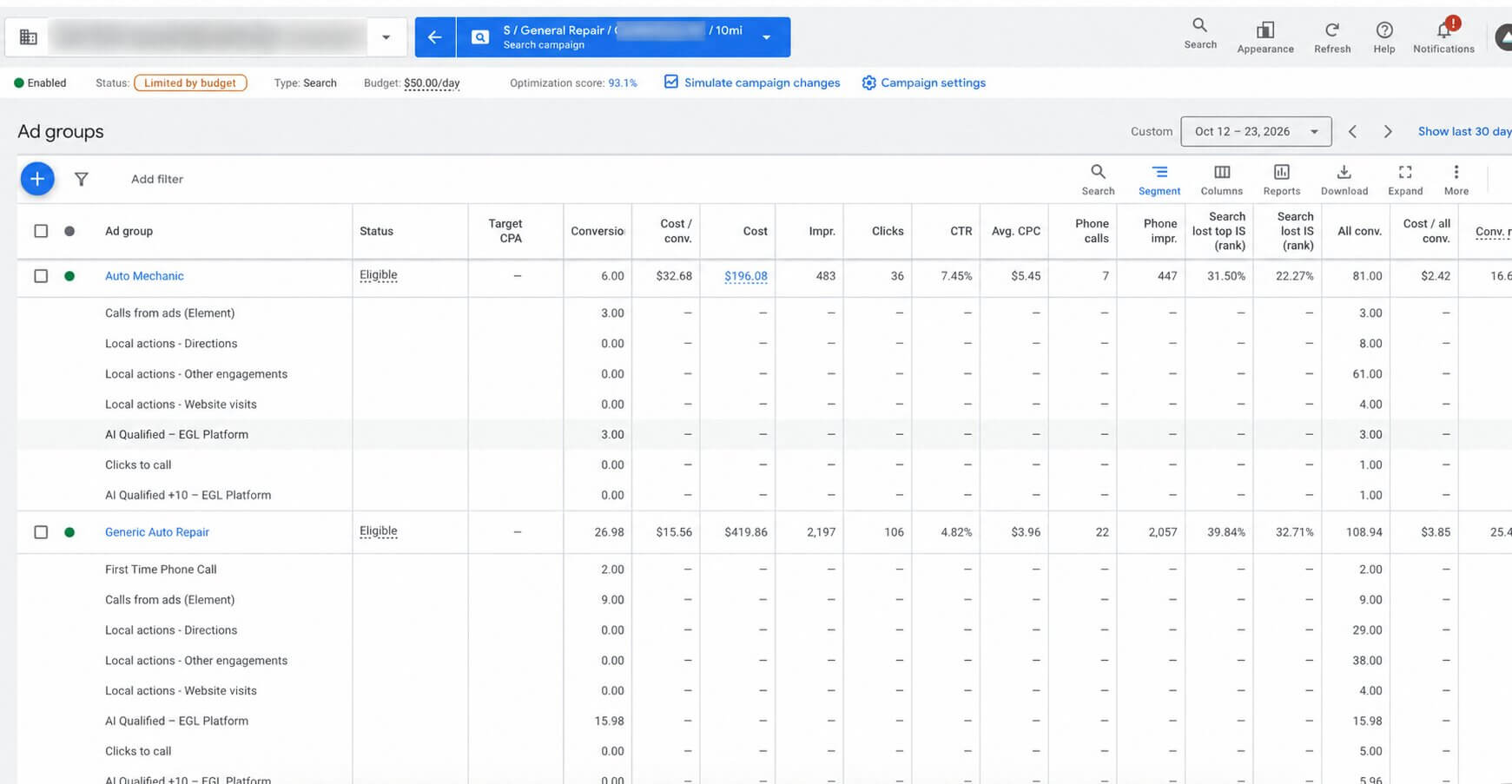
Eligible qualified-call outcomes are returned to Google Ads as conversion data. This gives campaign optimization information about the kinds of inquiries the shop wants to generate.
Google supports qualified-lead goals and offline conversion measurement. These tools allow advertisers to measure outcomes beyond the initial online interaction and use deeper lead information in optimization. support.google.com
The data also informs our team’s decisions.
| What the evidence shows | What we investigate or adjust |
|---|---|
| Relevant opportunities at an acceptable cost | Whether demand and shop capacity support more investment |
| Repeated inquiries about unsupported vehicles | Targeting, search terms, vehicle information |
| Customers misunderstand the service | Advertisement and landing-page wording |
| Suitable calls end without a next step | Advisor feedback and scheduling process |
| A priority service receives little qualified demand | Search coverage, offer, competition and page relevance |
AI analysis provides additional evidence. Our team still needs to interpret it, check the setup, and decide what to change.
Results depend on the quality and consistency of the data, campaign conditions, local demand, and the time available to learn.
A Real Example From MPB Auto Repair
MPB Auto Repair in Rancho Cordova, California, operated in a competitive local market and had gaps in call attribution.
Our published case study describes coordinated work across Google Ads, Google Business Profile, reviews, and CallRail tracking.
The reported figures include:
| Metric | Published result |
|---|---|
| Average monthly calls | 689 |
| Cost per call before optimization | Approximately $45–$50 |
| Reported cost per call after optimization | $24.78 |
| Google reviews | Increased from 54 to 105 |
| Reported monthly budget | $17,100 |
These are call and local-presence measures. They should not be interpreted as 689 completed repairs or 689 AI Qualified leads.
The example shows how acquisition and attribution can be improved together in a competitive market. The results for another shop will depend on its starting position, services, budget, and location.
Read the MPB Auto Repair case study. elementdma.com
What Working With Element DMA Looks Like
We begin by understanding the shop and reviewing the acquisition setup. That includes the services you want to grow, current marketing, account access, website contact paths, and measurement.
From there, the launch plan depends on what is already working and what needs to be built or corrected.
Paid campaigns can begin producing inquiries after launch. A useful picture of lead quality develops as enough conversations are collected and analyzed. Organic search and Maps visibility have their own development timelines.
As the work progresses, you should be able to answer:
- Which sources generate relevant opportunities?
- What does it cost to generate them?
- Which services are callers asking about?
- Where do conversations fail to progress?
- What are we changing based on the findings?
Your shop’s input matters throughout. Changes in technician availability, service priorities, or scheduling capacity should influence the marketing plan.
To evaluate completed-job revenue, we also need to connect marketing information with the shop’s appointment and repair-order records.
Frequently Asked Questions
How can I get more customers for my auto repair shop?
Start by identifying where potential customers are being lost. If relevant inquiries are scarce, improve local visibility, service pages, and targeted advertising. If suitable inquiries already arrive, review answering and scheduling. EGL connects these stages so the next action follows the evidence.
Can EGL help if I already run Google Ads?
Yes. Existing campaigns give us a starting point for examining targeting, tracking, and lead quality. We look at the services callers need, whether your shop can help, and what happens during those conversations to identify the changes required.
Does an AI Qualified lead mean a booked repair?
No. It indicates a credible repair opportunity based on the conversation. An appointment, a customer arriving, and a completed paid repair are separate stages. Keeping those distinctions clear makes reporting more useful.
Should I focus on lowering my cost per call?
Cost per call is useful, but it needs context. A cheaper call has limited value if the customer needs a service you do not provide. Evaluate cost per qualified opportunity alongside booking outcomes and, where reliable repair data is available, the economics of completed work.
Can you guarantee that my bays will stay full?
No agency controls every factor that affects shop workload. Local demand, staffing, customer decisions, and operational capacity all matter. We build and manage the agreed acquisition system, measure the opportunities it generates, and use the findings to improve performance.
Does the EGL method work for truck and body shops?
Element DMA also works with truck, diesel, body, collision, and other repair businesses. The connected process applies across these categories, while the targeting, service pages, customer questions, and performance measures must reflect each business.
Find Out What Is Limiting Your Shop’s Growth
If your shop has capacity for more work, the next step is understanding what is preventing that work from reaching your schedule.
You may need stronger visibility, better service targeting, a clearer website, or more effective handling of the calls already coming in.
Element DMA can review your market, current marketing, and lead flow to identify where EGL could help.
Tell us which services you want to grow and where your team has capacity. We will use that information to discuss a practical next step.
Let’s turn empty bays into your next growth opportunity.
You’ve seen how the EGL method works. Now let’s talk about your shop—the services you want to grow, the customers you want to reach, and what’s holding your marketing back.
Book My Strategy CallFor independent auto and truck repair shops.
CEO at Element DMA. Digital Marketer, Founder