

How to Build a Local Auto Repair Brand for Your Shop
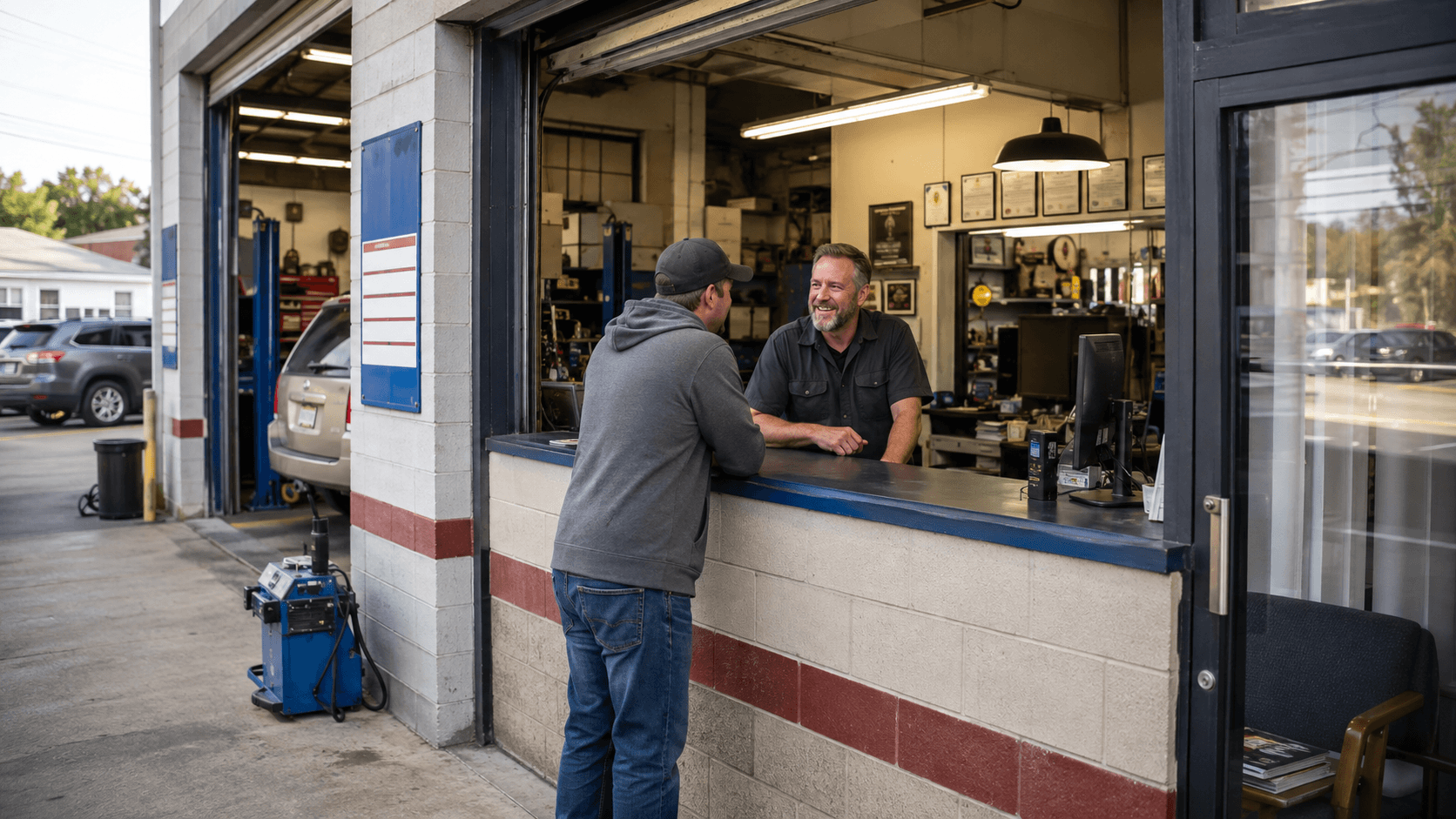
A local auto repair brand is not a new logo, a stack of giveaways, or a weekly social-media posting target. For an auto repair shop, it is the answer a driver gives when someone asks, ‘Why would I take my car there?’ The answer should be specific enough to remember and accurate enough that the next phone call, estimate, and repair experience prove it.
Drivers often choose a repair shop when they feel uncertain: the car is making a noise, a warning light is on, the dealer feels expensive, or a prior experience made them wary. A strong local brand reduces that uncertainty. It makes the shop easy to identify, easy to evaluate, and easier to recommend.
This guide keeps the focus on local recognition and trust. It does not replace a marketing plan, an SEO program, or a lead-generation service. It shows how to make every local touchpoint tell the same believable story.
Contents:
- Start With the Memory You Want to Earn
- Build the Promise From Real Customer Evidence
- Make the First Visit Feel Like the Same Shop
- Use Google Business Profile as a Trust Checkpoint
- Give the Team a Small Language System
- Choose Local Touchpoints That Fit the Shop
- Run a Local Brand Walkthrough Each Quarter
- Measure Recognition Through Real Customer Signals
- Common Local Brand Mistakes
- FAQ
- Make the Shop Easier to Remember for the Right Reason
Start With the Memory You Want to Earn
Choose one customer memory before choosing colors, slogans, or channels. The memory should come from an operating truth: a service process, a specialty, a convenience, a local relationship, or a communication habit that the team can repeat every day.
| Generic message | Memorable local meaning | Proof needed |
|---|---|---|
| Quality auto repair | Clear explanations before approved work begins. | Estimate process, advisor language, and reviews that reflect it. |
| Fast and friendly service | A dependable drop-off and pickup process for busy local drivers. | Accurate hours, availability, handoff instructions, and staff consistency. |
| Expert mechanics | A real specialty in diagnostics, a vehicle type, or a repair category. | Equipment, trained staff, service pages, and work the shop actually accepts. |
| Your neighborhood shop | A familiar, easy-to-find shop that understands the area’s vehicles and routines. | Local location details, community presence, and helpful customer experience. |
The test is simple: can a service advisor say the message naturally after answering the phone, and can a recent customer recognize it from their visit? If not, it is a marketing phrase rather than a brand promise.
Build the Promise From Real Customer Evidence
The best source material is already in the business. Read recent reviews, ask the front desk what customers thank the team for, review the questions people ask before booking, and look at which jobs become repeat work. Do not use a promise simply because it sounds polished.
| Evidence source | What to look for | How to use it |
|---|---|---|
| Review themes | Repeated mentions of honesty, communication, convenience, cleanliness, or a specialty. | Use the theme only when the current process still supports it. |
| Call and estimate notes | Questions about price, diagnosis, timing, vehicle fit, or drop-off. | Turn recurring uncertainty into clearer website, profile, and advisor explanations. |
| Repair-order mix | Work the shop completes well, profitably, and with repeat potential. | Feature the services the business can schedule and stand behind. |
| Local context | Commuter patterns, nearby employers, apartment areas, schools, or vehicle types. | Add useful local detail without pretending to serve places the shop cannot support. |
When a claim involves price, speed, warranty, ratings, or comparison language, check the FTC’s advertising guidance. A local brand gains trust by keeping promises precise, not by making the largest possible claim.
Make the First Visit Feel Like the Same Shop
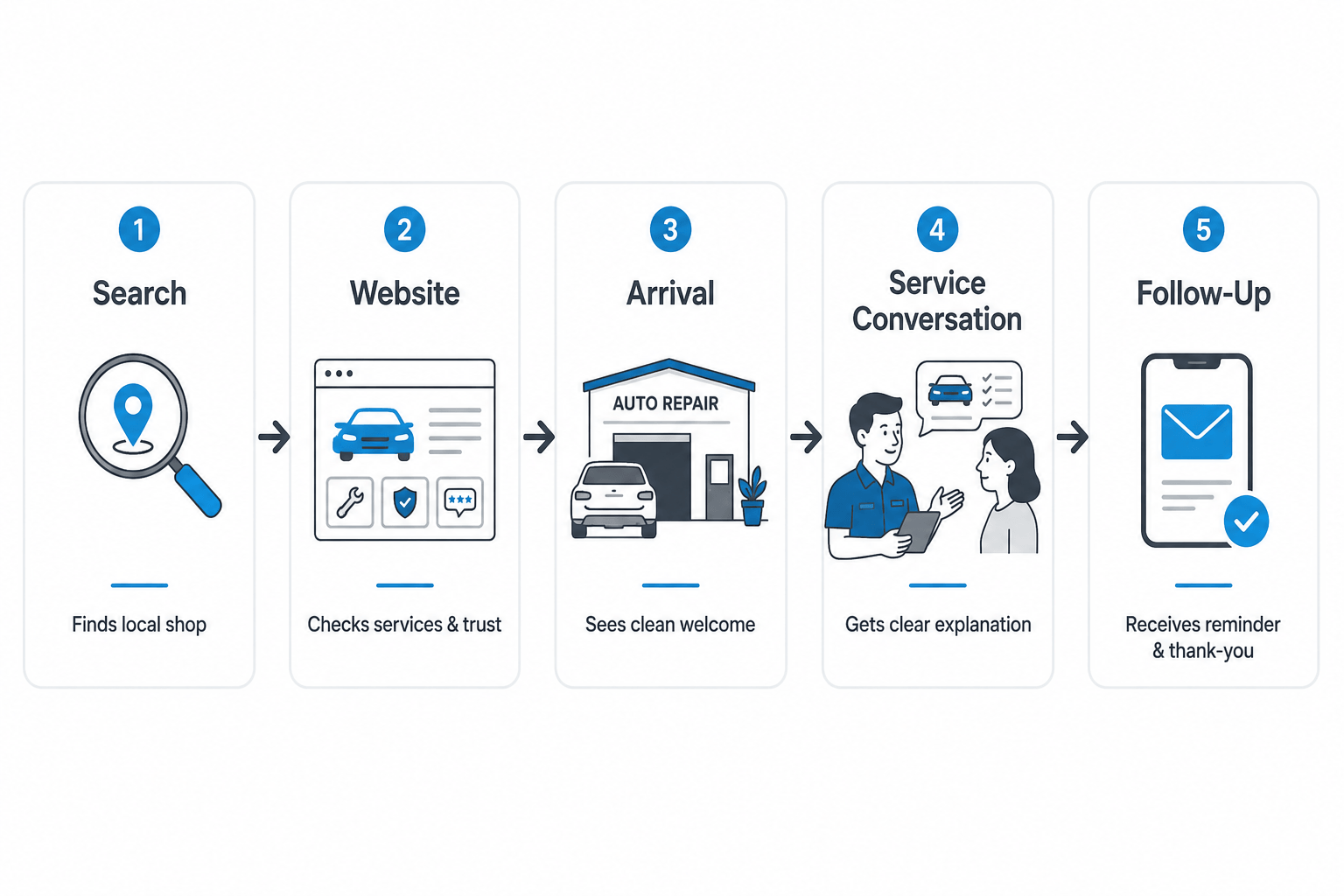
Recognition breaks when the website looks polished but the entrance is hard to find, the phone greeting sounds indifferent, or the estimate experience contradicts the advertised promise. Map the first visit from the customer’s perspective and fix the points where the story changes.
| Touchpoint | What a driver needs to know | Local-brand check |
|---|---|---|
| Search result or Maps listing | Is this shop nearby, open, relevant, and real? | Accurate name, address, hours, services, photos, and contact path. |
| Website or service page | Can this shop handle my problem and what happens next? | The same customer promise, service fit, proof, and booking or call action. |
| Arrival | Where do I park, enter, and check in? | Visible sign, safe entrance, simple instructions, and a consistent visual identity. |
| Phone or front desk | Will someone understand my concern and explain the next step? | A plain-language greeting and repeatable process for estimates and updates. |
| Pickup and follow-up | Did the experience match the reason I chose the shop? | Clear repair explanation, appropriate review request, and useful future-service guidance. |
A logo and color palette can make these moments easier to recognize, but they cannot repair a broken customer experience. Start with the operational handoff, then make the visual system consistent enough to support it.
Use Google Business Profile as a Trust Checkpoint
For many local drivers, the profile is the first screen where the shop must look credible. It should confirm the business identity, services, hours, location, phone number, photos, and next action. Google describes Business Profile as a way to manage how a business appears on Search and Maps; review the Business Profile overview before treating it as a finished one-time setup.
- Use the public business name used on signage and invoices, not a list of keywords.
- Show the real exterior, entrance, service counter, team, bays, and equipment where appropriate.
- Keep service categories, hours, phone number, and appointment path aligned with the website and staff instructions.
- Reply to reviews in a voice that matches the shop’s real customer experience, without disclosing private repair details.
- Remove outdated photos, old offers, inaccurate hours, and services the shop no longer accepts.
Google’s business representation guidelines are especially relevant to the name and identity shown in the profile. Consistency helps customers recognize the shop; accuracy protects that recognition.
Give the Team a Small Language System
Brand voice does not need a long document. It needs a few phrases and behaviors that make the shop sound like itself in the moments customers remember. Write them down, rehearse them with the front desk, and update them when the real customer experience changes.
| Moment | Weak default | Clear, on-brand direction |
|---|---|---|
| New call | Bring it in and we will see. | Ask one clarifying question, explain the first diagnostic or scheduling step, and set the right expectation. |
| Estimate approval | It will cost this much. | Explain what was found, what is recommended now, what can wait when appropriate, and what approval means. |
| Delay or parts issue | We are waiting on parts. | State the current status, the next update point, and any realistic options without inventing a timeline. |
| Review response | Thanks for the five stars. | Thank the customer in the shop’s natural voice and reference the experience only when it is public and appropriate. |
Choose Local Touchpoints That Fit the Shop
Not every community activity builds the right kind of recognition. Pick touchpoints that make sense for the customers, work, and capacity the shop wants. A local brand is stronger when the activity gives people a useful reason to remember the business rather than just placing its logo in more places.
| Local touchpoint | Best use | Avoid |
|---|---|---|
| Customer follow-up | Useful maintenance, declined-work, or seasonal reminders for customers who expect contact. | Generic messages that ignore the vehicle, prior visit, or consent. |
| Community participation | Events or partnerships that match the shop’s real local audience and staff capacity. | Sponsorships with no practical local connection or follow-through. |
| Helpful printed material | Clear service reminders, care tips, or contact details that a customer can actually use. | Cheap giveaways that do not reflect the service experience or create measurable value. |
| Local content | Answer recurring questions about services, drop-off, seasonal needs, or shop access. | Posting generic automotive facts just to maintain a publishing frequency. |
Run a Local Brand Walkthrough Each Quarter
Walk through the shop as a new driver would, from the first search to the completed repair. This is more useful than judging the brand only from a logo file or a social-feed grid.
- Search the shop name and key services from a phone. Check whether the correct business, hours, phone number, and photos appear.
- Call the main number and listen for whether the greeting and first questions match the promise.
- Visit the entrance, parking area, front desk, waiting area, and customer paperwork as if you had never been there.
- Compare the website, profile, sign, review responses, estimate explanation, and follow-up language for contradictions.
- Review whether current work mix, capacity, and customer feedback still support the message the shop is using.
- Fix one inconsistency at a time, then repeat the walkthrough after operational changes or a new campaign.
Measure Recognition Through Real Customer Signals
Local brand work should eventually make a customer conversation easier. Track the signals that connect recognition to behavior, but do not assume that one metric proves branding on its own.
| Signal | What it may indicate | Question to ask |
|---|---|---|
| Branded searches and direct visits | More people remember the shop name after another touchpoint. | Did the customer mention a sign, review, referral, local event, or prior visit? |
| Review language | Customers repeat the experience the shop is known for. | Are the same credible themes appearing without being prompted? |
| Referral calls | People can explain why they recommended the shop. | What exact reason did the referring customer give? |
| Booked-job quality | The message is attracting service fit rather than only price inquiries. | Are the promoted services matching capacity and margin? |
| Repeat visits | The delivered experience supports the promise after the first repair. | Did the shop make the next service decision clear and useful? |
When the walkthrough exposes local visibility or service-page gaps, review local SEO for auto repair shops.
Common Local Brand Mistakes
- Using broad phrases such as best, cheapest, or fastest without proof the team can consistently deliver.
- Changing names, logos, phone numbers, hours, or service claims across signs, profiles, ads, and the website.
- Investing in visual branding while the phone, estimate, and pickup experience remain confusing.
- Treating every local activity as useful instead of choosing touchpoints that match the shop’s customer and service mix.
- Forcing social posting or merchandise when it does not help a customer evaluate, contact, or remember the shop.
- Measuring likes and views while ignoring branded calls, referrals, booked-job fit, and repeat work.
FAQ
What is local branding for an auto repair shop?
Local branding is the consistent customer memory a shop earns through its promise, proof, service experience, visual identity, local presence, and communication. It helps a driver recognize why the shop is relevant and decide whether it feels trustworthy before booking.
How can an independent repair shop stand out locally?
Start with a real strength the team can demonstrate, such as clear diagnostic communication, a defined specialty, a dependable handoff process, or useful local convenience. Make the same promise visible in the profile, website, signs, calls, estimates, and follow-up.
Does a repair shop need a new logo to build a local brand?
Not always. A logo helps recognition when it is used consistently, but it cannot replace accurate business information, clear service expectations, honest communication, and a customer experience that matches the message. Fix the operational story before spending heavily on a redesign.
How should a repair shop use reviews for local branding?
Treat reviews as evidence of the experience customers actually received. Look for repeated themes, protect customer privacy in replies, and improve the process when a concern appears repeatedly. Do not script or filter reviews to manufacture a brand claim.
How long does it take to build local brand recognition?
There is no fixed timeline. Recognition grows through repeated, consistent experiences and local touchpoints. Start by correcting contradictions that make the shop hard to identify or trust, then measure branded searches, referrals, review themes, booked-job quality, and repeat work over time.
Make the Shop Easier to Remember for the Right Reason
A local brand becomes valuable when a driver can recognize the shop, explain why it fits, and receive the experience they expected. Choose one truthful customer memory, support it with real proof, carry it through every first-visit moment, and revisit the system whenever the shop changes. That is more durable than a generic campaign or a new visual treatment on its own.
For broader channel choices after the local story is clear, see auto repair shop marketing ideas. If the business needs its local brand connected to service pages and call outcomes, explore SEO for auto repair shops and auto repair lead generation.