

Content Marketing for Auto Repair Shops: A Future-Ready Content Plan
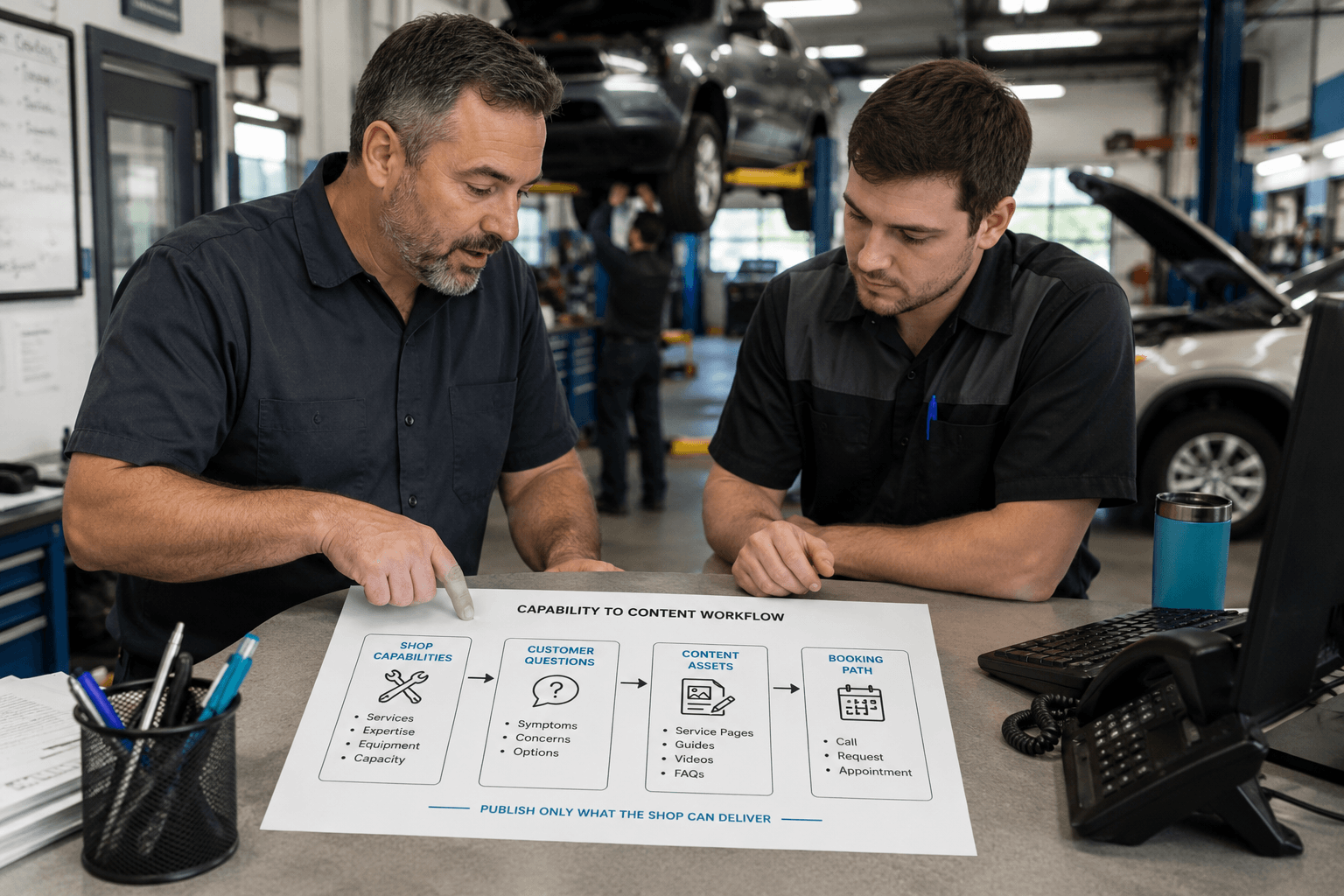
Content marketing for auto repair shops is not a calendar full of generic maintenance posts. It is a system for making the shop’s real capabilities easier to find, understand, and trust before a driver calls. The strongest content starts with work the team can actually inspect, diagnose, explain, schedule, and complete.
That matters when a shop is expanding into hybrid or EV-adjacent work, building a specialty, or simply trying to explain familiar repairs more clearly. Customers do not need a prediction about the future of the industry. They need to know what the shop handles today, what the first appointment looks like, and how to take the next step.
Use this guide to build a future-ready content plan around verified service capabilities, technician-reviewed explainers, service-page support, and measurable customer actions. It is not a broad marketing plan, a software comparison, or a substitute for technical training.
Contents:
- The Content Capability Test
- Start With Verified Services, Not Blog Ideas
- Build the Service Page Before the Supporting Article
- A Documented Service-Page Architecture Example
- Use Hybrid and EV Topics as Proof of Clarity, Not Hype
- Turn Technician Knowledge Into Customer Explanations
- Choose Content by Customer Decision, Not by Publishing Volume
- Use Local Context Without Manufacturing Local Pages
- Create a Content Review and Publishing Workflow
- Measure Content From Search to Suitable Work
- A 30-Day Content Capability Checklist
- Common Content Marketing Mistakes for Repair Shops
- FAQ
- Make the Website a Clearer Extension of the Shop
The Content Capability Test
Before assigning a keyword or drafting a page, run the subject through this test. Content should clarify a capability, not create an expectation the shop cannot meet.
| Before publishing | Content that fits | Do not publish until |
|---|---|---|
| The shop can name the service, technician process, service limits, and booking path. | A service page explaining what the shop evaluates, who the service is for, and how an appointment starts. | The service description, scope, training, equipment, or scheduling process is verified. |
| A technician can review the explanation in customer language. | A problem explainer that distinguishes symptoms, inspection, and next steps without diagnosing by article. | The technical explanation is reviewed and unclear or risky claims are removed. |
| The shop has a real local or seasonal reason for the topic. | A relevant seasonal guide or local driving explainer tied to an offered inspection or maintenance service. | The topic is only a generic trend or copied from another market. |
| The team can handle the action the content invites. | A clear call, request, or appointment CTA with a named response owner. | The inbox, phone path, or appointment capacity is not ready. |
Start With Verified Services, Not Blog Ideas
A useful content inventory begins inside the shop. List the services the team performs now, the work it is preparing to perform, the vehicle types it sees, recurring customer questions, and the evidence available for each claim. That evidence may include technician review, manufacturer training, approved equipment, inspection process, warranty policy, or a documented appointment workflow. Do not present a future training goal as a current customer service.
| Content inventory input | Question for the shop | Resulting content decision |
|---|---|---|
| Current service capability | What can the team complete confidently today? | Create or improve the matching service page first. |
| Hybrid or EV-adjacent work | Which inspections, maintenance, or repairs are actually offered, and what are the limits? | Publish a capability explainer only after technician approval. |
| Repeated customer question | What does the customer misunderstand before booking? | Create a plain-language FAQ or problem explainer linked to the relevant service. |
| Seasonal pattern | What local conditions make the question timely? | Create a seasonal page or post only if the service and capacity are real. |
| New capability under development | What is true now versus planned later? | Keep it off commercial service pages until the offering is ready. |
Google’s guidance on creating helpful, reliable content is a practical standard: make the page useful to the person with the question, not merely a place to repeat a target phrase.
Build the Service Page Before the Supporting Article
A driver looking for a repair shop is often closer to an appointment than a reader looking for a general car-care tip. Give the commercial service intent a complete page first. Supporting articles should then answer the questions that make the service page easier to trust and understand.
| Page type | Customer question | Job of the page | CTA |
|---|---|---|---|
| Service page | Can this shop help with my vehicle and this service? | Explain scope, process, local fit, proof, and how the first visit works. | Call, request an appointment, or ask a service question. |
| Capability explainer | What does this service involve, and what should I expect? | Set expectations and link to the matching service page without making a diagnosis. | Review the service page or contact the shop. |
| Problem explainer | What might this symptom mean, and what should I do next? | Help the reader understand why inspection matters and when to seek professional help. | Schedule an inspection or speak with the shop. |
| Seasonal guide | What should I plan for before a local driving change? | Connect a timely concern to an offered maintenance or inspection step. | Request a suitable appointment. |
For the commercial pages and internal architecture behind this work, see SEO for auto repair shops.
A Documented Service-Page Architecture Example
Element DMA’s published Many Parts LLC case describes a 17-page website that includes seven dedicated service pages for collision repair and related auto body services. That is useful first-party evidence of a service-page architecture being implemented. It is not a content-attributed ROI case, so this guide does not treat it as proof that a given page will produce calls or revenue.
Read the Many Parts LLC case study for the documented site structure and channel work. Use it as an implementation example, then measure each shop’s content through its own calls, appointments, and completed work.
Use Hybrid and EV Topics as Proof of Clarity, Not Hype
The former version of this page focused on future-proofing through electric and hybrid work. Keep the useful part: a shop should communicate verified hybrid and EV capabilities clearly. Remove the unsupported part: broad promises about what every electric vehicle owner needs, what training level is enough, or how much demand a page will generate.
For example, a shop that truly offers a particular hybrid inspection, brake service, HVAC work, alignment, or tire service can explain its process and service limits. A shop that is still evaluating high-voltage work should say less, not more. Accurate scope is better content than a long list of services the advisor cannot schedule.
| Verified capability | Content asset | Trust detail to include | Boundary |
|---|---|---|---|
| Hybrid or EV service the team performs | Service page plus a plain-language capability explainer. | What the first appointment includes and the vehicle types or service limits the shop can confirm. | Do not imply work on systems the shop does not service. |
| Technician training or new equipment | Short shop update or FAQ after the capability is operational. | What changed for customers and how the team uses the capability. | Do not publish a training goal as an available service. |
| Recurring customer uncertainty | Problem explainer reviewed by a technician. | Why an inspection is needed before a repair recommendation. | Do not diagnose a vehicle from a generic article. |
Turn Technician Knowledge Into Customer Explanations
The shop does not need to turn technicians into content writers. It needs a repeatable interview and approval process. Ask the technician what a customer commonly notices, what the team checks, what cannot be known without inspection, and what a good first appointment requires. Then write in customer language and send the draft back for factual review.
- Start with a customer question, not a component catalog.
- Separate a symptom from a diagnosis and a diagnosis from a repair recommendation.
- Explain the first inspection or appointment in plain language.
- Use real shop terminology only when it helps the customer understand the next step.
- Have the reviewer remove claims about speed, price, safety, savings, or results that the shop cannot support.
Claims in promotional content still need to be truthful and supportable. Use the FTC’s advertising and marketing guidance as a baseline, then have the shop’s own adviser review any regulated or high-risk claim.
Choose Content by Customer Decision, Not by Publishing Volume
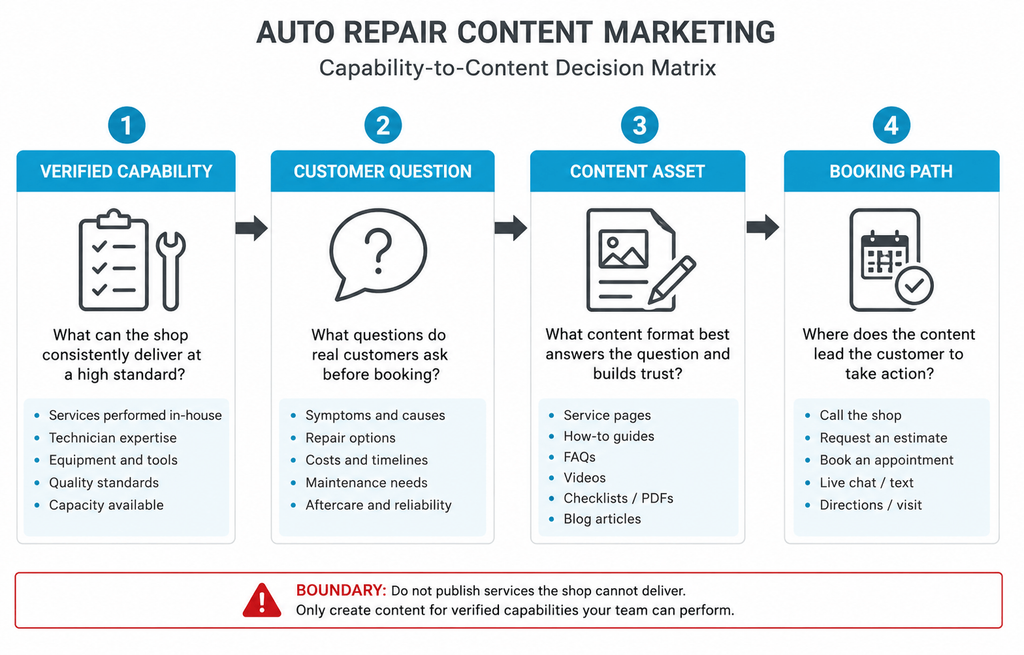
A short, connected library will usually serve the shop better than a long list of unrelated posts. Start with the decision the driver is trying to make, then give each page one job in the path.
| Customer decision | Best first content | Next content | Measure |
|---|---|---|---|
| Can this shop handle the service? | Service page with accurate scope and appointment path. | Capability explainer or technician-reviewed FAQ. | Qualified calls and appointment requests. |
| Should I get this symptom checked? | Problem explainer that sets inspection expectations. | Relevant service page and clear call path. | Calls that fit the offered service. |
| What should I plan for this season? | Seasonal guide tied to local driving and an offered service. | Email or Business Profile update for existing customers. | Requested and completed seasonal appointments. |
| Why should I trust this shop? | Process, team, review-response, or service-standard explainer. | Related service page with verifiable proof. | Questions, booked visits, and recurring objections. |
For a physical extension of a seasonal or reactivation content theme, see the separate guide to auto repair direct mail marketing. Keep the audience and measurement plan specific rather than sending every message through every channel.
Use Local Context Without Manufacturing Local Pages
Local relevance is more than placing a city name in a heading. It comes from real service-area information, local driving conditions, scheduling realities, team expertise, customer questions, and proof the shop can verify. One useful local explanation is stronger than copied pages for every neighborhood or vehicle model.
- Describe the service area and appointment path accurately.
- Use seasonal topics only when they match local conditions and shop capacity.
- Show the actual services, hours, and contact details consistently across content and business information.
- Avoid invented customer stories, fabricated city-specific claims, and near-duplicate location pages.
Create a Content Review and Publishing Workflow
- Choose one verified service or repeated customer question.
- Assign the page type: service page, capability explainer, problem explainer, seasonal guide, or FAQ.
- Collect the technician input, service limits, customer language, proof, and booking path.
- Draft the page around the reader’s decision and link it to the relevant service page.
- Review facts, claims, local details, and CTA ownership before publication.
- Publish, then use search, call, and appointment evidence to decide whether to improve, expand, or stop the topic.
Search Console’s Performance report can help identify the queries and pages earning search visibility. Pair it with booking and call records so a high-impression page is not mistaken for a successful customer path.
Measure Content From Search to Suitable Work
Traffic is useful context, but it is not the outcome. Record the page or topic, the customer action, the service requested, whether the inquiry fit the shop, the appointment result, and the completed work. This lets the owner improve a topic because it created the right demand, not because it produced a large pageview number.
| Measure | What it answers | Use it to decide |
|---|---|---|
| Search impressions and clicks | Is the page being discovered for a relevant question? | Improve title, page scope, internal link, or topic match. |
| Calls and appointment requests | Did the page make the next step clear enough to create contact? | Check CTA, service scope, and response ownership. |
| Qualified inquiries | Did the topic attract work the shop can actually serve? | Refine the content boundary or stop attracting the wrong need. |
| Completed work and gross profit | Did the content support suitable, profitable service? | Repeat, expand, or retire the topic. |
Use automotive call tracking to connect phone responses to the content path. For a cost-and-capacity model before promoting a new content asset with paid spend, use the Ads Revenue Calculator.
A 30-Day Content Capability Checklist
| Week | Priority action | Deliverable |
|---|---|---|
| Week 1 | Inventory verified services, future capabilities, repeated questions, proof, and capacity. | A capability list with clear publish and no-publish boundaries. |
| Week 2 | Improve the highest-priority service page and add its booking path. | One commercial page that accurately explains scope and first appointment. |
| Week 3 | Interview a technician and publish one supporting explainer or FAQ. | One reviewed trust-building page linked to the service page. |
| Week 4 | Review search visibility, calls, appointment requests, and question quality. | A next-topic decision based on customer evidence, not a publishing quota. |
Common Content Marketing Mistakes for Repair Shops
- Publishing generic car-care posts with no connection to a real service, customer question, or next step.
- Creating EV or hybrid pages before the shop can clearly state service scope, process, and limits.
- Writing technician-heavy copy that never explains what the customer should do next.
- Treating a service page as a thin list item instead of the main commercial explanation.
- Using copied local pages, invented stories, or claims that a technician cannot confirm.
- Judging content only by impressions or traffic without tracking suitable calls, appointments, and completed work.
FAQ
What is content marketing for auto repair shops?
It is a system of service pages, capability explainers, problem guides, FAQs, and local or seasonal content that helps drivers understand verified shop services and take a suitable next step. It is not simply publishing blog posts on a schedule.
What content should an auto repair shop create first?
Start with the highest-priority service page the shop can fully support. Then add a technician-reviewed explainer, FAQ, or problem guide that answers the customer questions preventing a call or appointment.
Should a repair shop publish EV and hybrid content?
Yes, but only for services and processes the shop can verify today. Explain the scope, service limits, and first appointment clearly. Do not use EV or hybrid terms as marketing copy for work the shop cannot schedule.
How does content marketing support auto repair SEO?
Useful content gives search engines and customers clear evidence of the services, questions, and local context the shop covers. Connect supporting articles to complete service pages and measure whether the resulting inquiries fit the business.
How should a shop measure content marketing?
Track relevant search visibility, calls, appointment requests, qualified inquiries, completed work, and gross profit. Pageviews or rankings alone do not show whether content produced suitable work.
Make the Website a Clearer Extension of the Shop
Content marketing becomes useful when it helps a driver understand a real capability and move toward the right appointment. Start with verified services, turn technician knowledge into clear customer language, support commercial pages with focused explainers, and judge every topic by the quality of the work it helps create.
For a broader list of channels after the content foundation is in place, see auto repair shop marketing ideas.
Shops that need help connecting content, service pages, calls, and booked work can review auto repair lead generation.

With a background in psychology, Valeriu has worked in sales and marketing for 8+ years, and learned through experience that the best way to do business is to serve clients well, and solve their problems. He has joined Element DMA in September of 2025, attracted by the honest nature of the work and attitude of auto & truck repair shops. In this role, he helps shop owners across the U.S. see the ROI of properly done advertising, and the growth this brings to their shops, regardless of niche or state.