

Auto Body Shop SEO: How to Win More Google Maps Estimate Calls
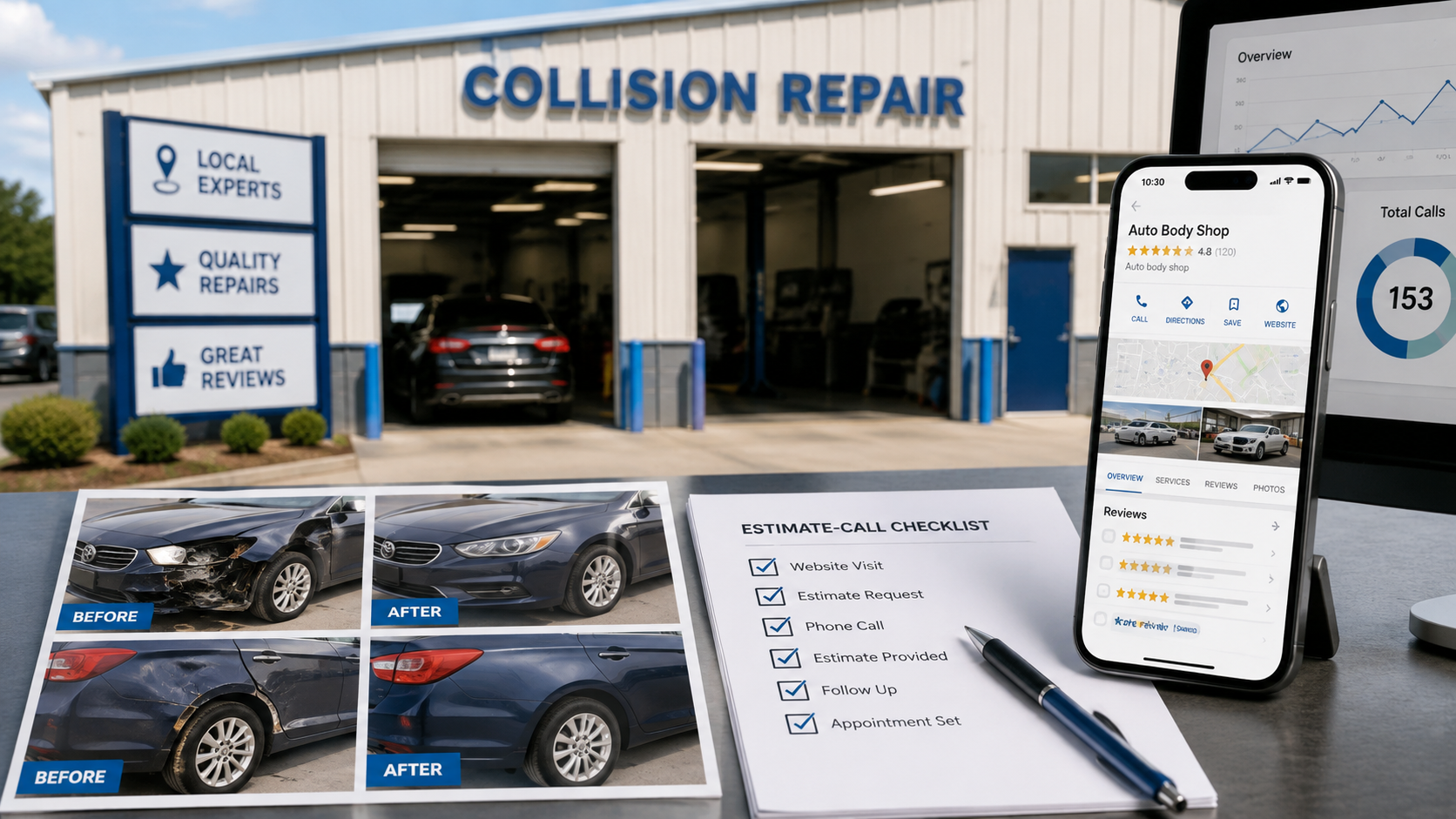
Body shop SEO is not a generic marketing exercise. A driver looking for collision repair is often standing next to a damaged vehicle, comparing nearby shops, checking photos, reading reviews, and deciding who looks credible enough to call for an estimate.
That search moment is different from normal maintenance. Collision, dent, paint, bumper, hail, and frame repair customers need local proof before they need a long explanation. A strong SEO system helps them see the right evidence quickly: what the shop fixes, where it works, what the results look like, and how to request an estimate.
Google says local ranking is shaped mainly by relevance, distance, and prominence in its local ranking guidance. For a body shop, those three factors translate into a practical system: make the profile clearly relevant to body repair, make the shop and service area easy to understand, and build prominence through reviews, photos, service pages, citations, and local proof.
Contents:
- Start With the Collision Search You Actually Want
- Build the Google Business Profile Around Body-Shop Relevance
- Use Photos as Repair Proof, Not Decoration
- Turn Reviews Into Estimate Confidence
- Connect Maps Visibility to Service Pages
- Build Local Proof Without Turning This Into an Advertising Article
- Body Shop SEO Checklist
- Add a Collision Estimate Conversion Layer
- 30-Day Auto Body Shop SEO Action Plan
- What to Avoid
- FAQ
- Conclusion
Start With the Collision Search You Actually Want
A body shop should not try to rank one page or one Google Business Profile for every automotive term. The best searches are tied to visible damage, estimate intent, location, and trust. The first planning step is deciding which repair jobs the shop wants more of, then making the profile and website support those searches.
| Search pattern | What the customer wants | Page/profile signal to build |
| collision repair near me | A trusted shop after an accident | Primary category, collision repair service page, review proof |
| auto body shop [city] | A nearby body shop that looks legitimate | Accurate GBP, exterior photos, local service area, phone visibility |
| dent repair [city] | A specific service and likely estimate | Dent repair section or page, before-and-after photos |
| bumper repair near me | Quick repair, pricing or estimate path | Bumper service details, estimate CTA, repair examples |
| auto painting [city] | Paint match confidence | Paint booth photos, paint repair page, review language |
| hail damage repair [city] | Specialized seasonal repair | Hail service section, photo proof, FAQ, local timing |
Paid ads, brochures, and broad marketing plans can support a body shop, but they solve a different problem. Start with organic visibility, Google Maps, service-page trust, and estimate conversion before expanding into paid campaigns or offline promotion.
Build the Google Business Profile Around Body-Shop Relevance
A strong Google Business Profile makes every field work harder for body-shop relevance. The profile should help Google and the customer understand that the business handles body and collision work, not only general mechanical repair.
Use the official business name. Do not stuff keywords into the name. If the business is primarily a body shop, use the most accurate primary category available, then add only secondary categories that describe real services the shop provides. The profile description should name the city or market, explain the main body-shop services, and make the estimate path clear.
| Profile field | Weak setup | Stronger body-shop setup |
| Primary category | Auto repair shop because it sounds broad | Auto body shop when collision/body work is the main business |
| Secondary categories | Random high-volume categories | Dent removal, auto painting, glass, restoration, or other real services |
| Business description | Generic full-service repair copy | City, collision repair, estimates, paint, dent, frame, insurance/direct-pay context |
| Services | One broad service list | Separate entries for collision, bumper, dent, paint, frame, hail, and estimates |
| Hours and contact | Old holiday hours or hard-to-find phone path | Accurate hours, phone, booking/estimate link, and clear response expectation |
If categories, service descriptions, reviews, photos, and location signals are difficult to keep consistent in-house, review Element DMA’s local SEO for auto repair shops service. Collision-focused operators can also compare the collision repair center marketing approach when they need positioning built around estimates, repair proof, and local trust.
Use Photos as Repair Proof, Not Decoration
Photos matter more for body shops than for many other local businesses because the work is visible. A customer cannot judge paint match, dent repair, frame equipment, or final handoff from generic marketing copy. Google Business Profile photo guidance recommends clear, well-lit, realistic photos and category-specific images that show what customers use when deciding whether to buy.
| Photo type | What to show | Why it helps estimate calls |
| Exterior | Storefront, signage, parking, entrance, view from the road | Customers can recognize the shop and feel more confident visiting |
| Before/after | Dent, bumper, hail, paint, collision, panel alignment examples | Shows repair quality before the customer calls |
| Facility | Paint booth, frame equipment, estimate area, clean bays | Supports trust for higher-value repair work |
| Team | Estimator, technician, front desk, delivery handoff | Makes the shop feel accountable and approachable |
| Process | Estimate intake, teardown, quality check, final wash | Explains what happens after the first call |
A practical rule: every major service page should have matching proof in the profile. If the site talks about hail damage, dent repair, bumper repair, or paint work, the profile should include real photos that support those claims. Do not use competitor photos, manufacturer images, stock collision scenes, customer plates, VINs, or visible personal information.
Use Google Posts selectively when the update helps a customer act: estimate availability, seasonal hail repair demand, new photo sets, holiday hours, community repair events, or a short reminder about uploading damage photos before calling. Google says Business Profile posts can include updates, offers, events, media, and action buttons, so each post should point to a real next step rather than repeat generic keywords.
Turn Reviews Into Estimate Confidence
Reviews help prominence, but they also help a nervous customer decide whether to call. Google allows businesses to ask customers for reviews and recommends replying so customers know feedback matters; see Google’s guidance on getting more reviews and managing customer reviews. The useful SEO move is to ask at the right moment and make replies specific without stuffing keywords.
Ask after delivery, after a successful estimate experience, or after a customer praises the repair in person. The request should be simple: ask for honest feedback about the repair experience, communication, timeline, and final result. Do not pressure customers, script fake language, or offer incentives.
| Review theme | Why it matters | Reply angle |
| Paint match | Customers worry the repair will be visible | Thank them and mention quality-control care, not ranking terms |
| Estimate clarity | Direct-pay and insurance-involved customers compare process | Acknowledge the estimator and clear communication |
| Turnaround | Repair time affects work, family, and rental plans | Thank them and avoid promising universal timelines |
| Insurance communication | Customers often feel confused after an accident | Mention helpful coordination without giving legal or claim advice |
| Clean handoff | The final vehicle condition shapes referrals | Thank them for trusting the shop with the repair |
The strongest reviews are not always the longest. A review that mentions the repair type, the estimator, the final finish, and whether the customer would return can do more than a vague five-star rating.
Connect Maps Visibility to Service Pages
A Google Maps profile should not send every visitor to a generic homepage. If a customer searched for bumper repair, dent removal, collision repair, paint repair, or hail damage repair, the site should make that path easy. The website gives Google and the customer deeper evidence than the profile can hold.
Google Search Central explains that LocalBusiness structured data can help describe details such as business hours, departments, and business information to Google. Structured data is not a ranking guarantee, but it is part of a cleaner local entity setup when the visible page content is accurate.
- Create or improve service pages for collision repair, dent repair, bumper repair, auto painting, frame repair, hail repair, and estimate requests.
- Use city or service-area context naturally where the shop actually serves those areas.
- Put the phone number, estimate CTA, repair examples, trust proof, and review snippets close to the service explanation.
- Match website NAP, hours, service names, and location details to the Business Profile and major citations.
- Track calls and forms by source so Maps visibility can be tied to booked estimates, not only rankings.
For a broader look at body-shop positioning, direct-pay demand, reviews, photos, and repair-service visibility, review Element DMA’s auto body shop marketing guide.
Build Local Proof Without Turning This Into an Advertising Article
Body shop SEO often touches direct-pay work, insurance conversations, and local reputation. Keep those ideas inside the local SEO frame. The goal is not to write an insurance claims guide or a DRP strategy article. The goal is to help the searcher trust the shop enough to request an estimate.
Local proof can include community sponsorships, local supplier mentions, chamber listings, repair associations, technician certifications, before-and-after galleries, review depth, and location-specific service pages. Those signals should help real customers and make the business easier to understand. They should not become a thin list of directory links or a vague claim that SEO automatically beats paid ads.
Mobile estimators and service-area repair businesses need clearer coverage boundaries, photo-upload instructions, response expectations, and realistic repair limitations. Element DMA’s mobile roadside services guide covers that service-area angle in more detail.
Body Shop SEO Checklist
Use this checklist before adding more content. It separates profile cleanup, proof building, service-page work, and measurement so the shop does not confuse activity with lead quality.
| Area | What to fix | How to judge success |
| GBP relevance | Primary category, secondary categories, services, description, hours, phone, estimate link | The profile clearly matches collision, dent, paint, bumper, frame, and hail searches |
| Photos | Exterior, before/after, facility, team, process, delivery handoff | A customer can see proof of repair quality before calling |
| Reviews | Review request timing, direct review link, calm replies, service-specific language | New reviews mention repair type, communication, estimate clarity, and trust |
| Service pages | Dedicated or clearly structured sections for high-value repair services | Maps and organic traffic have relevant landing pages beyond the homepage |
| Local proof | Citations, associations, local mentions, supplier/manufacturer/certification proof where accurate | NAP is consistent and proof feels recognizable to local customers |
| Conversion path | Click-to-call, estimate form, photo upload, hours, what happens next | Visitors know how to request an estimate in under a minute |
| Tracking | GBP calls, website calls, forms, booked estimates, service type, source | The shop can separate visibility from real estimate demand |
Add a Collision Estimate Conversion Layer
A body shop can rank better and still waste demand if the customer cannot tell what happens after the first click. The estimate path should be visible on the Business Profile, homepage, service pages, and mobile layout.
| Customer concern | Content that answers it | Best page element |
| Can you fix this damage? | Service-specific copy and before/after proof | Collision, dent, bumper, paint, hail, or frame section |
| Can I trust the result? | Reviews, certifications, photos, repair-process detail | Proof block near the CTA |
| How do estimates work? | Plain-language steps and what to bring or upload | Estimate CTA and FAQ |
| Are you close enough? | Location and service-area clarity | Map, city references, service-area page |
| Will someone answer? | Phone visibility, hours, response expectation | Sticky call button and call tracking |
This is where an auto body shop SEO company should be judged carefully. Ask whether the agency can connect rankings to calls, estimate requests, service mix, and booked repairs. If the answer stops at keyword positions, the strategy is incomplete.
30-Day Auto Body Shop SEO Action Plan
- Week 1: Audit the Google Business Profile. Fix category accuracy, services, hours, phone number, estimate link, business description, photos, and service-area information.
- Week 2: Build the proof layer. Add current exterior photos, repair-process photos, before-and-after examples, team photos, and review request steps tied to completed repairs.
- Week 3: Improve service pages. Update collision, dent, bumper, paint, frame, hail, and estimate content so the site supports the searches the profile is trying to win.
- Week 4: Measure quality. Review GBP actions, website calls, estimate forms, booked estimates, and the service type behind each lead. Keep what drives qualified calls and cut busywork.
Do not wait for a perfect SEO rebuild before fixing obvious conversion friction. A missing phone link, weak estimate page, old hours, or no repair photos can cost calls before a ranking campaign has time to mature.
What to Avoid
- Do not turn the article into a broad auto body advertising guide. Keep paid campaigns and brochures in their own content lane.
- Do not use generic auto repair advice when the page needs collision, paint, dent, bumper, hail, and estimate details.
- Do not add fake review language, stock repair photos, unverified certification claims, or guaranteed ranking promises.
- Do not target every city in a service area with thin copied pages. Build real location context and service proof.
- Do not measure success only by ranking. Track qualified calls, estimate requests, booked repairs, and service mix.
FAQ
What is body shop SEO?
Body shop SEO is the work of improving how a collision repair business appears in Google Search and Google Maps for collision repair, dent repair, paint repair, bumper repair, hail damage, estimates, and related local searches. It includes the Google Business Profile, service pages, reviews, photos, local proof, technical basics, and lead tracking.
What is the best Google Business Profile category for a body shop?
When the business mainly provides body and collision repair, Auto body shop is usually the most relevant primary category. Secondary categories should only describe real services, such as dent removal, auto painting, glass work, or restoration when those services are actually offered.
Can SEO help an auto body shop get more direct-pay customers?
Yes, but SEO should not promise a fixed result. Strong photos, service pages, reviews, estimate information, and local proof can help direct-pay customers trust the shop before they call. Insurance-involved customers may also use the same proof when comparing repair options.
Should a body shop mention insurance in SEO content?
Mention insurance only where it helps the customer understand the estimate and repair decision. Avoid legal advice or claims guidance. Keep the focus on trust, repair proof, clear communication, and the next step for requesting an estimate.
How do you know whether body shop SEO is working?
Track Google Business Profile calls, website calls, estimate forms, photo-upload requests, booked estimates, and the repair type behind each lead. Rankings and impressions matter, but they are not enough if the shop is not getting qualified estimate opportunities.
Conclusion
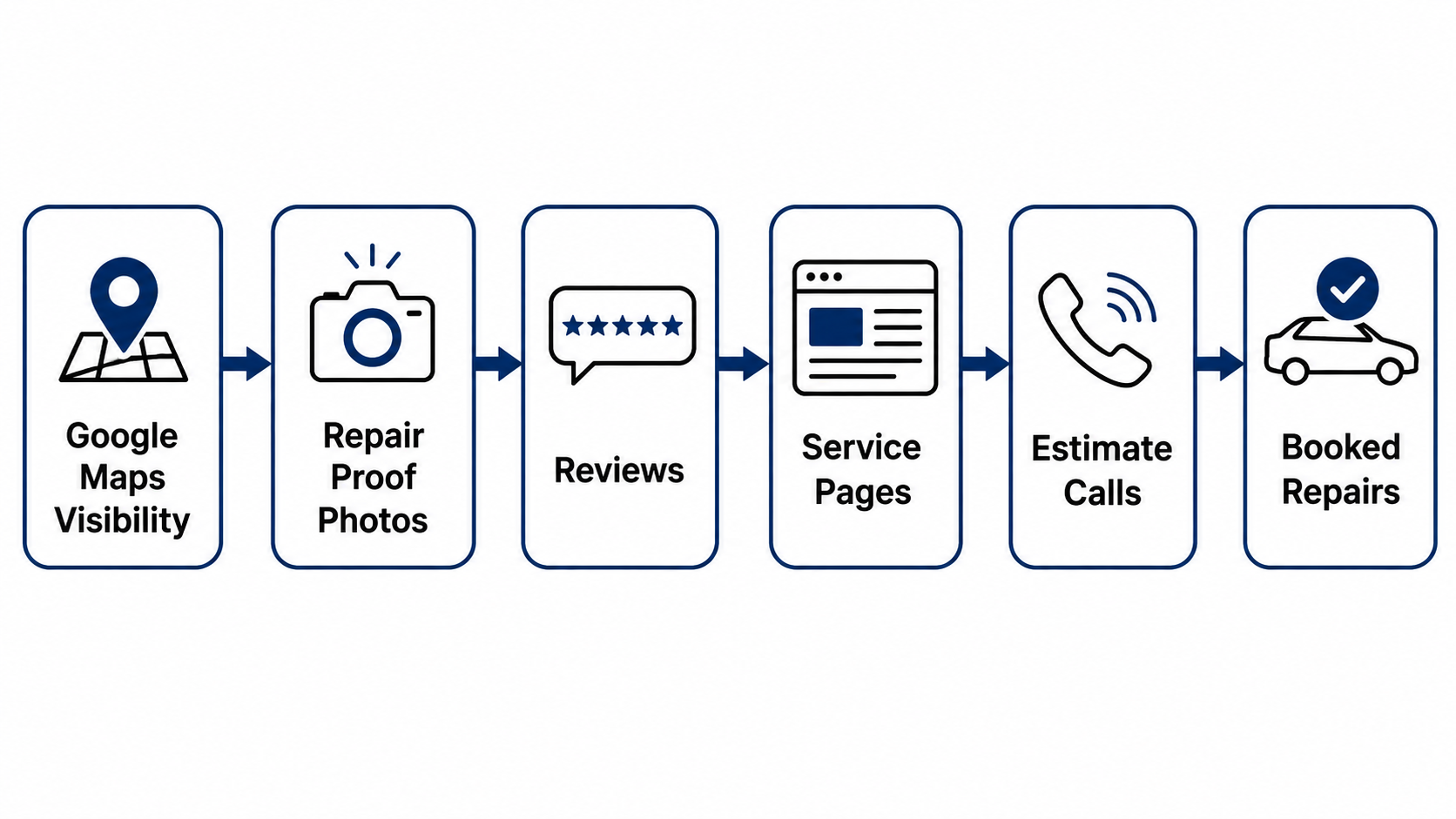
Body shop SEO works best when it matches how collision customers actually choose a shop. They search locally, scan photos, read reviews, compare proof, check whether the shop handles their repair type, and decide whether to call for an estimate.
The strongest strategy does not stop at ranking. It connects Google Maps relevance, repair proof, service pages, review depth, local trust, and call tracking into one system, so the shop can understand which visibility gains are turning into qualified estimate opportunities.