

Brake Repair Shop Search Engine Optimization: Build the Page That Earns Calls

Brake repair shop search engine optimization is not about adding the phrase “brake repair” to a generic services page.
A driver searching for brake repair is usually not browsing casually. They may hear squeaking, feel vibration, see a warning light, smell burning, or worry the car is unsafe. The search is local, urgent, and trust-heavy. If your page looks thin, vague, or interchangeable with every other shop, the customer may call someone else even if you rank.
The problem is that many auto repair websites bury brake service inside a broad “services” list. Google can crawl that page, but the customer still does not get a clear reason to choose the shop for brake work.
This article gives auto repair shop owners a brake repair SEO blueprint: the search intents to cover, the page sections to build, the proof to show, the Google Business Profile details to align, and the tracking needed to know whether the page creates calls.
Think of brake repair shop SEO as a service-page system, not a one-time keyword edit.
Contents:
- Start With Brake Search Intent, Not Keywords Alone
- Build a Brake Repair Service Page, Not a Paragraph
- Above-the-Fold Wireframe for a Brake Page
- Use Symptoms as Entry Points
- Add Local Proof Above the Fold
- Align the Page With Google Business Profile
- Write for Calls, Not Just Rankings
- Handle Brake Repair Cost Carefully
- Use Reviews by Service Theme
- Schema and Technical Signals
- Internal Links That Help the Brake Page Rank
- Measurement Plan for Brake Repair SEO
- Real Element DMA Example: Why Service Pages Matter
- Sample Brake Page SEO Fields
- Brake Repair SEO Launch Checklist
- FAQ
- Conclusion
Start With Brake Search Intent, Not Keywords Alone
Brake repair keywords are not all the same. A good page should answer several nearby intents without becoming bloated.
| Search intent | Example query | What the page should answer |
| Urgent repair | brake repair near me | Can I call now, get inspected, and trust the shop? |
| Symptom research | brakes squeaking when stopping | What might this mean, and when should I schedule? |
| Safety concern | grinding brakes | Is this urgent enough to stop driving? |
| Price concern | brake repair cost | What affects price before an inspection? |
| Local comparison | brake shop near me | Why this shop over another nearby shop? |
| Maintenance | brake pad replacement | What service is included and how long can it take? |
The page should not pretend to diagnose the vehicle from a search query. It should help the driver understand whether they need an inspection and make the next step easy.
Google’s SEO Starter Guide frames SEO around helping search engines understand content and helping users decide whether to visit a site. For brake repair, that means the page needs both machine-readable clarity and human trust.
Build a Brake Repair Service Page, Not a Paragraph
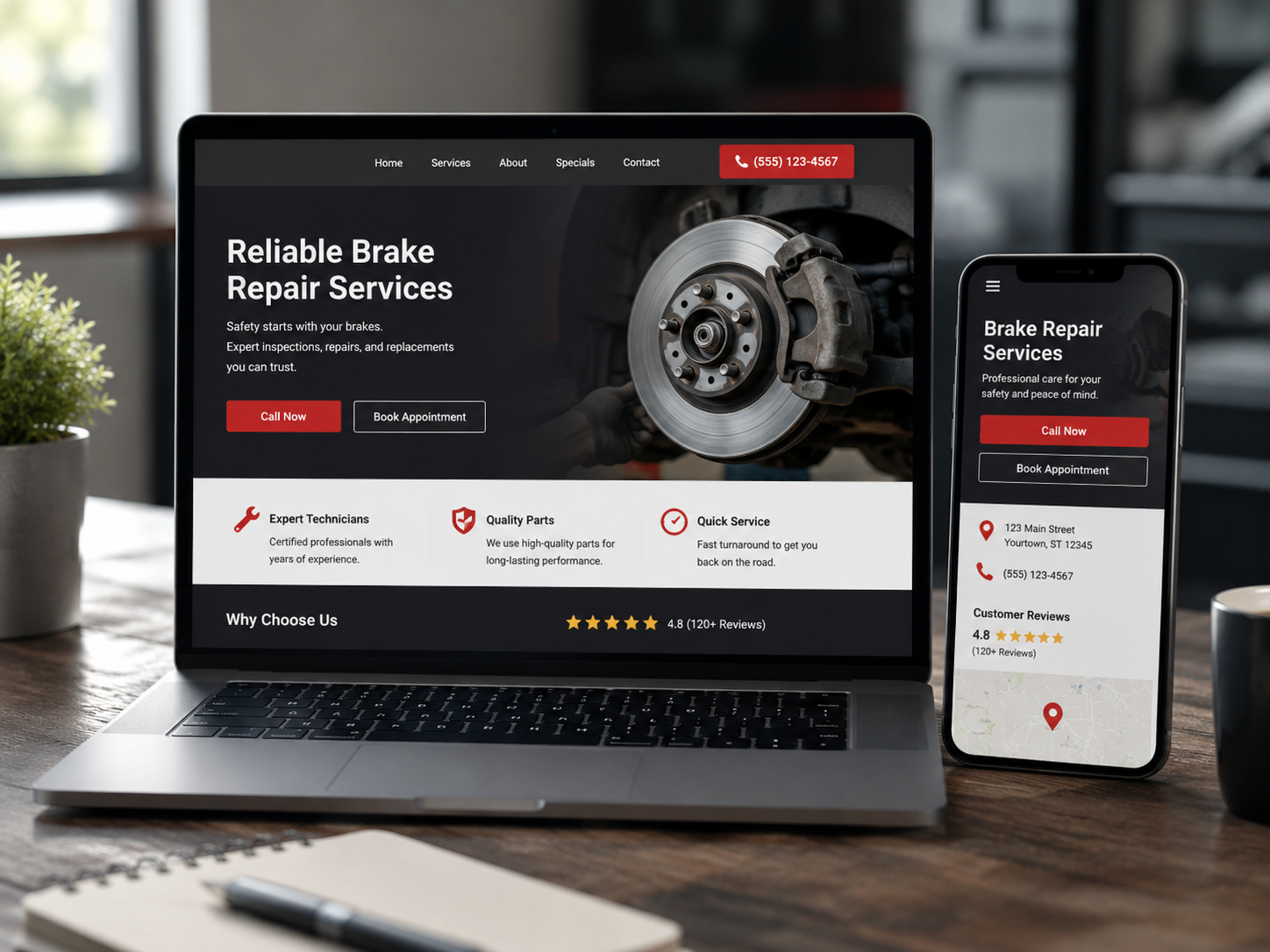
A brake repair service page should have one job: earn a qualified call from a local driver with a brake concern.
Use this page blueprint:
| Page section | Purpose | What to include |
| H1 and intro | Confirm the service and local fit | Brake repair, inspection, city/service area, phone CTA |
| Symptoms | Match the driver’s concern | Squeaking, grinding, vibration, soft pedal, warning light |
| Services included | Clarify scope | Brake pads, rotors, calipers, fluid, inspection, diagnosis |
| Safety guidance | Build trust | When to stop driving and call a professional |
| Process | Reduce uncertainty | Inspect, explain findings, estimate, approval, repair |
| Proof | Differentiate the shop | Reviews, photos, technician experience, warranty notes |
| FAQ | Capture long-tail questions | Cost, timing, driving safety, pads vs rotors |
| CTA | Convert the visitor | Call, request appointment, ask for brake inspection |
Do not make the page a keyword wall. A driver does not need 1,500 words of generic brake education before seeing how to book. They need enough useful detail to trust the shop and take the next step.
Above-the-Fold Wireframe for a Brake Page
The first screen should answer the driver’s main questions before they bounce back to Google.
| Page element | What it should do |
| H1 | Say the service clearly: brake repair, brake inspection, or brake service |
| Trust line | Mention local shop, experience, warranty, reviews, or inspection process |
| Primary CTA | Click-to-call button on mobile |
| Secondary CTA | Request appointment or ask for inspection |
| Symptom match | Short line for squeaking, grinding, vibration, warning light |
| Local proof | City/service area, shop photo, review excerpt, or rating |
| Friction reducer | “Inspection before estimate” or “We explain findings before repair” |
A brake page should not make the customer hunt for the phone number, wonder whether brakes are actually a priority service, or guess whether the shop handles their concern.
Use Symptoms as Entry Points
Most customers do not know whether they need pads, rotors, calipers, fluid, or a full brake inspection. They search symptoms.
Your page should include symptom-based subsections such as:
- squeaking or squealing brakes;
- grinding noise;
- vibration when braking;
- soft or spongy brake pedal;
- brake warning light;
- burning smell after driving;
- car pulling to one side while braking;
- longer stopping distance.
Each symptom section should be short and careful. Use language like:
“This can have several causes, so the safest next step is a brake inspection.”
Avoid language like:
“This means you need new rotors.”
The goal is to capture symptom intent without overpromising a diagnosis.
Add Local Proof Above the Fold
Brake repair is local. The page should prove the shop is real, nearby, and trusted before the customer scrolls too far.
Useful local proof includes:
- shop name and city;
- visible phone number;
- appointment or call CTA;
- service area;
- review rating or review excerpt;
- exterior shop photo;
- technician or advisor photo;
- warranty or workmanship note;
- financing or fleet note only if real;
- hours and emergency/after-hours expectations if relevant.
Do not hide the phone number under a form. Brake searchers often want to talk to someone quickly.
If the page gets traffic but few calls, the issue may not be rankings. It may be conversion. This is where call tracking for auto repair helps separate ranking problems from phone, page, or advisor problems.
Align the Page With Google Business Profile
The brake repair page should match the shop’s Google Business Profile signals.
Google’s Business Profile editing guide explains that verified businesses can keep details such as address, hours, contact information, photos, and services up to date. For a repair shop, those details influence how credible and consistent the business looks across Search and Maps.
Check:
- primary category and relevant additional categories;
- services list;
- business description;
- photos that show the shop and bays;
- hours;
- appointment link;
- phone number;
- review response pattern;
- posts or updates if used;
- service-area accuracy.
If the website has a brake page but the Google Business Profile never mentions brake service, the signals are weaker than they should be.
For shops that need Maps visibility and service-page alignment, local SEO for auto repair shops should connect GBP, reviews, local pages, and website service content instead of treating them as separate tasks.
Write for Calls, Not Just Rankings
Ranking for a brake query is not the finish line. The page needs to convert the visitor.
Use a call-focused page audit:
| Page element | Conversion question |
| Headline | Does it clearly say brake repair or brake inspection? |
| First paragraph | Does it match urgent driver concerns? |
| Phone CTA | Can a mobile visitor call without searching? |
| Proof | Is there a reason to trust this shop? |
| Symptoms | Does the page speak the customer’s language? |
| Estimate language | Does it explain why inspection comes before price? |
| Reviews | Do reviews support trust, speed, honesty, or communication? |
| Tracking | Can the shop see calls from this page? |
Some brake pages rank but fail because they sound like a manual. Others convert poorly because they jump straight to “schedule service” without explaining why the shop is trustworthy.
The best page does both: it answers the concern and makes the call easy.
Handle Brake Repair Cost Carefully
Cost intent matters, but a brake repair page should not publish a fake universal price.
Brake repair cost can depend on:
- vehicle make and model;
- pads, rotors, calipers, fluid, and hardware;
- front, rear, or all-wheel brake work;
- corrosion or seized components;
- parts quality;
- labor rate;
- diagnostic or inspection process;
- whether other safety issues are found.
A useful cost section might say:
“Brake repair pricing depends on what the inspection finds. Pads-only service, pads and rotors, caliper replacement, and brake fluid service are different jobs. The shop should inspect the vehicle, explain the findings, and get approval before repair work begins.”
That language is better than a generic “cheap brake repair” angle. Low-price messaging can attract shoppers who are unlikely to value inspection quality, warranty, or safety communication.
Use Reviews by Service Theme
A brake page should not only display random reviews. It should use review themes that support the brake decision.
Look for reviews mentioning:
- honest estimates;
- clear explanations;
- fast turnaround;
- no-pressure recommendations;
- safety concerns;
- noise or vibration fixed;
- fair pricing;
- trust with family vehicles;
- communication during the repair.
Do not invent review language. Use real public reviews or paraphrase themes without pretending they are quotes.
If review quality is weak, the brake page has a trust gap. That is not only an SEO issue. It may require review request workflows, advisor training, and better follow-up. For that side of the system, auto repair reputation management can support the page’s trust signals.
Schema and Technical Signals
Schema will not save a weak page, but it can help clarify the business and service for search engines.
For an auto repair shop, the Schema.org AutoRepair type can describe the local business entity. A brake repair service page may also use service-related structured data where appropriate, but the content on the page still needs to be accurate, visible, and useful.
Technical checks:
- indexable page;
- clean URL, such as `/services/brake-repair/`;
- unique title tag;
- unique meta description;
- one clear H1;
- internal links from related service pages;
- mobile-friendly design;
- fast loading;
- click-to-call link;
- no duplicate brake pages competing with each other;
- Search Console tracking.
For most shops, the bigger problem is not missing one schema property. It is having no dedicated brake page, no proof, no calls tracked, and no internal links pointing to the page.
Internal Links That Help the Brake Page Rank
A brake repair page should not sit alone.
Link to it from:
- main services page;
- general auto repair page;
- maintenance page;
- inspection or diagnostics page;
- suspension or wheel/tire pages where relevant;
- blog articles about brake noise, brake cost, seasonal safety, or inspections;
- location pages when those pages exist and are approved;
- homepage service highlights if brake work is a priority.
Use natural anchors:
- brake repair service;
- brake inspection;
- brake pad replacement;
- brake noise diagnosis;
- local brake repair;
- brake service for [vehicle type] if real.
Avoid stuffing the exact same anchor across every page.
This is where SEO for auto repair shops should be service-specific. The goal is not only “auto repair SEO.” The goal is to build a repair-service content system where each important job has a page, proof, internal links, and conversion tracking.
Measurement Plan for Brake Repair SEO
Do not judge the brake page only by ranking position. Track whether it creates real service opportunities.

| Metric | What it tells you |
| Search Console impressions | Whether Google is testing the page for brake-related queries |
| Organic clicks | Whether the title and snippet earn attention |
| Calls from the page | Whether visitors are taking action |
| Call quality | Whether callers are asking about real brake concerns |
| Booked appointments | Whether the page creates shop capacity demand |
| Repair orders | Whether calls turn into completed brake work |
| Close rate | Whether the advisor script and estimate process support conversion |
| Review mentions | Whether customers describe brake service, trust, speed, or communication |
If impressions rise but calls do not, improve the page title, proof, CTA, or mobile layout. If calls rise but booked jobs do not, review phone handling, estimate explanation, and service advisor follow-up.
Real Element DMA Example: Why Service Pages Matter
Brake repair SEO is not only a content problem. It is also a visibility, website, and call-flow problem.
In the A&V Auto Repair case study, Element DMA built a complete digital presence for an auto repair shop that previously had no website or online presence. The published case notes 25 optimized pages, a fast mobile-friendly structure, Google Business Profile optimization, Top 3 Local Pack rankings for major “near me” searches, 128 monthly calls from Google Ads, and a $12.24 cost per call.
That case is not specifically about brake repair SEO, so it should not be treated as proof that every brake page will rank the same way. The relevant lesson is practical: service-specific pages, GBP alignment, mobile conversion, paid search, and call handling work better when they are built as one system.
Sample Brake Page SEO Fields
A focused brake repair page should make the page purpose obvious to Google and to a driver who is deciding whether to call.
| Field | Example | Why it works |
| URL | /brake-repair-[city]/ | Keeps the service and local modifier clear. |
| H1 | Brake Repair in [City] | Matches urgent local search intent without stuffing. |
| Meta title | Brake Repair in [City] | Schedule Brake Service | Combines keyword, location, and call-to-action. |
| Intro promise | Squeaking, grinding, vibration, or longer stopping distance? Call for brake inspection and repair options. | Uses symptoms that real drivers search and describe on calls. |
| Primary CTA | Call now or request an appointment | Supports the high-intent phone behavior of brake searches. |
| Internal links | Auto repair SEO, local SEO, call tracking, reputation management. | Connects the page to services and proof signals that support ranking and conversion. |
Use a blog post for education, but use the service page to win local calls. A brake blog can answer questions; the brake service page must prove location, trust, availability, and next step.
Brake Repair SEO Launch Checklist
Use this checklist before publishing or rebuilding a brake repair service page.
| Item | Pass standard |
| Primary intent | Page clearly targets brake repair or brake inspection |
| Local relevance | Shop location, service area, phone, and hours are clear |
| Symptom coverage | Page covers common brake concerns without diagnosing online |
| Service scope | Pads, rotors, inspection, fluid, and related components are explained |
| Trust proof | Reviews, photos, warranty, team, or process proof appear on page |
| GBP alignment | Services, photos, hours, and contact info are consistent |
| CTA | Mobile visitor can call or request service easily |
| Schema | Local business/service markup is considered where appropriate |
| Internal links | Relevant site pages link to the brake page |
| Tracking | Calls, forms, and appointments from the page can be measured |
If three or more items are missing, the page is probably not ready to compete.
FAQ
What is brake repair shop search engine optimization?
Brake repair shop search engine optimization is the process of building and improving a brake repair page so nearby drivers can find it, trust it, and call the shop. It includes keyword intent, page content, local proof, Google Business Profile alignment, internal links, and call tracking.
Is a brake repair page better than listing brakes on a services page?
Usually, yes. A dedicated brake repair page can answer brake-specific symptoms, pricing questions, safety concerns, FAQs, reviews, and booking steps in more detail than a short services-list paragraph.
What should a brake repair SEO page include?
A strong page should include local service context, common brake symptoms, repair scope, inspection process, trust proof, FAQ, a clear phone CTA, internal links, and tracking for calls or appointment requests.
Should a shop publish brake repair prices?
Only if the pricing is accurate and properly qualified. Many shops are better served by explaining what affects cost and encouraging an inspection before giving a final repair price.
How do reviews help brake repair SEO?
Reviews can support trust and conversion, especially when they mention clear communication, honest estimates, safety, speed, and quality. Reviews should support the page’s credibility, not replace useful service content.
How do you measure whether a brake repair SEO page works?
Track impressions, rankings, organic visits, calls, forms, booked appointments, repair orders, and close rate. A page that ranks but does not create qualified calls may need better proof, CTA placement, phone handling, or tracking.
Should brake repair SEO use city pages or one service page?
Start with one strong brake repair service page. Add city or location pages only when the shop has a real service-area strategy, unique local proof, and enough content to avoid thin duplicate pages. A weak city page network can dilute trust instead of helping.
Conclusion
Brake repair SEO works when the page matches the urgency of the search. Drivers with brake concerns need clear answers, local proof, and an easy way to call.
Do not rely on a generic services page. Build a dedicated brake repair page that covers symptoms, inspection, repair scope, trust signals, Google Business Profile alignment, schema, internal links, and call tracking.
If your shop is missing high-intent brake searches, Element DMA can help audit the service page, local signals, conversion path, and tracking setup so brake repair visibility turns into calls and booked jobs.