

Stop Losing Money on Equipment: The ROI Framework for Smart Diagnostic Tool Investments
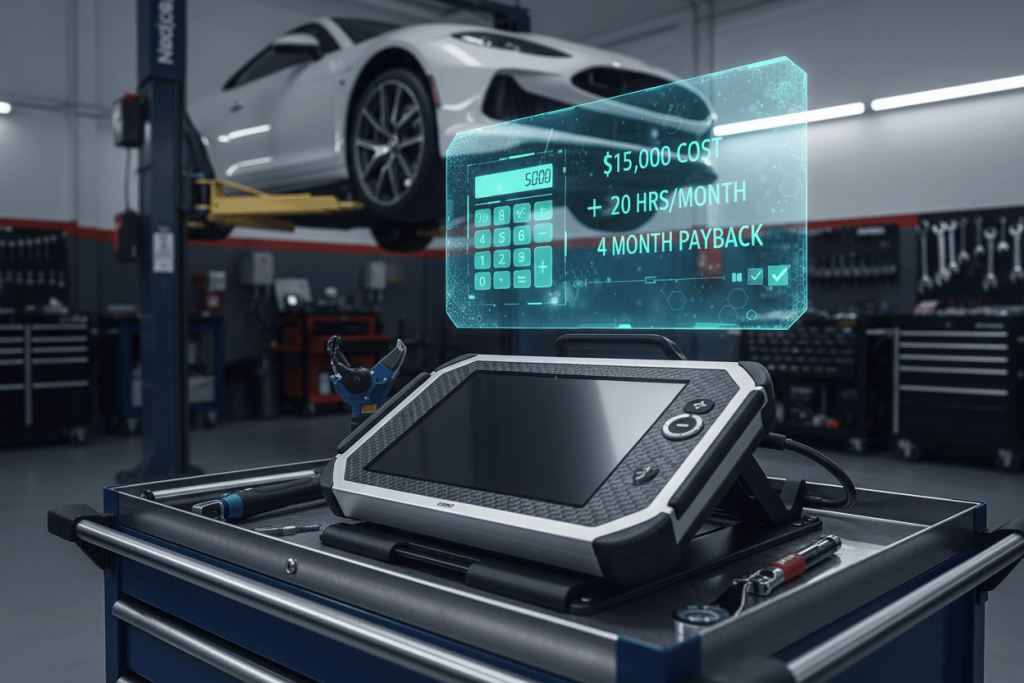
The diagnostic tool salesman just quoted you $15,000 for equipment that would “expand your capabilities”—but will it actually expand your profits?
Most auto repair shop owners buy equipment based on what they might need someday instead of what generates revenue today. The result is thousands of dollars sitting on your tool cart that hasn’t paid for itself in years. Meanwhile, you’re turning down profitable work because you lack different equipment you haven’t purchased yet. This backwards approach to tool investment keeps shops cash-poor while competitors with smaller tool collections run more profitable operations.
By the end of this article, you’ll know exactly how to evaluate every equipment purchase based on utilization rates, revenue generation, and competitive necessity—so you invest in tools that pay for themselves instead of collecting dust.
Contents:
How Analytics Reveals Which Equipment Investments Make Sense
The first thing we suggest auto repair shop owners do is implement tracking and analytics that show which services are most profitable and in-demand, because it’s one of the services we offer our paying clients at Element DMA, and we see its impact firsthand on guiding smart equipment decisions.
Here’s what most shop owners miss: you’re making equipment decisions without data on which services your customers actually want. Analytics track which services you perform most frequently, which generate the highest margins, and which services customers call requesting that you currently can’t provide.
This data transforms equipment decisions from guesses to strategic investments. When analytics show you’re declining two ADAS calibrations weekly because you lack the equipment, and each calibration would bill $350, you’re walking away from $36,400 annually. That $20,000 ADAS system pays for itself in seven months—and your competitors are capturing that revenue instead.
We also help shops test demand for new services before purchasing expensive equipment. By running targeted Google Ads campaigns for services you’re considering offering, we measure exactly how many customers search for those services in your area. If nobody calls requesting the service, you just saved yourself an expensive mistake. If phones ring constantly, the data proves the investment makes sense.
At Element DMA, we work with auto repair shops to make data-driven equipment decisions based on actual customer demand rather than equipment salesman promises.
The Utilization Calculation That Reveals True Equipment Value
Beyond testing demand, you need to calculate how many billable hours equipment will actually generate monthly.
A $12,000 scan tool that gets used 20 hours per month at $150 per hour generates $3,000 monthly or $36,000 annually. That tool pays for itself in four months. The same $12,000 spent on equipment you use three hours monthly generates $5,400 annually—taking 26 months to break even.
The shops making smart equipment investments track how often they currently turn away work requiring specific tools. If you’re declining work twice weekly because you lack specific diagnostic capabilities, calculate the annual revenue loss. That number tells you whether the equipment investment makes financial sense.
Four Questions That Determine Equipment ROI
Is This Equipment Necessary to Service Vehicles You Already See? The best equipment purchases let you keep existing customers instead of sending them elsewhere. If you’re currently referring transmission diagnostics to other shops, those customers might not come back for their next oil change.
What’s the Competitive Landscape Requirement? Some equipment purchases aren’t about generating new revenue—they’re about preventing customer loss. If three competitors in your area offer TPMS service and you don’t, you’re losing customers who expect that basic capability.
What’s the Training Investment Required? Equipment costs include the initial purchase plus ongoing training. A $10,000 tool requiring $2,000 in annual training and certification actually costs $18,000 over four years. Factor complete ownership costs into ROI calculations.
Does This Equipment Enable Higher-Margin Work? Some tools let you perform services with better profit margins than your current offerings. Diagnostic equipment that reduces troubleshooting time increases hourly profitability even if it doesn’t add new service categories.
What You Can Do Right Now
- Track how often you decline work due to missing equipment over a three-month period
- Calculate potential monthly billable hours for equipment you’re considering purchasing
- Divide equipment cost by monthly revenue potential to determine payback period
- Survey your customer base about which services they currently get done elsewhere
- You can also contact our team at Element DMA to see how we can bring your shop 100+ qualified calls per month and help your shop rank in the top 3 local search results
To Summarize…
The best ways for your shop to make smart equipment investments is to track which services customers request but you can’t provide, calculate utilization rates against equipment costs, and test demand through advertising before purchasing—including working with Element DMA to use analytics and targeted Google Ads that reveal actual customer demand for services requiring new equipment.
All the auto repair shops that work with us at Element DMA benefit from analytics tracking which services are most profitable and in-demand, combined with Google Ads campaigns that test demand for new services before expensive equipment investments. Once you implement this data-driven approach to equipment decisions, you invest in tools that generate revenue instead of sitting idle.

With a background in psychology, Valeriu has worked in sales and marketing for 8+ years, and learned through experience that the best way to do business is to serve clients well, and solve their problems. He has joined Element DMA in September of 2025, attracted by the honest nature of the work and attitude of auto & truck repair shops. In this role, he helps shop owners across the U.S. see the ROI of properly done advertising, and the growth this brings to their shops, regardless of niche or state.