

How We Run Google Ads & Local Service Ads for Our Paying Clients
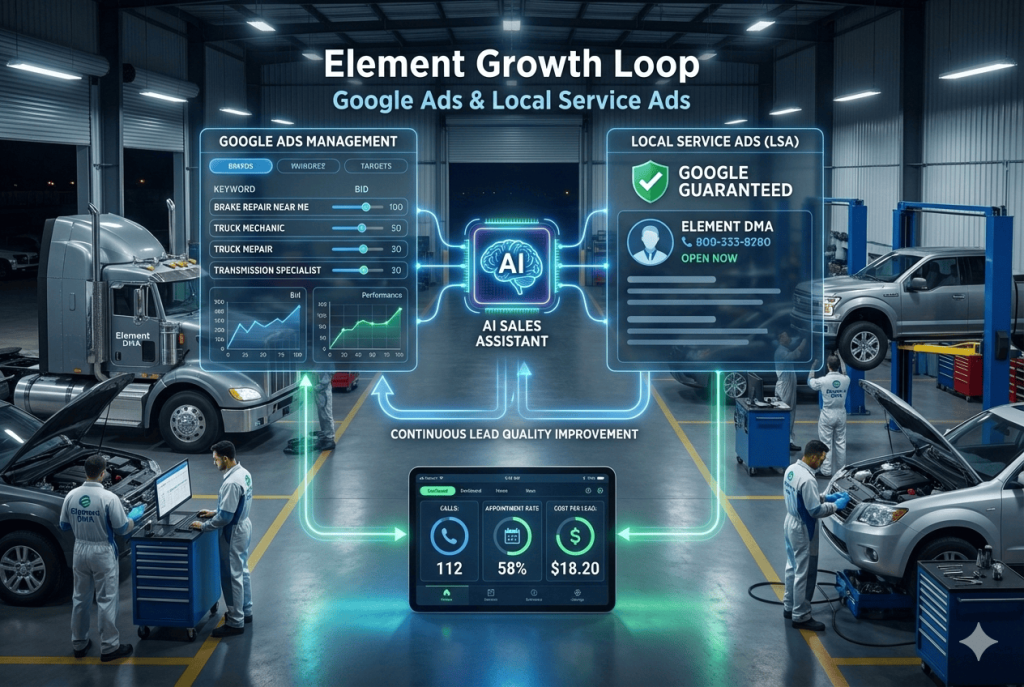
Our clients average a 50% reduction in cost per lead through Google Ads—from $25-45 per call down to $15-20. That’s not from spending more. It’s from spending smarter.
By the end of this article, you’ll see the exact 30-step process we use to set up and optimize Google Ads for auto repair shops, and you’ll know which tactics you can implement immediately to cut your ad costs.
Contents:
How We Run Google Ads & Local Service Ads
Most agencies set up Google Ads in 2-3 hours and call it done. We spend 15-20 hours on initial setup because every detail matters when you’re trying to reduce costs by half.
Here’s our complete process:
Targeting & Audience Strategy
1. Maximum 15 Mile Radius for Auto Repair Shops, 60 miles for Truck Repair Shops
We never target beyond 15 miles (for Auto Repair Shops). Yes, you might get more clicks with a 25-mile radius. But customers won’t drive that far for auto repair. We’ve tested this across dozens of shops. Beyond 15 miles, conversion rates drop by 60%+ because customers choose closer shops.
For Truck Repair Shops – the strategy is different. We use a much wider area, up to 60 miles – and target “people who are located in or show interest in the area”
This is because, in many cases, the person searching is not the driver but a dispatcher trying to find repair services for a truck. Dispatchers can be located in a different state, while the truck needing repair is local. Also, truck businesses often operate across states or internationally, so the targeting needs to reflect that
2. Exclude Underperforming Zip Codes
After 30 days of data, we identify zip codes with high clicks but zero conversions. Maybe it’s an area with lots of DIYers, or a low-income neighborhood that can’t afford your services. We exclude those zip codes and redirect budget to winners.
3. Schedule Ads During Business Hours + Buffer
We run ads during your business hours plus 1-2 hours before opening. Why the buffer? Because customers searching at 7 AM want same-day service. If they can’t reach you until 9 AM, they’ve already called your competitor.
We also pause ads during lunch if you don’t have coverage. No point paying for clicks when no one answers the phone.
4. Adjust Bids by Time of Day
Morning searches (7-10 AM) convert 35% better than afternoon searches for auto repair. We increase bids by 20-30% during peak hours and decrease them during slow periods. This shifts your budget toward appointment-seekers.
5. Layer Audience Targeting
We create custom audiences based on your best customers and tell Google to prioritize showing ads to similar people. If your highest-value customers are fleet managers or commercial truck drivers, we target those audiences specifically.
Keyword Strategy
6. Focus on Top 6 Most Profitable Services First
We don’t advertise everything you offer. We start with your 6 highest-margin services. For most shops, that’s transmission repair, engine diagnostics, brake repair, AC repair, suspension work, and electrical diagnostics.
Why? A transmission repair averages $2,500-4,000. An oil change averages $45. We’d rather get 50 transmission calls than 500 oil change calls.
7. Balance Service Campaigns with General Repair Campaign
Here’s a trick that reduces cost per click by 40-50%: create separate campaigns for specific services AND one “General Repair” campaign.
Specific service searches (“transmission repair near me”) are expensive because competition is high. But broader searches (“auto mechanic near me,” “car repair shop near me”) cost half as much. The General Repair campaign captures those cheaper clicks.
8. Use Exact Match and Phrase Match Only
We never use broad match keywords. Broad match wastes money on irrelevant searches.
Exact match: [brake repair near me] shows ads only for that exact phrase. Phrase match: “brake repair near me” shows ads for that phrase plus close variations.
This precision targeting eliminates 60-70% of junk traffic right from the start.
9. Add Location-Specific Keywords
We don’t just target “brake repair near me.” We target “brake repair in [your city],” “brake repair [neighborhood name],” “brake shop [your zip code].” This captures customers who search with specific locations instead of “near me.”
10. Build Extensive Negative Keyword Lists
We add 200+ negative keywords during setup and continue adding 10-20 more every week. This blocks searches like:
- “free brake inspection” (tire-kickers)
- “how to repair brakes” (DIYers)
- “brake repair jobs” (job seekers)
- “brake parts for sale” (parts buyers, not service seekers)
- “cheap brake repair” (price shoppers who won’t pay your rates)
- “brake repair school” (students, not customers)
Every negative keyword saves you money by preventing clicks from people who won’t become customers.
Ad Copy & Creative
11. Highlight Your Key Differentiator in Every Headline
What makes you different? ASE certification? Lifetime warranty? Same-day service? Family-owned since 1985? Put it in every headline. Example: “Expert Brake Repair | ASE Certified | Same-Day Service”
For our clients, we intentionally structure Headlines 1, 2, and 3 to control the message order and avoid Google’s random mix-and-match behavior.
Headline 1 → Main service (the exact keyword searched)
Headline 2 → Key benefit or differentiator
Headline 3 → Call to action
This ensures Google does not show something like “$50 Off Brake Service This Week” as the first message when the user is actually searching for transmission or tire services.
We make sure the first thing the user sees is the exact service they searched for, keeping the ad highly relevant to their intent.
12. Include Specific Pricing When Possible
If you can advertise pricing, do it. “Brake Pads Starting at $129” pre-qualifies callers. People who can’t afford your rates won’t click. This saves you money and reduces time-wasting calls for service advisors.
13. Create Urgency with Limited-Time Offers
“$50 Off Brake Service This Week” or “Free Diagnostic with Any Repair—Call Today” creates urgency. Customers searching for repairs usually need service within 24-48 hours. Give them a reason to call you first.
14. A/B Test Multiple Ad Variations Continuously
We create 6-8 different ads for every campaign and let Google show them in rotation. After 30 days, we pause underperformers and create new variations to test against winners. This continuous testing improves click-through rates by 15-25% over time.
15. Use All Available Ad Extensions
Extensions make your ads bigger and more visible. We use:
- Call extensions (click-to-call button)
- Location extensions (shows your address and distance)
- Sitelink extensions (links to specific service pages)
- Callout extensions (“Free Estimates,” “Open Saturdays,” “Mobile Service”)
- Structured snippets (lists your services or brands you service)
Ads with all extensions get 30-40% higher click-through rates.
Landing Pages & Conversion
16. Direct Each Ad to Corresponding Service-Specific Page
“Transmission repair near me” ad → Transmission repair landing page. Never your homepage.
Message match increases conversion rates by 25-40%. When the ad headline matches the page headline, customers know they’re in the right place.
17. Prominent Click-to-Call Buttons on All Pages
70-80% of searches happen on mobile phones. Your landing pages need a click-to-call button at the top, middle, and bottom of the page. Make it impossible to miss.
18. Add Trust Signals
Every landing page includes: recent Google reviews, years in business, certifications (ASE, AAA approved, etc.), warranties offered, and number of satisfied customers served.
Trust signals reduce bounce rates by 20-30% because customers feel confident choosing you.
19. Optimize Page Load Speed to Under 3 Seconds
53% of mobile visitors abandon sites that take longer than 3 seconds to load. We optimize images, minimize code, and use fast hosting. Every second of delay costs you 10-15% of potential customers.
20. Implement Conversion Tracking on All Calls and Forms
We track every conversion—phone calls and form submissions—and feed that data back into Google Ads. This tells Google which keywords and ads generate actual customers, not just clicks.
Bidding & Budget
21. Start New Accounts with Maximize Clicks, Then Transition to Smart Bidding
For brand new accounts, we start with Maximize Clicks to quickly drive traffic, bring in initial customers, and gather real conversion data as fast as possible.
After the account builds a solid volume of conversions and reliable performance history, we transition to Smart Bidding strategies such as Maximize Conversions or Target CPA.
22. Allocate 80% Budget to Proven Performers, 20% to Testing
Once we identify which campaigns convert best, we shift budget accordingly. If transmission repair generates leads at $15 but brake repair costs $30 per lead, we allocate more budget to transmission while testing ways to improve brake campaigns.
23. Adjust Bids Based on Device Performance
We analyze whether mobile, desktop, or tablet users convert better for your shop. Often, mobile converts 40-50% better for auto repair (people searching on the side of the road). We increase mobile bids by 20-30% to capture more of that traffic.
24. Implement Dayparting Bid Adjustments
Searches at 8 AM convert better than searches at 4 PM? We increase morning bids and decrease afternoon bids. This shifts more budget to high-converting hours.
25. Set Campaign-Level Budget Caps
We prevent overspending by setting daily budgets for each campaign. If your monthly budget is $3,000, that’s $100/day. We might allocate $40/day to transmission, $30/day to general repair, $20/day to brakes, $10/day to testing new services.
AI & Advanced Optimization
26. Feed Appointment-Booking Data Back to Google
This is where the EGL Growth Loop begins. Our AI Sales Assistant analyzes every call and identifies which callers booked appointments. We feed that data into Google Ads as conversion data.
Google’s algorithm learns: “This keyword brought someone who booked an appointment. Show ads for this keyword more often. This other keyword brought someone who just asked questions and didn’t book. Show that one less.”
Over 60-90 days, the percentage of appointment-seeking calls increases from industry average (25-35%) to our average (50-60%).
27. Create Custom Audiences from Your Best Customers
We upload lists of your highest-value customers (email addresses or phone numbers) and create lookalike audiences. Google finds people with similar characteristics and prioritizes showing them your ads.
28. Implement Remarketing to Recapture Lost Visitors
Only 2-3% of visitors convert on first visit. Remarketing shows ads to the other 97% as they browse other websites. This brings them back when they’re ready to book.
29. Use Call History Data to Optimize for Quality
Most agencies optimize for maximum calls. We optimize for maximum appointment-seeking calls. If a keyword brings 20 calls at $10 each but none book appointments, we pause it. If another keyword brings 5 calls at $30 each and 4 book appointments, we increase budget.
30. Conduct Monthly SERP Analysis and Competitive Monitoring
We search for your key terms every month and see which competitors appear, what they’re saying in ads, and what offers they’re promoting. This helps us stay ahead with better ad copy and more compelling offers.
Local Service Ads Strategy
Local Service Ads work differently than regular Google Ads. You pay per lead (phone call or message), not per click. Leads cost $15-50 depending on service and location.
We apply for Google Guaranteed status, which adds a green checkmark badge to your profile. This increases trust and improves conversion rates by 20-30%.
We optimize your LSA profile with detailed service categories, service area coverage, business hours, and photos. We also manage disputes for invalid leads (wrong service area, spam calls, etc.) to get refunds and reduce your cost per valid lead.
LSA leads convert at higher rates than regular Google Ads because they include the Google Guaranteed badge and appear above everything else on search results.
Why This Works So Well for Auto Repair Shops
We don’t just do Google Ads alone. It’s part of the EGL AI Marketing system, and every component feeds data into each other and reinforces results.
The service-specific landing pages (built with WP PageFlow AI) match your Google Ads perfectly. When someone clicks “transmission repair near me,” they land on a page that continues that exact conversation. This message match increases conversion rates by 25-40%.
CallRail tracking assigns unique phone numbers to Google Ads, so we know exactly which campaigns and keywords generate calls. That data flows into the AI Sales Assistant, which transcribes calls and identifies appointment-seekers versus time-wasters.
The appointment data flows back into Google Ads as conversion data. This trains Google’s algorithm to show your ads to more people likely to book appointments. Over time, the percentage of qualified calls increases while cost per call decreases.
Your Google Business Profile rankings improve as more customers call, visit, and leave positive reviews. Higher rankings bring more visibility. More visibility brings more traffic to both your profile and your website. This creates a flywheel effect.
The Local Service Ads benefit from your growing review count and Google Guaranteed badge. More reviews = higher trust = better conversion rates = lower cost per lead.
Every piece strengthens every other piece. That’s why costs drop by 50% over 60-90 days instead of staying flat like they do with traditional agencies.
Can You Replicate This Yourself?
You could replicate about 60% of these results on your own.
What’s achievable without our system:
- Set up Google Ads campaigns with proper geographic and schedule targeting
- Research and implement negative keywords by reviewing search term reports weekly
- Create service-specific campaigns for your top services
- Use exact match and phrase match keywords instead of broad match
- Write compelling ad copy with your key differentiators
- Set up conversion tracking for phone calls (requires CallRail or similar)
- Test different ad variations and pause underperformers
- Adjust bids based on time-of-day and device performance
- Apply for Local Service Ads and Google Guaranteed status yourself
What you can’t replicate:
- The AI-powered feedback loop that trains Google to send appointment-seekers
- The integrated data flow between Google Ads, CallRail, and the AI Sales Assistant
- The continuous optimization based on appointment-booking data (not just call data)
- The service-specific landing pages optimized for conversion (requires WP PageFlow AI)
Coming Up Next: How We Manage Google Business Profile & Local SEO
In the next article, I’ll show you exactly how we get auto repair shops ranked in the top 3 of Google’s Local Pack within 60-90 days—and how we generate 8+ calls per day from Google Maps alone.
You’ll see the weekly optimization tasks we perform, the review generation strategy that grows shops from 20 to 170 reviews in 7 months, and the GBP features 95% of shops don’t use but should.
Want to dominate local search results instead of getting buried on page 2? This is the blueprint.

With a background in psychology, Valeriu has worked in sales and marketing for 8+ years, and learned through experience that the best way to do business is to serve clients well, and solve their problems. He has joined Element DMA in September of 2025, attracted by the honest nature of the work and attitude of auto & truck repair shops. In this role, he helps shop owners across the U.S. see the ROI of properly done advertising, and the growth this brings to their shops, regardless of niche or state.